

Crops affected
How to identify scale insects
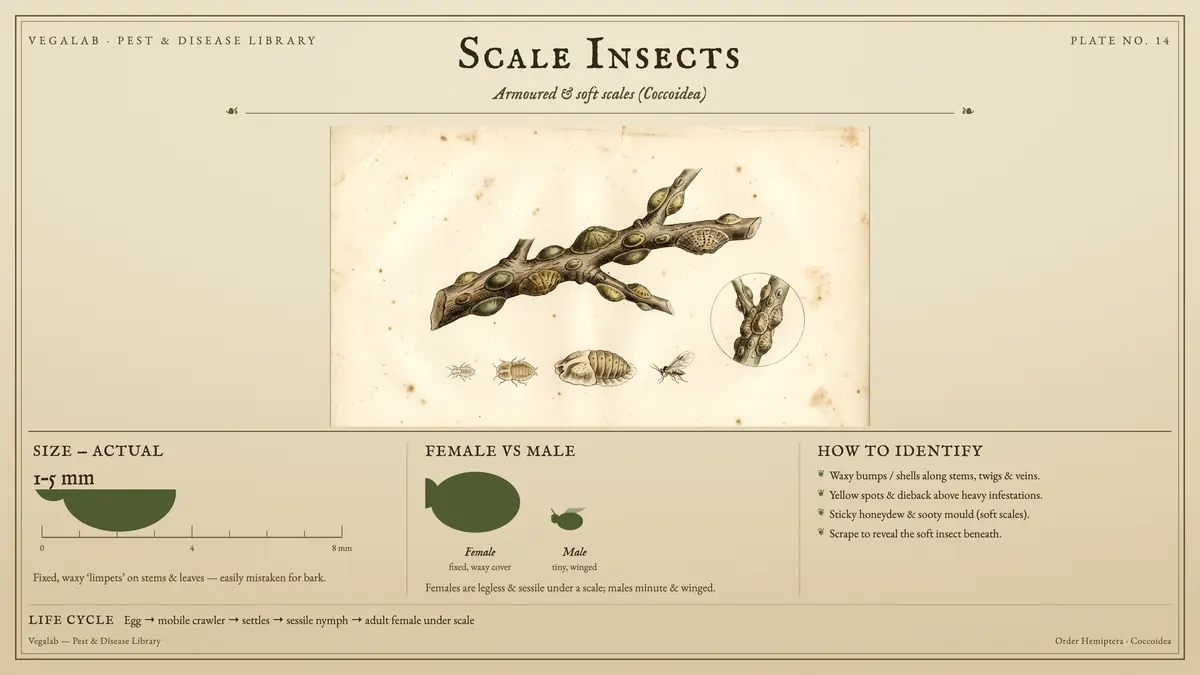
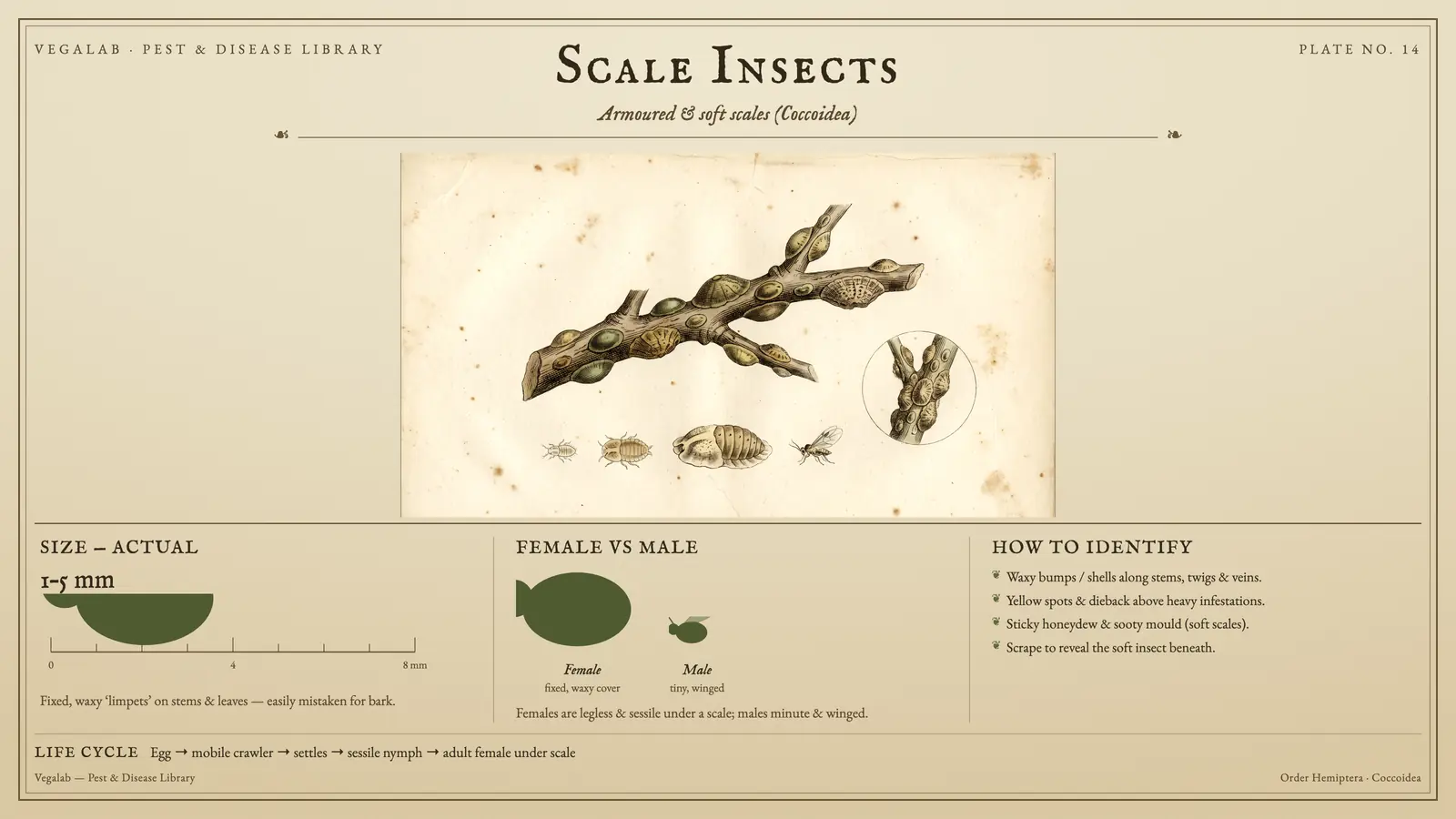
Size. 1 - 5 mm Fixed, waxy ‘limpets’ on stems & leaves - easily mistaken for bark.
Female and male. Female, fixed, waxy cover; Male, tiny, winged.
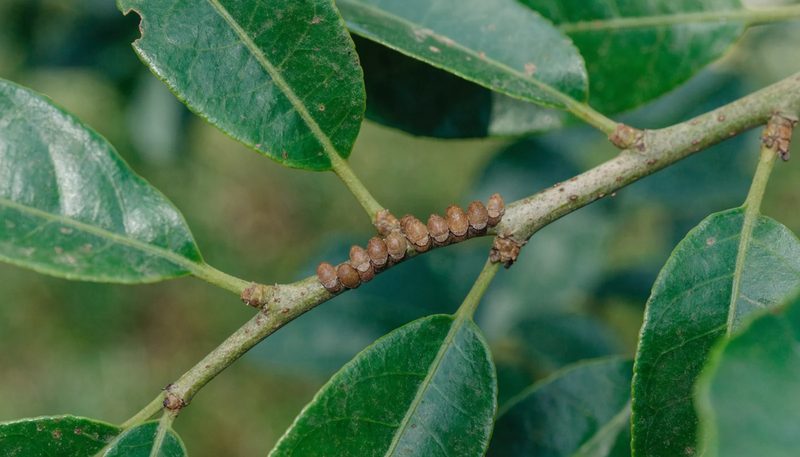
- Waxy bumps / shells along stems, twigs & veins.
- Scrape to reveal the soft insect beneath.
Life cycle. Egg → mobile crawler → settles → sessile nymph → adult female under scale
What is it?
Scales are sap-feeding insects that, once settled, form a protective waxy or armoured cover. The mobile first-instar crawler stage is the window when contact control is effective; settled adults are shielded by their cover.
How to identify it
- Bumps, shells or cottony covers on stems, leaf undersides and fruit.
- Sticky honeydew and black sooty mould on foliage and fruit (soft scales).
- Yellowing, leaf drop, branch dieback and reduced vigour in heavy infestations.
- Tiny moving crawlers on bark and leaves shortly after egg hatch.
Life cycle & spread
Eggs hatch into mobile crawlers that settle and develop a protective cover; one to several generations per year depending on species and climate.
Conditions that favour it
Warm conditions, dusty/stressed plants, and ant activity (ants tend soft scales for honeydew and deter natural enemies) favour build-up.
Damage and how it spreads
Sap feeding weakens plants and reduces yield and fruit quality; honeydew and sooty mould foul fruit and foliage and cut photosynthesis. Heavy infestations cause dieback.
Monitoring & scouting
Use the crawler stage to time treatments (degree-day models, sticky tape on branches, or hand-lens scouting); inspect bark and leaf undersides.
How to control it
- Target the crawler stage with thorough coverage;
- prune out heavily infested wood;
- manage ants;
- conserve natural enemies between treatments.
How to control scale insects
- Time to the crawler stage. Crawlers are the newly hatched, mobile, uncovered young. Sticky tape wrapped around an infested branch catches them and tells you when they are active - that is the moment to act, and it may last only a week or two.
- Use horticultural oil. Oils work by smothering, which is effective even against covered stages because it does not need to penetrate chemically. Dormant-season oil on deciduous woody hosts is one of the most reliable treatments available for scale.
- Prune out heavily encrusted wood and destroy it. On a badly infested branch this beats any spray.
- Protect the parasitoids. Scale is heavily parasitised by tiny wasps, and scale outbreaks are very often the result of broad-spectrum sprays removing them. Look for neat round exit holes in the scale covers - that is parasitism already working.
- Control ants, which farm the soft scales for honeydew and drive off their natural enemies.
- Scrub or spot-treat on small plantings. Physical removal with a brush or an alcohol swab works on ornamentals and houseplants.
- Inspect and quarantine new stock, since scale arrives on plants and moves very little on its own.
Scale insects spend almost their entire life immobile under a protective cover, and that cover is the whole management problem. There is exactly one window when they are genuinely vulnerable: the mobile crawler stage, before the cover forms. Timing to that window matters more than product choice.
A dead scale stays stuck to the bark and looks exactly like a live one. To judge whether a treatment worked, flip the covers with a thumbnail - live scale is soft and moist underneath, dead scale is dry and hollow.
Armoured scale or soft scale? It decides the treatment
- Armoured scale (Diaspididae): a hard, separate shield that can be lifted off with a fingernail, leaving the insect beneath. Produces no honeydew, so there is no stickiness and no sooty mould. Feeds on cell contents. Examples: San José scale, oystershell scale, red scale.
- Soft scale (Coccidae): a leathery or waxy dome fused to the insect body - lift it and the insect comes with it. Produces abundant honeydew, so sticky leaves and black sooty mould are the giveaway. Feeds on phloem sap. Examples: brown soft scale, black scale, cottony cushion scale.
- Most soft scales excrete honeydew; armored scales do not. Honeydew helps distinguish scale types after scale insects are found, but stickiness alone is not diagnostic because aphids, mealybugs, whiteflies, and psyllids also produce it.
These two groups look superficially similar and respond quite differently, so it is worth telling them apart before planning anything.
Sticky leaves and ants mean soft scale. A hard shield that pops off cleanly with no stickiness means armoured scale.
Why scale is a chronic problem in perennial crops
Scale insects have almost no dispersal ability of their own - only the crawler walks, and only a short distance - which has two consequences. Infestations build slowly and locally over years rather than arriving suddenly, and they persist indefinitely in perennial crops because nothing interrupts them the way harvest and replanting interrupts an annual.
That is why scale is disproportionately a problem of orchards, vines, citrus, olives and long-lived ornamentals, and why the dormant season is such a valuable intervention point: the canopy is off, coverage of the wood is achievable, and an oil application reaches overwintering stages that are impossible to hit through a full canopy in summer. It is also why sanitation of nursery stock matters so much - most new infestations are introduced, not evolved.
Dormant oil: the best timing you get all year
- Do not tank-mix oil with sulphur, and observe the interval between them - the combination is phytotoxic
- Avoid application in freezing conditions or onto wet wood, and avoid delaying past bud break when oil injury risk rises sharply
- Check the label for crop sensitivity · some species and cultivars are oil-sensitive at any timing
- Follow up on the crawler stage in season for a heavy infestation; dormant oil reduces the population but rarely clears it in one year
On deciduous woody crops, the dormant season is the most favourable moment to treat scale you will get, and it is routinely underused. Three things line up at once: there is no foliage in the way, so genuine coverage of the wood is achievable; the overwintering stages are sitting exposed on bark rather than protected inside a canopy; and higher oil rates are tolerated on dormant wood than on active foliage.
The timing that matters is late dormancy - after the coldest weather has passed but before bud break. Apply on a dry day above roughly 4–5 °C with no frost forecast for 24–48 hours, to the point of run-off, covering trunk, scaffolds and the smaller wood where scale settles. Thorough wetting is the whole point; a partial application leaves a partial population.
For evergreen crops such as citrus and olives there is no dormant window, so summer-weight oils timed to the crawler stage do the equivalent job at lower rates and with more care over heat and water stress.
Recommended Vegalab solution: Spider Mite Control
Spider Mite Control · all-natural contact product (geraniol with peppermint, cottonseed and rosemary oils) timed to crawler emergence, with thorough coverage of stems, leaf undersides and fruit.
| Role | Product | Use |
|---|---|---|
| Primary control | Spider Mite Control |
Preventing it next season
Monitor for crawlers, prune infested material, manage ants and dust, and treat early before protective covers form.
Claims and product availability vary by jurisdiction. Always read and follow the product label.