

Last updated:
Crops affected

Illustration

How to identify eastern filbert blight
- Slow decline & death over several years.
What is it?
Anisogramma anomala is an obligate biotroph. It cannot be cultured on artificial media and cannot live on dead tissue except to fruit from wood it has already killed. It has no asexual stage - no conidia, no summer spores, no secondary spread within a season. Everything the fungus does, it does with ascospores released from perithecia embedded in stromata on cankers formed one or two years earlier.
On its native host, the American hazelnut (Corylus americana), the fungus produces small cankers and the plant lives with it. On the European hazelnut (C. avellana) - the species behind essentially all commercial production - the same fungus produces expanding perennial cankers that girdle and kill. The western native beaked hazelnut, C. cornuta var. californica, does not get eastern filbert blight and is not an inoculum source, which is worth knowing before you clear a hedgerow.
The disease is absent from Europe and is an EPPO quarantine organism. Growers outside North America should treat any suspect find as a reportable event rather than a management problem.
How to identify it
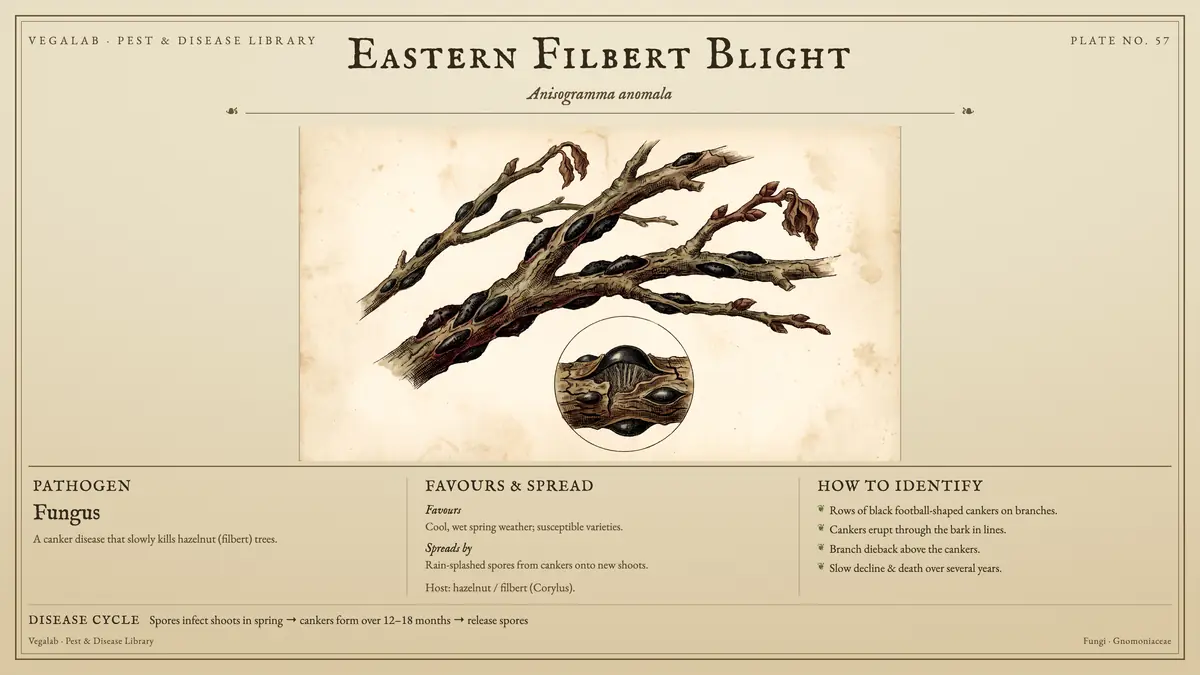
The diagnostic sign is the stroma, and specifically its arrangement. Look for raised, black, football- or lemon-shaped eruptions pushing out through the bark of one- to three-year-old wood, arranged in distinct longitudinal rows running along the axis of the branch. It is the row that identifies the disease. Scattered fruiting bodies are something else.
Above the canker, leaves flag, wilt and die but stay attached to the branch - a dead, leaf-bearing limb in mid-summer is a strong prompt to go and look for stromata below it. Vigorous suckering often appears below the girdle. Cut into the bark at the canker margin and the cambium is dead and discoloured, and the dead zone extends further along the branch than the visible stromata suggest.
Stromata persist on dead wood for years and keep discharging spores for as long as the wood stays moist enough to do so. A canker on a branch you cut last winter is still a canker.
What to rule out first
Winter injury and sunscald: dead bark, no stromata, no rows, and typically on the south-west aspect of the trunk or scaffold.
Cytospora or Nectria dieback: fruiting bodies present but scattered rather than in rows, often with cream or orange spore tendrils extruding in wet weather.
Bacterial blight of hazelnut (Xanthomonas arboricola pv. corylina): mainly a young-tree problem, giving water-soaked leaf spots and dark angular lesions on green shoots, with no stromata anywhere.
Big bud mite and herbicide injury both distort growth without producing bark eruptions.
Life cycle & spread
Ascospores are discharged from perithecia within the stromata, and discharge is triggered by the stromata being wetted by rain. Dew does not trigger it. This is the single most important operational fact about the disease, and it is the one most often got wrong. More than ninety per cent of the spores released in a season come out during rain events lasting longer than twenty hours.
Released spores are carried on wind and splash to the tree. Infection then succeeds only on juvenile tissue immediately behind the apical meristem - the actively elongating shoot tip. Inoculation work puts the success rate on that tissue at about 69 per cent, against roughly 1 per cent on tissue only slightly older. There is a very narrow target and a very narrow window.
Then the fungus goes silent. Latency runs 12 to 16 months and has been recorded out to 26. The cankers you are looking at this spring came from infections that occurred one or two springs ago. Two things follow. First, a rising canker count is a report on the weather of two previous seasons, not a verdict on last year’s spray programme. Second, the sprays you apply this April are protecting wood you will not see the state of until 2028.
Conditions that favour it
Prolonged spring rain during shoot elongation, at or just after bud break. In the Pacific Northwest that is roughly late March through May. Long rain events matter far more than frequent short ones, because of the twenty-hour figure above.
The risk window closes when shoot elongation stops, because the susceptible tissue stops being produced. Anything that extends elongation - heavy nitrogen, a wet cool spring, young vigorous trees - extends the window.
Proximity to inoculum is a condition in its own right. Abandoned orchards, unmanaged plantings and wild C. avellana upwind are spore factories, and no spray programme compensates for a neighbouring source you have not dealt with.
Damage and how it spreads
The loss is structural. A canker girdles the branch it is on; everything distal to it dies. Successive seasons of infection produce successive rings of cankers further into the tree, and an untreated susceptible planting is progressively taken apart from the periphery inwards until it is uneconomic to farm.
There is no within-season spread. One infection wave, tied to spring rain, and then nothing until the following spring. This is unusual and it is good news: the epidemic is annual, not compounding within the year, which is why a four-spray programme can genuinely cover the risk period.
Spread between trees and between orchards is by wind-carried ascospore during rain. Movement of infected nursery stock is how the disease crosses distances it could never cross on its own, which is why the quarantine status matters.
Monitoring & scouting
Scout in late winter to early spring, before leaf-out. Bare wood is the only condition under which stromatal rows are easy to see, and once the canopy is out you will miss cankers you would have found in February. Walk rows with the sun behind you and look along the branch, not at it.
Flag every canker you find, and mark the cut point three feet below the lowest visible stroma at the same time - doing it in one pass saves a second trip and stops the crew guessing.
Record cultivar and block with every find, because the most useful thing your scouting can tell you is whether a resistance gene has failed. Race 1, the Woodburn strain, breaks the Gasaway resistance that most modern resistant cultivars are built on. It became widespread over the winter of 2021-22, was characterised in 2022, and Oregon State flagged it in December 2023. A third distinct isolate, the Silverton strain, was reported in May 2025. If a Gasaway-derived block is producing cankers, that is the explanation, and it is a planting decision rather than a spray decision.
Do not read the current year’s canker count as a scorecard for last year’s fungicide. The latency makes that comparison meaningless.
How to control it
Two operations, and neither works without the other.
Sanitation pruning. Cut approximately three feet below the lowest visible canker margin. The published range is one to three feet and three feet is the safe end, because the fungus occupies wood well beyond the point where stromata are visible. Prune in the dormant season, and destroy the cut wood before bud break. Cut wood keeps sporulating until it dries out, so a brush row at the headland is an inoculum source, not a disposal method. Burn it, or chip and remove it, or bury it.
Protective fungicide through shoot elongation. Four applications at roughly two-week intervals, starting at bud swell or bud break. Modes of action in commercial use include FRAC M5 (chlorothalonil), M1 (copper), 3 (DMI), 11 (QoI) and 7 (SDHI); rotate across groups rather than repeating one.
No fungicide cures an established canker. The pathogen sits inside dead and dying wood that no spray reaches. Fungicide has exactly one job on this disease, which is to protect elongating shoot tips from new infection during rain. Pruning removes the inoculum; spraying protects the target. Drop either and the programme fails.
How to manage eastern filbert blight
Plant resistant material, and do not plant a whole block to one resistance source. ‘Lagerstedt’, released 7 January 2026, carries the ‘Ratoli’ resistance on linkage group 7 and resists Race 1 - which the Gasaway-derived cultivars no longer reliably do. Spreading resistance sources across a planting is the only structural defence against the next strain.
Deal with external inoculum. Remove or persuade a neighbour to remove abandoned orchards and unmanaged C. avellana upwind. This is usually a larger lever than anything you can do inside your own fence.
Keep the pruning and spraying calendars linked. Sanitation done after bud break, or with the brush left in the row, converts a control operation into a distribution operation.
On heavily pruned trees, expect a vigour setback and manage nutrition and root support accordingly - a tree that has just lost a third of its scaffold needs help rebuilding, and a weak recovery flush is a poor platform for the following season.
Why the latency period changes everything
Almost every mistake made with this disease traces back to the 12-to-16-month lag. Growers conclude a spray programme failed when it worked; they conclude a programme worked when the two preceding springs were dry; they replace a fungicide that was doing its job; and they cut a block out a year before the resistant replanting would have been justified.
The only sound way to run the programme is to treat it as insurance against weather you cannot yet see the consequences of, and to judge it over multi-year canker trends rather than year-on-year counts. Keep block-level records for at least four years before drawing any conclusion about a product or a cultivar.
The disease at a glance
| Feature | Detail |
|---|---|
| Pathogen | Anisogramma anomala · obligate biotroph, no asexual stage |
| Spore type | Ascospore only, from perithecia in bark stromata |
| Discharge trigger | Rain wetting the stroma. Dew does not trigger discharge |
| Peak release | >90% of spores during rain events longer than 20 hours |
| Susceptible tissue | Juvenile tissue immediately behind the apical meristem |
| Infection rate | ~69% on juvenile tissue vs ~1% on slightly older tissue |
| Latency | 12-16 months, recorded to 26 months |
| Secondary spread | None within a season |
| Sanitation cut | ~3 ft below the lowest visible canker (published range 1-3 ft) |
| Spray programme | 4 applications at ~2-week intervals from bud swell |
| Resistance status | Race 1 "Woodburn" breaks Gasaway; "Silverton" reported May 2025 |
| Regulatory | Absent from Europe; EPPO quarantine organism |
Recommended Vegalab solution: Armour Boost
Eastern filbert blight is a wood canker disease with no curative option once a canker is established, so Vegalab products play a supporting role in an integrated programme built on resistant cultivars, sanitation pruning and protective fungicide through shoot elongation. They are not a control or a cure for this disease.
| Role | Product | Use |
|---|---|---|
| Plant resilience | Armour Boost | Silica for resilient tissue |
| Roots | Root Boost | Root-zone support during recovery from heavy sanitation pruning |
| Soil biology | Charge BioBoost | Root-zone support to re-establish soil biology in replanted blocks |
Preventing it next season
Plant resistant cultivars and diversify the resistance sources across the block rather than relying on one gene. Scout on bare wood in late winter and mark cut points in the same pass. Prune three feet below the lowest visible canker and destroy the wood before bud break. Run four protective sprays at two-week intervals from bud swell, rotating FRAC groups. Remove abandoned and wild Corylus avellana upwind. Support recovery on heavily pruned trees with Armour Boost and root-zone inputs, and judge the programme on four-year canker trends, never on a single season.
Claims and product availability vary by jurisdiction. Always read and follow the product label.