

Last updated:
Rice blast is a fungal disease of rice caused by Pyricularia oryzae (sexual state Magnaporthe oryzae), and neck blast is the same fungus colonizing the panicle neck node. Leaf blast often costs little yield, but neck blast cuts the vascular supply to the panicle and leaves blank or partly filled grain. A deep, continuous flood, moderate nitrogen and fungicide timed at boot and panicle emergence protect the neck.
Crops affected


How do you identify rice blast?
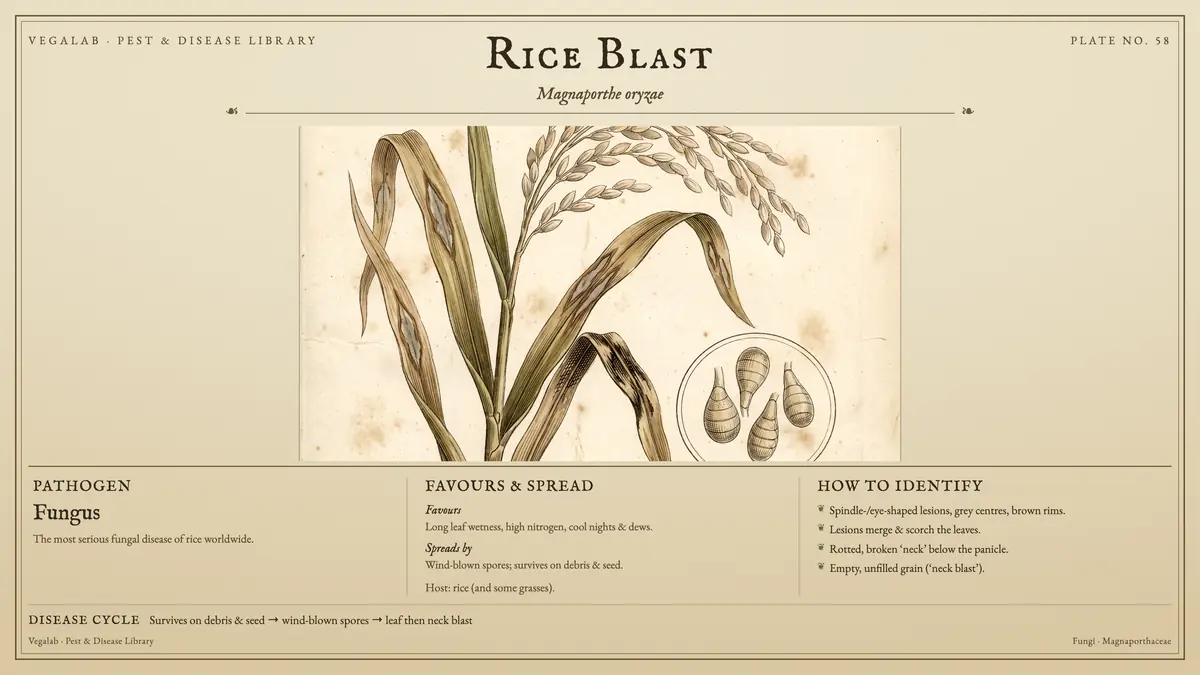
- Lesions merge & scorch the leaves.
- Rotted, broken ‘neck’ below the panicle.
Disease cycle. Survives on debris & seed → wind-blown spores → leaf then neck blast
What causes rice blast?
The pathogen is Pyricularia oryzae, whose sexual state is Magnaporthe oryzae. Older references call it Magnaporthe grisea; that name is no longer correct for the rice pathogen and now applies to the crabgrass pathogen, so a source using it is either dated or describing a different organism.
It penetrates the leaf directly using an appressorium - a specialized swollen cell that generates enormous turgor pressure and drives a penetration peg through the cuticle. It does not need a wound or a natural opening, which is why sanitation alone never controls it.
It is strongly polycyclic. A lesion becomes sporulating in roughly five to seven days and keeps producing conidia for weeks, so inoculum compounds through the season wherever conditions allow.
What do rice blast lesions look like?
The classic leaf lesion is diamond- or spindle-shaped, 10 to 15 mm long and 3 to 5 mm wide, with pointed ends, a pale gray or white center and a brown to reddish-brown margin. On a susceptible reaction the lesions expand and coalesce; on a resistant reaction the fungus produces small brown specks that never expand. Both are the same fungus; the difference is the host.
Collar blast appears at the junction of the leaf blade and sheath and can kill the entire blade, including the flag leaf - which is a direct hit on grain fill.
Node blast blackens and shrinks a stem node, and the stem commonly breaks there.
Neck or panicle blast is the one that matters. The panicle neck turns gray-brown to black and shrivels. Grain above it is blank or partially filled, and the panicle stands whitish and upright above a green canopy.
Rachis blast affects the panicle branches and gives partial blanking rather than a whole-panicle loss.
What else looks like rice blast?
Stem borer whiteheads are the main confusion, and the IRRI pull test separates them in seconds. Take the whitehead and pull gently. A borer-damaged panicle pulls free from the sheath, because the stem has been severed inside. A neck blast panicle does not pull free, because it is still attached - it is simply dead at the neck. If you learn one field test for rice, learn this one.
Bacterial panicle blight discolours the grain but produces no lesion on the neck.
Brown spot (Bipolaris oryzae) gives round to oval brown spots with a definite dark margin and often a yellow halo - not diamond-shaped, not pointed, and strongly associated with poor soil fertility rather than with wet, mild weather.
Sheath blight (Rhizoctonia solani) produces irregular greenish-gray lesions with an irregular brown border, starting at the waterline on the sheath and moving upward.
Narrow brown leaf spot (Cercospora janseana) gives linear lesions running with the veins.
How does rice blast spread?
The fungus overwinters as mycelium and conidia in infected straw, stubble and seed, and on volunteer and weedy grass hosts. Seed-borne inoculum is how the disease enters a clean field.
Conidia form at night on existing lesions under high humidity, are released around dawn, and are dispersed by wind and splash. They germinate under free water on the leaf surface and penetrate directly. Free water on the leaf is required, which is why the length of the dew period is the driving variable rather than rainfall total.
Because a lesion sporulates for weeks and a new lesion is producible within a week, the disease compounds rapidly once conditions are right. That compounding is what turns an early leaf blast focus around a levee into a neck blast problem at heading.
What conditions favor rice blast?
This is where rice blast is most often misunderstood. The optimum for infection and sporulation is 24 to 28 degrees Celsius with long leaf wetness and high humidity. Temperatures of 28 to 30 degrees and above suppress the disease.
Rice blast is not a hot-weather disease. It is a mild, wet, overcast, heavy-dew disease. The dangerous pattern is a run of cloudy days with nights that cool enough to give ten hours or more of leaf wetness. A hot, bright, dry spell suppresses it.
High nitrogen sharply raises susceptibility, and it is the input most under your control. Excess nitrogen, and particularly a heavy late application, produces soft, dense, humid canopies that are ideal for the fungus.
Dense canopies with poor air movement extend the wetness period at the leaf surface and keep it favorable long after the open field has dried.
What damage does rice blast cause?
Leaf blast damage is usually modest in itself; the reason to care about it is that it builds the inoculum that later infects the neck.
Neck blast is the loss event. The fungus colonizes the neck node and severs the vascular connection to the panicle, so grain fill stops. Depending on when it happens, the result is blanks, partial fill, or a panicle of entirely empty glumes. Rachis blast produces the same effect on individual branches.
Node blast weakens the stem mechanically and causes lodging, which compounds harvest loss.
Spread within a field is by wind-borne conidia, so a focus on a levee top or a sandy cut seeds the whole field once the canopy closes and humidity rises.
How do you scout for rice blast?
Scout for leaf blast from tillering onward, and concentrate on the places where the flood is unreliable: levee tops, high spots, sandy cuts, field corners and any area that has gone dry. Blast in a rice field is a map of where the water was not.
Record leaf blast severity, but understand what you are recording. It is an early-warning indicator for the neck blast decision, not a treatment threshold in its own right.
The decision that actually matters is the neck blast spray timing, and it is a growth-stage decision, not a threshold decision. There is no scouting count that improves on the growth stage. Walk the field and split boots.
Check flood depth and continuity weekly, and physically walk the high ground. A field that reads as flooded from the road may have a quarter of its area exposed.
How do you control rice blast?
Water first. Maintaining a deep, continuous flood - at least four inches, and Louisiana guidance is four to six inches - with complete soil coverage is the strongest cultural suppressant available. Fields that go dry, fields with high spots that break the flood, intermittent flooding, and upland or aerobic rice are where blast becomes severe. If you fix nothing else, fix the flood.
Nitrogen second. Reduce total nitrogen, split applications, and avoid a heavy late flush.
Fungicide third, and the timing is the whole of it. Two applications:
Application one: late boot to boot split, up to about 10 percent panicle emergence.
Application two: 75 to 90 percent of panicles emerged, before the necks are exposed.
The extension rule is unambiguous and worth quoting in the field: if the necks of the main and secondary tillers are out of the boots, fungicide application is too late. Once the neck is exposed, the tissue you needed to protect has already been available for infection and you are spraying a target that has already been hit.
QoI fungicides (FRAC 11), azoxystrobin and trifloxystrobin, are the standard actives at those timings. Note that tricyclazole, which appears throughout the Asian literature as a reference product, is not registered in the United States - do not carry an Asian program into a US field without checking registration.
What else reduces rice blast pressure?
Silicon works, but only where it is missing. Datnoff’s work reports 17.4 to 30.5 percent disease reduction where soil silicon is limiting. On a silicon-sufficient soil, applying silicon does nothing measurable for blast. Test the soil before spending on it - this is one of the few inputs where a soil test genuinely decides whether the money is wasted.
Assume any single resistance gene has a finite working life. Pi-ta was deployed in 1989 and was broken by race IE-1k by 1994. Rotate cultivars, do not build a whole farm on one gene, and treat cultivar resistance as one component rather than as the program.
Use clean, certified seed and do not carry seed forward from a field that had blast. Destroy or fully incorporate infected straw and stubble, and control volunteer rice and weedy grass hosts along ditches and headlands.
Plant at recommended dates and avoid excessive seeding rates - a canopy that closes too early holds leaf wetness far longer than it needs to.
Why does flood depth matter so much for rice blast?
Flood management is free, it is already part of the operation, and it does more for blast than any other single decision. Continuous deep flood suppresses the disease directly; a broken flood creates exactly the mild, humid, intermittently wet microclimate the fungus wants, in exactly the parts of the field where the plant is already stressed.
The practical implication is that levelling, levee maintenance and water management are blast control activities, and they should be budgeted as such. A grower spending on a third fungicide application while running a shallow, patchy flood is paying for the expensive solution to a problem the cheap one would have prevented.
What does each blast phase cost?
| Phase | Where | What it costs |
|---|---|---|
| Leaf blast | Leaf blade, nursery to tillering | Usually modest directly; builds inoculum for the neck |
| Collar blast | Blade / sheath junction | Can kill the whole blade including the flag leaf |
| Node blast | Stem node | Blackened, shrunken node; stem breaks and lodges |
| Neck / panicle blast | Panicle neck node | The loss event. Blanks or partial fill across the panicle |
| Rachis blast | Panicle branches | Partial blanking on affected branches |
Recommended Vegalab solution: Armour Boost
Rice blast control rests on flood management, nitrogen discipline, cultivar choice and correctly timed protective fungicide at boot and panicle emergence. Vegalab products support that program through tissue resilience and root-zone support; they are not a substitute for the boot and panicle-emergence fungicide timings, which are what protect the neck.
| Role | Product | Use |
|---|---|---|
| Plant resilience | Armour Boost | Silica for resilient tissue · most relevant on silicon-depleted soils |
| Integrated support | Spore Control | Protective film, supporting role in the wet, high-risk period |
| Roots | Root Boost | Root-zone support for even establishment and canopy uniformity |
How do you prevent rice blast next season?
Level and maintain levees so the flood is deep and continuous at four to six inches with complete soil coverage - this is the single largest lever. Cut total nitrogen, split it, and avoid a late flush. Test soil silicon before buying silicon. Use clean certified seed, destroy infected straw and stubble, and control volunteer and weedy grass hosts. Rotate cultivars rather than relying on one resistance gene. Diarise the two fungicide timings - late boot to boot split, and 75 to 90 percent panicle emergence - because a missed timing cannot be recovered later.
Key takeaways
- Neck blast is the loss event: the fungus severs the vascular supply to the panicle and grain fill stops.
- Blast is a mild, wet, overcast, heavy-dew disease; infection peaks at 24 to 28 degrees Celsius, and 28 to 30 degrees and above suppress it.
- A deep, continuous flood of four to six inches with complete soil coverage is the strongest cultural control.
- Fungicide goes on at late boot to boot split and again at 75 to 90 percent panicle emergence; once the necks are out of the boot it is too late.
- Silicon reduces blast only where soil silicon is limiting, so test the soil first.
Claims and product availability vary by jurisdiction. Always read and follow the product label.