


Early blight vs late blight: how to tell them apart
Last updated:
Early blight (Alternaria linariae, formerly A. solani) makes brown spots with concentric target rings and yellow halos that start on the lowest, oldest leaves.1,5 Late blight (Phytophthora infestans) makes pale to olive-green patches that turn brown-black, water-soaked and oily, appears anywhere on the plant, and in cool, wet weather can kill whole plants in 7 to 10 days.1,4
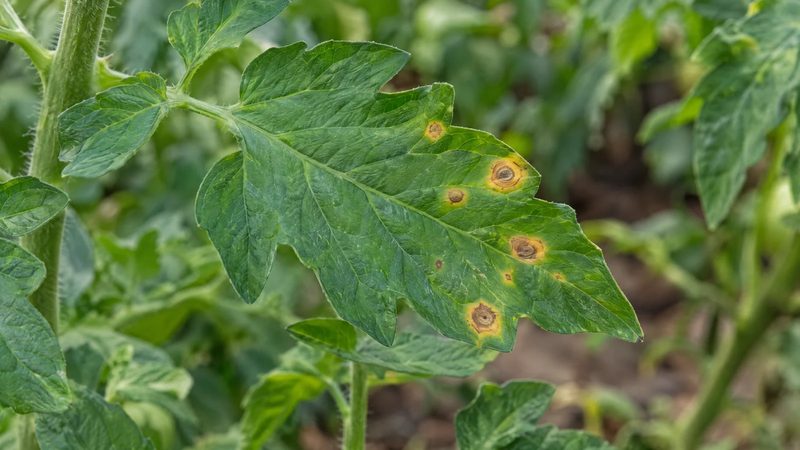
How do you tell early blight from late blight on tomato leaves?
Start with where the spots are and what they look like. Early blight lesions begin on lower leaves as small brownish-black spots that expand to about 1/4 to 1/2 inch, with concentric rings inside the dark area and often a yellow zone around them.1 Late blight produces lighter tan lesions that typically have a light green halo, and it occurs all over the plant, including young leaves, whereas early blight is found mainly on the lower leaves.1
Late blight leaf symptoms start as small water-soaked areas that rapidly enlarge into purple-brown, oily-looking blotches, and on the underside rings of grayish white growth may appear around them.3 The two diseases also differ in speed: early blight moves up from the lower leaves and can defoliate the lower part of the plant, while late blight can collapse entire plants in 7 to 10 days when weather is cool and wet.1,4
| Feature | Early blight | Late blight |
|---|---|---|
| Cause | Fungus Alternaria linariae (formerly A. solani) | Water mold Phytophthora infestans |
| Where it starts | Oldest, lowest leaves, moving upward | Anywhere, including young leaves and stems |
| Leaf spots | Brown to black, 1/4 to 1/2 inch, concentric rings, yellow halo | Pale or olive-green, becoming brown-black, water-soaked and oily |
| Leaf underside | Spores may be abundant on lesions | White-gray fuzz around blotches in humid weather |
| Fruit | Sunken, leathery, dark lesions with rings, often near the stem end | Large, firm, golden to chocolate-brown spots, often on the shoulders |
| Favored by | Warm weather above 80°F with rain or heavy dew | Mild temperatures of 60 to 78°F with humidity above 90% |
| Spread | Wind, air currents and water splash | Airborne spores carried several miles |
| Survival between seasons | Crop debris in soil, seed and transplants | Mainly living tissue: infected potato tubers, volunteers, transplants and compost piles |
In North America, early blight symptoms typically begin as tomato canopies close in early summer5, and late blight moves fastest in cool, wet spells at 60 to 78°F with high humidity3; the 2009 northeastern outbreak began in mid to late June7. In the Southern Hemisphere, the same risk period falls from about December to February.
What causes early blight and late blight?
Early blight is caused primarily by the fungus Alternaria linariae (also called A. tomatophila and formerly known as A. solani), and besides tomato it can affect other members of the nightshade family.1 UW Extension lists eggplants, peppers and potatoes among the vegetables it can seriously damage.5
Late blight is caused by Phytophthora infestans, a water mold.4 It was once thought to be a fungus but is now understood to be an oomycete, quite distinct from the true fungi.7 Late blight was partly responsible for the Irish potato famine, and it affects both tomatoes and potatoes.4,6 Spores are produced on structures that are readily dislodged, so they spread on wind and rain splash, on clothing and equipment, and over long distances on infected transplants and potato tubers.7
How can you check whether it is late blight?
In dry weather, late blight lesions may look like plain dark spots without the white fuzz. Cornell Cooperative Extension suggests placing an affected leaf in a damp zip-lock bag for a day to see whether white sporulation appears.6
Other diseases are often mistaken for one or both blights.1,4 Septoria leaf spot produces smaller lesions with tan or light gray centers, gray leaf spot produces smaller, lighter brown lesions whose centers tend to crack, and bacterial spot lesions are smaller still, at about 1/16 inch.1 Verticillium wilt can also be misidentified as late blight.4 When in doubt, a plant disease diagnostic clinic can confirm the cause.4
Does tomato blight live in the soil?
Early blight does. The fungus survives in the soil on residue of infected tomatoes, potatoes and nightshade weeds, and it can also be carried on seed and transplants.2,8 Spores are typically splashed by rain onto the lower leaves early in the season.8 That is why rotating away from tomatoes every 2 to 3 years, removing volunteers and mulching all matter.1,8
Late blight mostly does not. In the United States the pathogen reproduces asexually, and these asexual spores cannot overwinter without living plant tissue, so the main sources of new outbreaks are infected tubers, volunteer potatoes, transplants and compost piles.6 UW Extension states that P. infestans is unlikely to survive the winter in Wisconsin soils.4 There are limits to that rule: detached spores can survive for weeks in soil, and where both mating types occur, sexual oospores allow long-term survival without a host.7 UC IPM notes the pathogen overwinters in potatoes, tomatoes and hairy nightshade, and possibly in soil.3
- Rotate away from tomatoes and other nightshade crops: 2 to 3 years for early blight, and three years from nightshade-family crops for late blight.1,6
- Remove volunteer tomato and potato plants and nightshade weeds each spring.2,4
- Do not replant potatoes saved from last year's crop; buy certified seed potatoes.4
How do you treat early blight on tomatoes?
Once symptoms appear, early blight is difficult to control, so the aim is to slow it and protect new growth.5 Remove infected leaves during the season, prune off the lowest 3 to 4 leaf branches once plants are established and setting fruit, keep plants well mulched, and water at the base to keep foliage dry.8 Thinning plants or removing selected branches may slow the disease by improving airflow.5
Fungicides containing copper or chlorothalonil and labeled for vegetables may provide control if applied very early, ideally before symptoms develop, and then regularly through the season; read and follow the product label.5 There is no genetic resistance to early blight in tomato, but some varieties are more tolerant, such as 'Mountain Magic', 'Juliet F1' and 'Big Beef Hybrid'.1
What should you do if you find late blight?
Act the same day. Plants showing late blight cannot be saved and should be removed immediately to limit spread to other plants.4 UW Extension advises pulling affected plants, roots and all, sealing them in plastic bags left in the sun for a few days, and putting them out with the trash; diseased plants and fruit should not be composted.4
Protectant fungicides are useful only before the disease arrives, and they are most likely to help during cool, wet weather.4 Under ideal conditions thousands of spores form on infected plants and travel several miles on the air, so a neighbor's outbreak is a real risk.6 Late blight tolerant or resistant tomatoes such as 'Defiant PHR', 'Iron Lady', 'Mountain Merit' and 'Plum Regal' reduce the risk.4 Inspect transplants before planting: in 2009, infected tomato transplants sold through large retail garden centers started a late blight pandemic across the northeastern United States, and many home gardeners lost most or all of their tomato crop.3,7
Key takeaways
- Early blight starts low on the plant with ringed brown spots and yellow halos; late blight strikes anywhere with greasy, water-soaked blotches.
- Late blight is a water mold, not a true fungus, and can kill plants within 7 to 10 days in cool, wet weather.
- Early blight survives in soil on crop debris, so rotation, mulch and debris removal are the core defense.
- Late blight survives in living tissue such as tubers and transplants rather than in northern soils, so start with clean transplants.
- Neither disease can be cured on infected leaves; protectant sprays work only before infection, following the product label.
References
- Early Blight of Tomato
- UC IPM Pest Management Guidelines: Tomato, Early Blight (UC ANR Publication 3470)
- UC IPM Pest Management Guidelines: Tomato, Late Blight (UC ANR Publication 3470)
- Late Blight (UW Plant Disease Facts D0068)
- Early Blight (UW Plant Disease Facts D0046)
- Late Blight
- The 2009 Late Blight Pandemic in the Eastern United States: Causes and Results
- Early Blight of Tomatoes