


What organic fungicides work on tomatoes?
Last updated:
Fixed copper is the best-supported organic fungicide for tomato early blight, Septoria leaf spot and late blight, while sulfur, potassium bicarbonate and plant oils target powdery mildew.2,4,6,7 Bacillus biofungicides give suppression rather than full control.3 All of these are protectants, so apply them before or at the first sign of disease, alongside rotation and mulch, and follow the product label.1,2
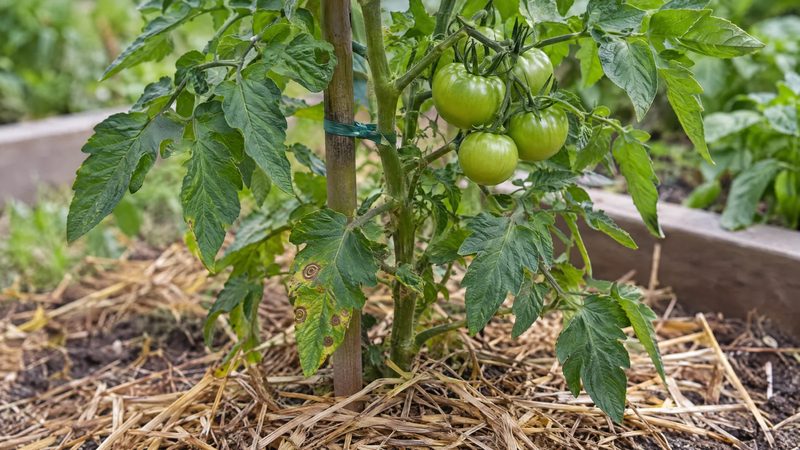
Which organic fungicides work on which tomato diseases?
Organic options are not interchangeable, because the main tomato leaf diseases are caused by different organisms. Early blight is caused mainly by the fungus Alternaria linariae (formerly known as Alternaria solani), Septoria leaf spot by the fungus Septoria lycopersici, and late blight by the water mold Phytophthora infestans.1,2,4 Powdery mildew on tomatoes is caused by Erysiphe lycopersici and Leveillula taurica.7
NC State Extension lists, as example organic products for early blight, fixed copper, potassium bicarbonate, several Bacillus strains (including Bacillus subtilis QST 713 and Bacillus amyloliquefaciens D747), an extract of Reynoutria sachalinensis, polyoxin D zinc salt and Streptomyces lydicus WYEC 108.1 For Septoria leaf spot the organic list is shorter: fixed copper and potassium bicarbonate.2 Not every product carrying an active ingredient is approved for organic production, so check the individual product.3
| Disease and cause | Organic options named by extension | What the evidence says |
|---|---|---|
| Early blight (Alternaria linariae) | Fixed copper, Bacillus strains, Reynoutria extract, Streptomyces lydicus, potassium bicarbonate | Cultural practices are the best means of control; Bacillus subtilis is listed for suppression |
| Septoria leaf spot (Septoria lycopersici) | Fixed copper, potassium bicarbonate | Organic fungicides have limited efficacy; some copper formulations may give adequate control |
| Late blight (Phytophthora infestans) | Copper products allowed in organic production | Must be applied before disease starts; may fall short in very cool, wet weather |
| Powdery mildew (Leveillula taurica, Erysiphe lycopersici) | Sulfur, potassium bicarbonate, horticultural and plant oils, Bacillus subtilis | Potassium bicarbonate matched sulfur in greenhouse trials; Bacillus subtilis was less effective than oils or sulfur |
In North America, interest in organic tomato fungicides peaks in June as plants grow into the season; late blight sprays matter most in cool, wet weather and are not needed in hot, dry spells4. In the Southern Hemisphere, the same spray window falls from about December to February.
How does copper fungicide work, and what are its limits?
Copper has been used against plant diseases since the 1880s, when the lime and copper mix known as Bordeaux mixture was discovered.6 The active form is the cupric ion, which acts at many sites in the cell and blocks respiration, stopping spores from germinating.6 Because it must already be on the leaf surface before infection, copper is a protectant, and fungi and oomycetes have shown no resistance to copper compounds.6
A review of copper in plant protection found that no replacement yet matches copper's plant protection effectiveness, and that organic disease management depends almost entirely on it.6 The drawback is the soil. Copper does not break down, is barely removed by leaching or plant uptake, and accumulates in soil with repeated use, where high concentrations can reduce earthworm populations.6 The USDA National Organic Program allows fixed coppers (copper hydroxide, copper oxide and copper oxychloride) for crop disease control only if they are used in a way that minimizes accumulation in the soil.5
Do biological fungicides like Bacillus subtilis work on tomatoes?
They help, but expectations should be modest. UC IPM lists Bacillus subtilis as a biological fungicide acceptable for organically grown tomatoes and describes it as giving suppression of early blight, with applications starting when plants are 4 to 6 inches tall and repeated as the label directs.3 NC State Extension adds several other microbial and plant-extract products to its organic list for early blight, while stating that cultural control measures remain the best means of control for organic growers.1
Against powdery mildew on vegetables, UC IPM reports that Bacillus subtilis has not proven as effective as oils or sulfur.7 Biological products therefore fit best as one part of a program that also relies on rotation, sanitation and well-timed protectant sprays.1,7
What natural fungicides work on powdery mildew on tomatoes and other vegetables?
Sulfur, potassium bicarbonate and oils are the main natural options for powdery mildew, which also affects many other vegetables, including cucumbers, squash, melons, peppers and eggplant.7 Sulfur has been used against powdery mildew for centuries but works only when applied before symptoms appear.7 Horticultural oils and plant-based oils such as neem oil work best on mild to moderate infections that are already present.7
Potassium bicarbonate is the bicarbonate listed for crop disease control under the National Organic Program.5 In greenhouse trials reported in Acta Horticulturae, a potassium bicarbonate product reduced powdery mildew about as well as sulfur on most crops tested, including tomato and cucumber, with efficacy above 90% when applied protectively and no plant injury observed.8
- Do not apply sulfur when the air temperature is near or above 90°F.7
- Do not apply an oil within 2 weeks of a sulfur spray, or plants may be injured.7
- Do not apply oils above 90°F or to drought-stressed plants.7
- Copper is available for powdery mildew but is not very effective against it.7
When should you spray organic fungicides on tomatoes?
Before the disease takes hold. Organic fungicides for Septoria leaf spot give only preventive protection and will not cure an infected plant, so in gardens with a history of the disease they need to go on before symptoms appear.2 For late blight, fungicide applications must be made before the disease starts or they will be ineffective; they are most useful during cool, wet weather and are not needed in hot, dry periods, when Phytophthora infestans is unlikely to be active.4 Even properly timed sprays may not give adequate late blight control when weather is excessively cool and wet.4
For early blight, NC State Extension advises applying fungicides preventatively.1 Copper and the other contact products also need thorough coverage of every leaf they are meant to protect.7 Whatever the product, read the label for the crops, diseases and intervals it allows, and follow the product label exactly.4
What cultural steps make organic fungicides work better?
Organic fungicides work best on plants that are already hard for disease to infect. These steps come from extension guidance on early blight and Septoria leaf spot.1,2
- Rotate away from tomatoes for 2 to 3 years for early blight, and 2 or more years for Septoria leaf spot.1,2
- Mulch to stop spores splashing from soil onto lower leaves.1,2
- Trellis or stake plants to increase airflow, and prune the lowest leaves as the plant grows.1
- Remove volunteer tomatoes and solanaceous weeds such as horsenettle, which carry inoculum.1,2
- Remove tomato crop debris and avoid working among plants when leaves are wet.2
- Grow tolerant varieties: there is no true resistance to early blight, but NC State Extension names more tolerant cultivars such as 'Mountain Magic', 'Juliet F1' and 'Celebrity Hybrid'.1
- For late blight, consider tolerant or resistant varieties such as 'Defiant PHR', 'Iron Lady' and 'Mountain Merit'.4
Key takeaways
- Extension guidance lists copper for all three tomato blights, and no organic alternative yet matches its effectiveness.
- Copper accumulates in soil, so the National Organic Program allows it only in ways that minimize soil buildup.
- Sulfur, potassium bicarbonate and oils are the main natural choices for powdery mildew; keep sulfur and oils 2 weeks apart and avoid spraying near 90°F.
- Bacillus biofungicides give suppression, not full control, and work best inside a wider program.
- Organic fungicides protect healthy leaves; they do not cure infected ones, so spray early and follow the product label.
References
- Early Blight of Tomato
- Septoria Leaf Spot of Tomato
- UC IPM Pest Management Guidelines: Tomato, Early Blight (UC ANR Publication 3470)
- Late Blight (UW Plant Disease Facts D0068)
- 7 CFR 205.601, Synthetic substances allowed for use in organic crop production
- Copper in plant protection: current situation and prospects
- Pest Notes: Powdery Mildew on Vegetables (UC ANR Publication 7406)
- Potassium Bicarbonate as a Potential Sulphur Substitute in Protected Organic Cropping
Frequently asked questions
Is copper fungicide allowed in organic gardening?
Does baking soda work as a fungicide on tomatoes?
The bicarbonate that holds a place on the National Organic Program list for crop disease control is potassium bicarbonate, not sodium bicarbonate (baking soda).5 Potassium bicarbonate is the form NC State Extension names for organic early blight and Septoria control, and the form tested against powdery mildew on tomato in greenhouse trials.1,2,8
Can an organic fungicide cure blight once you see it?
Is neem oil a fungicide for tomatoes?
UC IPM lists neem oil among the plant-based oils that can reduce mild to moderate powdery mildew on vegetables, including tomatoes.7 Do not apply it within 2 weeks of sulfur or when temperatures are above 90°F, and follow the product label.7 NC State Extension's organic product lists for early blight and Septoria leaf spot do not include neem.1,2