


Crops affected
Ticks at a glance
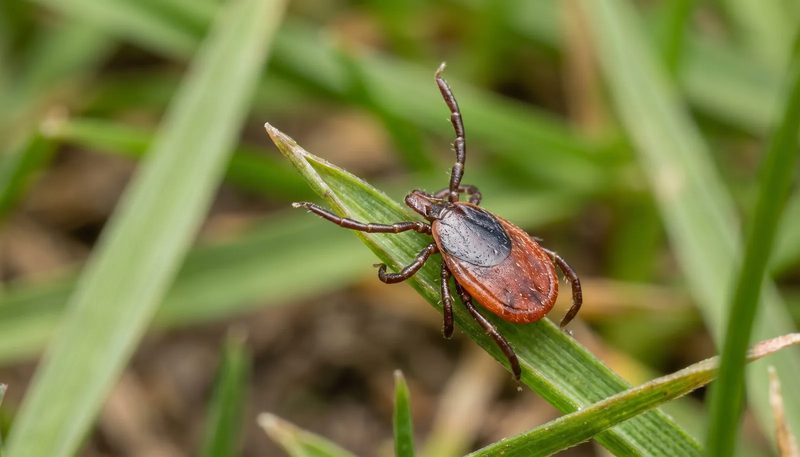
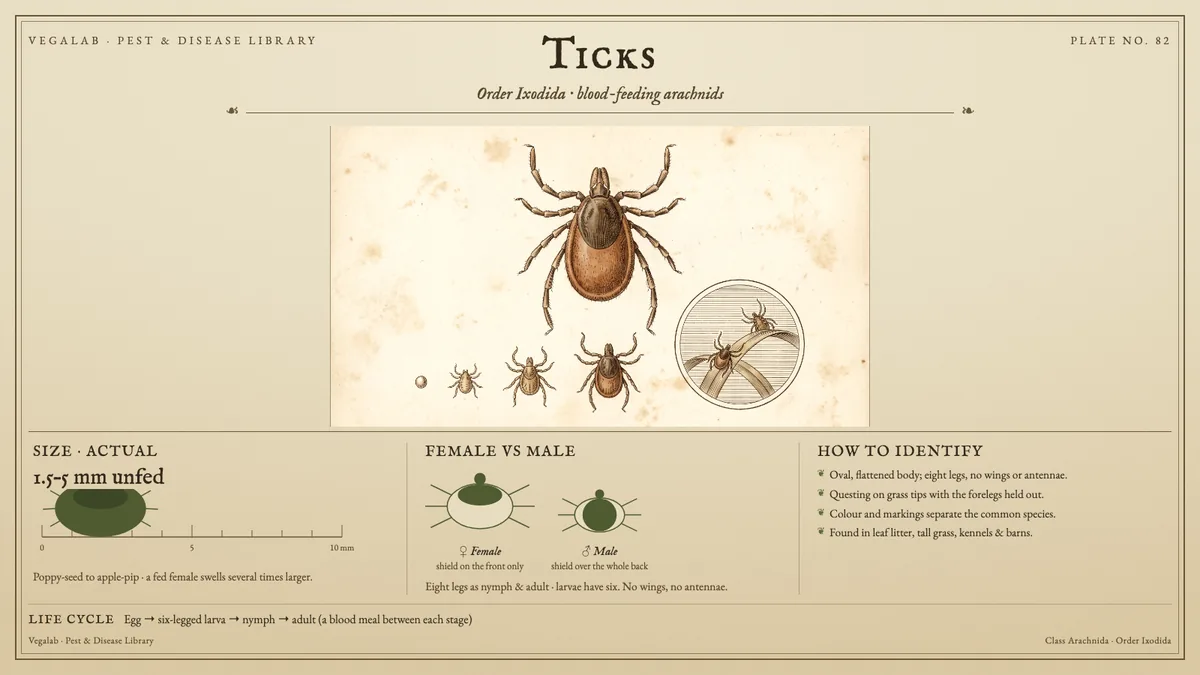
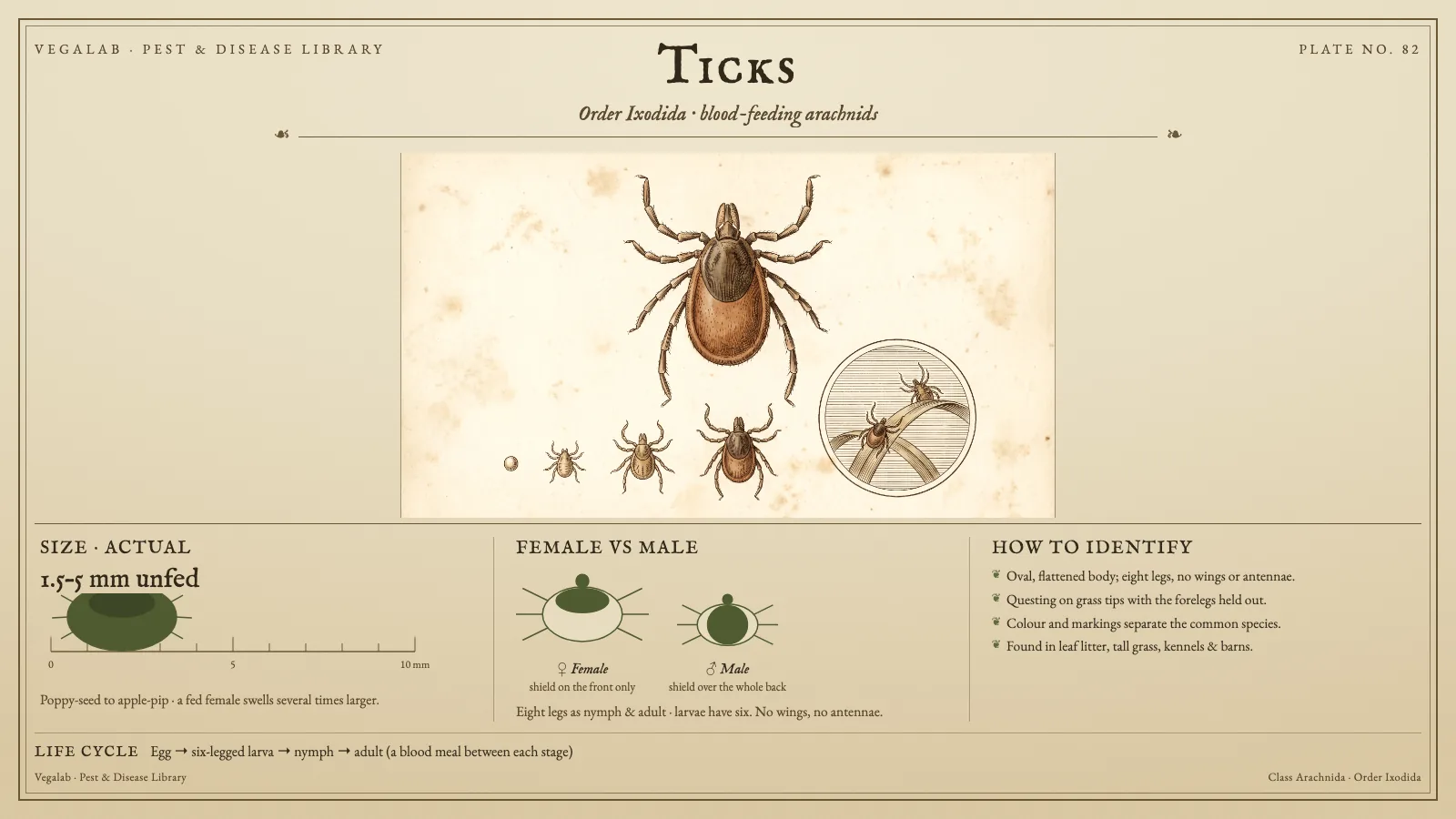
- Questing on grass tips with the forelegs held out.
How to Identify Ticks
- Black-legged tick (deer tick): 1.5 to 3 mm unfed, orange-brown body with dark legs and a dark scutum. Larvae and nymphs are tiny and easily overlooked.
- American dog tick: up to 5 mm unfed, reddish-brown with cream-coloured white markings on the scutum. The largest commonly encountered tick in the eastern and central US.
- Lone star tick: 3 to 4 mm unfed; the female has a single white spot on the centre of the scutum. Aggressive host-seeking behaviour; can run toward a host rather than waiting.
- Brown dog tick: slender and uniformly reddish-brown, no markings. The only tick species that can complete its full life cycle indoors, making kennels and homes a persistent source of infestation.
Adult ticks are visible to the naked eye at 1.5 to 5 mm unfed, expanding significantly after feeding. All ticks have eight legs as nymphs and adults; larvae have six. Key species identification:
Activity and Seasonal Risk
Hard ticks (family Ixodidae) seek hosts by questing: they climb grass stems and low vegetation and extend their forelegs to attach to passing hosts. Peak activity varies by species and climate. Black-legged tick nymphs peak in late spring to early summer across the northeastern and midwestern US. Lone star ticks are active spring through fall in the southeast. Brown dog ticks are active year-round in warm climates and indoors. All three life stages can parasitize dogs, livestock, and wildlife.
Vegalab Spider Mite Control for Tick Management
Spider Mite Control (geraniol 30%) contains geraniol as its principal active ingredient. Geraniol is a naturally occurring monoterpene alcohol with well-documented repellent and contact-acaricidal activity against multiple tick species. Laboratory data confirm contact activity against Rhipicephalus and Amblyomma larvae and adults.
For tick applications, Spider Mite Control is used at a higher concentration than for spider mites, reflecting the dose required for geraniol to reach effective acaricidal and repellent thresholds at tick life stages. The recommended tick application rate is 1:50 (20 mL of product per 1 litre of water).
| Application site | Dilution | Product per 1 L water | Repeat interval |
|---|---|---|---|
| Yard perimeter and shrub borders | 1:50 | 20 mL | Every 7 to 14 days |
| Kennel runs and barn floors | 1:50 | 20 mL | Every 7 to 14 days |
| Livestock (cattle, horses, sheep) | 1:50 | 20 mL | Every 7 to 14 days |
| Dogs (body application) | 1:50 | 20 mL | Every 7 to 14 days |
Application guidance
Tick treatment targets active, questing ticks on vegetation and surfaces. It does not reach ticks sheltered in deep leaf litter and soil. For perimeter applications, focus on the boundary between maintained lawn and woodland, shrub beds, or fence lines where ticks are most active. Remove or bag leaf litter before treatment where possible. Repeat every 7 to 14 days during peak tick activity or after significant rainfall.
Always check the current product label for the most current application directions. Product claims, registrations, and availability vary by jurisdiction. Label directions govern.
Animal Safety
DO NOT USE ON CATS. Cats lack the hepatic glucuronidation enzyme pathway needed to metabolize monoterpene compounds such as geraniol. Even small exposures can be toxic. Keep cats away from treated areas until surfaces are completely dry.
For dogs: do not apply near eyes, nose, mouth, or genital areas. Perform a patch test 24 hours before the first full application. Do not use on puppies under 12 weeks of age or on sick, aged, pregnant, or nursing animals without veterinary advice.
We publish additional information on essential oil safety with animals at /crop-science/knowledge/safety/cats.
Important information
Product claims, registrations, and availability vary by jurisdiction. Always consult the current product label for approved uses, rates, and safety instructions before use. This page does not constitute a registered label or a guarantee of efficacy.
Recommended Vegalab solution: Spider Mite Control
Spider Mite Control · geraniol 30%, applied at 1:50 (20 mL/L) to yard perimeters, kennel runs, barn floors and animals per label, repeated every 7 to 14 days through peak tick activity. Not for use on cats.
| Role | Product | Use |
|---|---|---|
| Primary control | Spider Mite Control |
Claims and product availability vary by jurisdiction. Always read and follow the product label.