

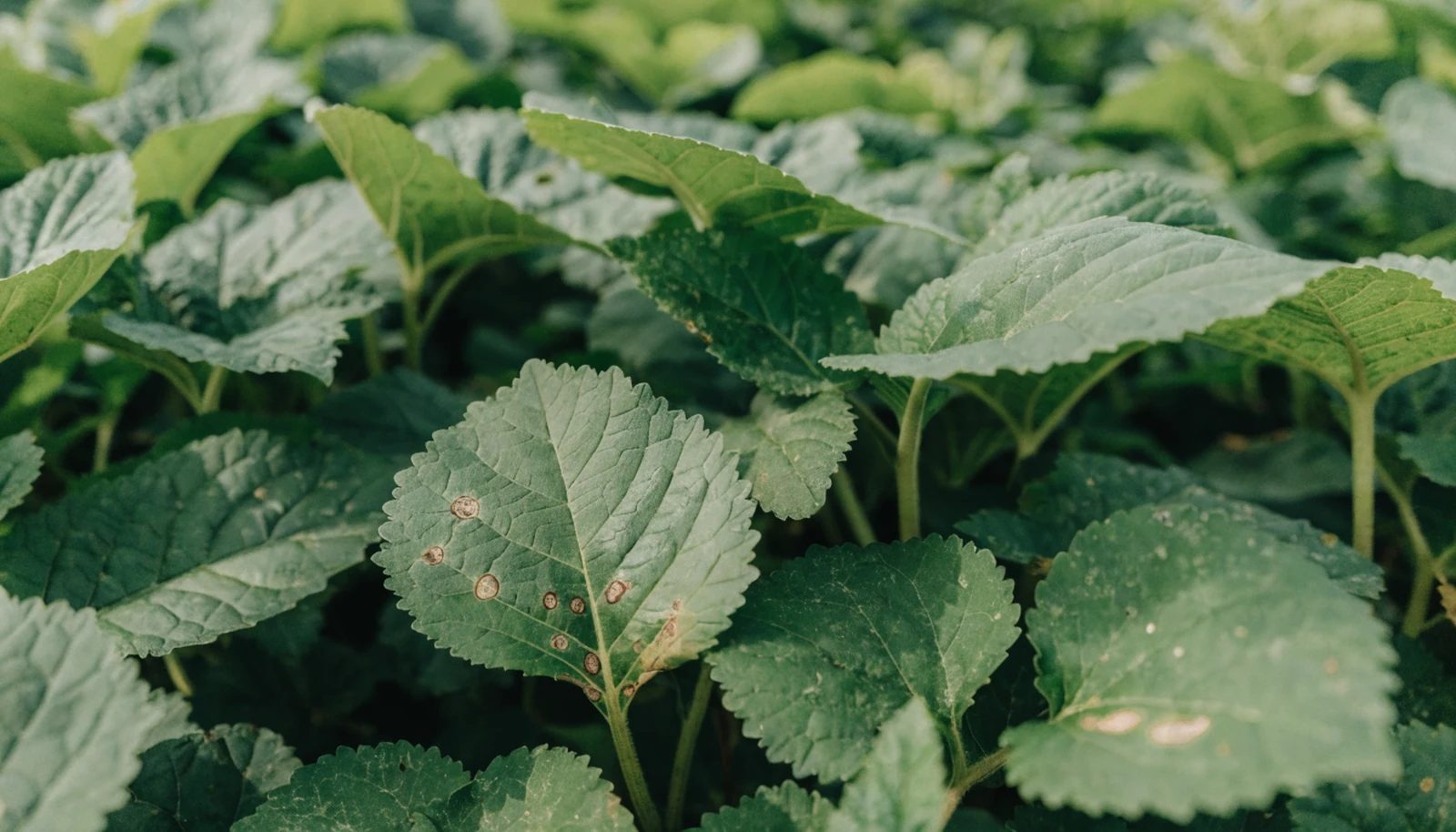
Crops affected
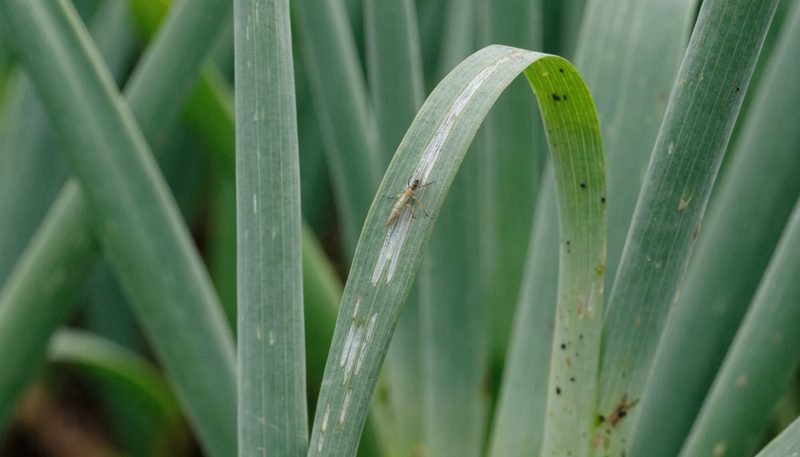
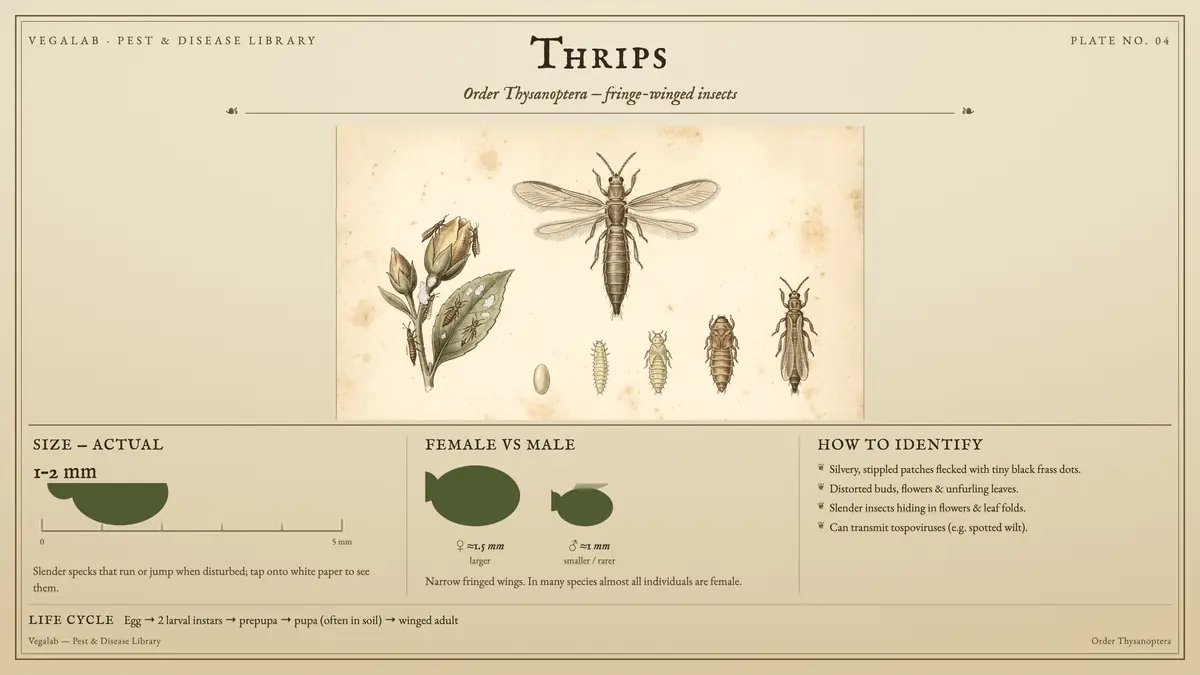
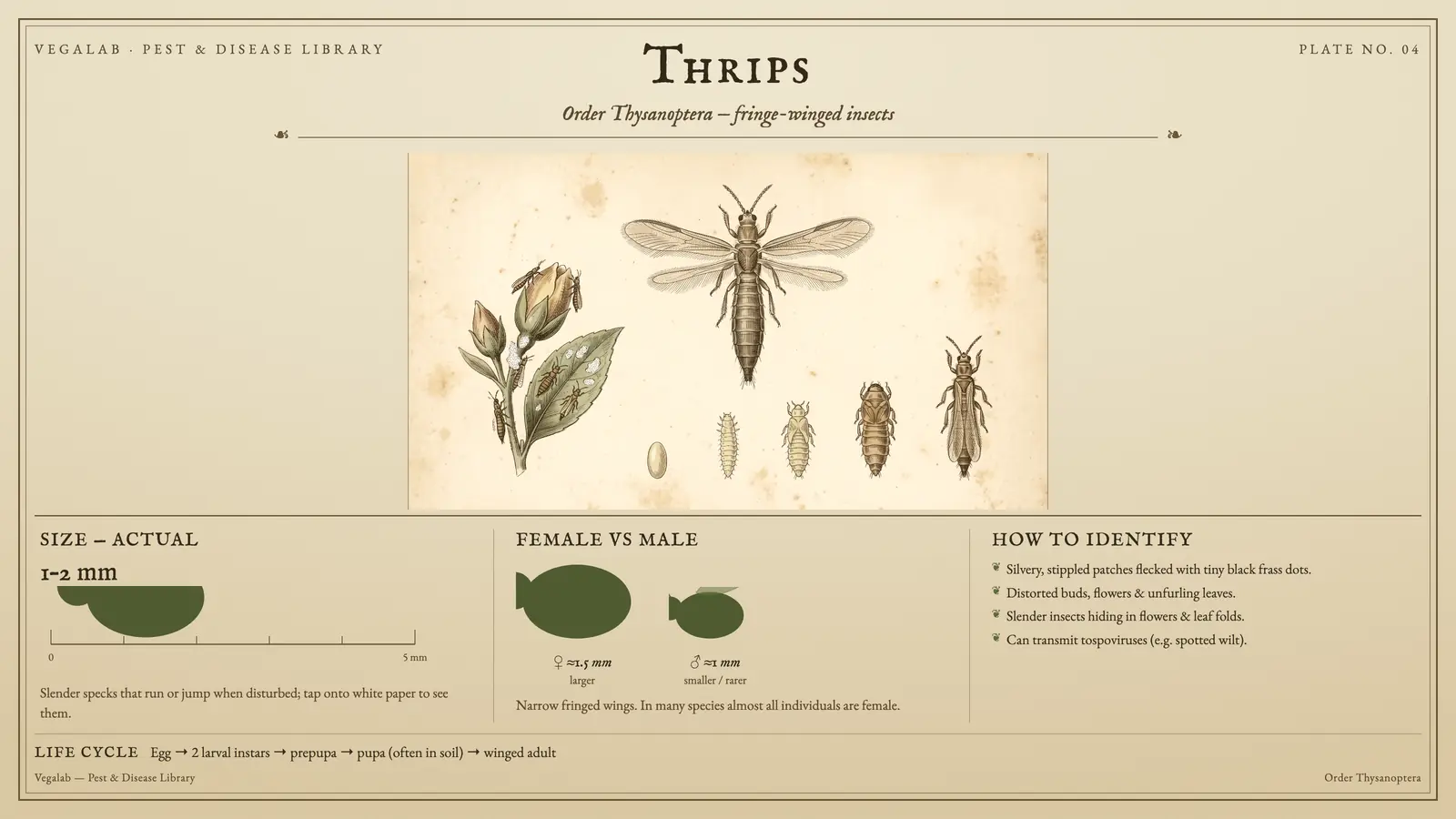
How to identify thrips
Female and Male. ♀ ≈1.5 mm, larger; ♂ ≈1 mm, smaller / rarer. Narrow fringed wings. In many species almost all individuals are female.
- Silvery, stippled patches flecked with tiny black frass dots.
- Slender insects hiding in flowers & leaf folds.
What is it?
Thrips are tiny (1–2 mm) elongated insects that feed by puncturing plant cells and drinking the contents. They favor flowers, buds, and tender new growth, and many species reproduce rapidly. Some thrips transmit damaging plant viruses as they feed.
How to identify it
- Silvery feeding scars and dark frass flecks
- Distorted growing points and flowers
- Scarred, downgraded fruit
- Virus symptoms (spotted wilt) from feeding
Life cycle & spread
Thrips have an unusual life cycle for a pest, and it explains most of the difficulty in managing them. Eggs are inserted *into* plant tissue, where no contact spray can reach them. Two feeding larval stages follow on the plant, and then most species drop to the soil or growing medium to pass through two non-feeding stages - prepupa and pupa - before the winged adult flies back up into the crop.
So at any moment a large share of the population is somewhere a foliar application cannot touch: inside leaf tissue, or in the top few centimetres of soil. That is why foliar-only programmes plateau, and why soil-directed measures and sticky-trap monitoring earn their place.
Development is fast in warm conditions - roughly two to three weeks from egg to adult at greenhouse temperatures - and females of many species can reproduce without mating, so a single introduced individual is enough to start a population.
Damage and how it spreads
Thrips feeding scars leaves and downgrades the appearance and value of flowers and fruit. Their role as virus vectors can be even more damaging than the direct feeding. They breed quickly and shelter inside buds and flowers, so infestations build out of sight.
How to control it
- Use blue or yellow sticky traps to monitor populations.
- Remove spent flowers and weeds that harbor thrips.
- Protect predatory mites and minute pirate bugs.
- Spray a natural contact insecticide, targeting flowers and new growth, and repeat to catch emerging thrips.
What are thrips?
Thrips are slender insects of the order Thysanoptera, typically 1–2 mm long, with fringed wings and rasping-sucking mouthparts. They scrape the surface of plant tissue and drink what escapes, which produces the characteristic silvering rather than the clean holes a chewing insect leaves.
Growers usually meet them as one of a handful of species: western flower thrips (Frankliniella occidentalis), onion thrips (Thrips tabaci), and in warm regions chilli thrips (Scirtothrips dorsalis). "Thrip" is the common singular in the field; the formal singular is also thrips.
Western flower thrips is the species behind most protected-crop problems and most virus transmission. It has its own entry: Western Flower Thrips.
Thrips damage: what to look for
- Silvering and bronzing on leaves, petals and fruit surfaces, with black frass specks
- Distorted new growth · feeding in the bud, symptoms visible after expansion
- Scarred, russeted fruit and, in onions and alliums, whitened leaf tips
- Virus symptoms: ring spots, necrotic flecking and one-sided growth from tospovirus infection
Feeding damage is silvery or bronzed patches where cells have been emptied of their contents, usually with tiny black specks of frass in the middle of them. On expanding tissue the scarring distorts as the leaf or fruit grows, so damage done in the bud shows up as twisted leaves and scarred, misshapen fruit weeks later - long after the insects responsible have gone.
The larger cost is often viral. Thrips are the only vectors of the tospoviruses, including tomato spotted wilt and impatiens necrotic spot. A population small enough to cause no visible feeding damage can still transmit a virus that takes the crop, which is why the action threshold for a virus-susceptible crop is far lower than the threshold for cosmetic damage.
How do you get rid of thrips?
- Monitor with sticky traps before you treat. Thrips are small and cryptic; traps tell you the population is rising a week or more before the damage does.
- Treat the flowers and growing points. That is where thrips concentrate, and a canopy-directed application largely misses them. Tapping flowers over a white surface is the standard field check.
- Include the soil or medium where the crop allows it. Two of the five life stages are down there, and a foliar-only programme leaves them untouched.
- Repeat on a short interval. New adults emerge continuously from protected stages; a single application only removes what is exposed on the day.
- Manage weeds and crop debris, and observe a host-free break between crops under protection. Thrips move in from flowering weeds and survive on volunteers.
- Rotate modes of action. Western flower thrips has documented resistance to several insecticide groups, and protected crops select for it quickly.
Because eggs sit inside tissue and pupae sit in the soil, thrips management is a programme rather than a spray. The pieces that consistently matter:
Neem oil for thrips, and where it fits
Neem's azadirachtin works better on thrips than a simple contact product does, because it acts as an insect growth regulator: treated larvae often fail to complete moulting rather than dying on contact. That reaches part of the population a pure knock-down misses.
It will not reach eggs inside the tissue, its activity is short-lived in sunlight, and it needs to contact the larvae in the flowers to do anything at all. Treat in the evening, aim at flowers and growing points, and expect to repeat every five to seven days through a generation rather than once.
Insecticidal soap and sticky traps: honest limits
Insecticidal soap kills the thrips it wets and nothing else - no residual, no activity on eggs in tissue or pupae in soil. In a flower crop, where thrips shelter deep in the bloom, achieving that contact is genuinely difficult. It is a reasonable pre-harvest or spot-treatment tool and a poor foundation for a programme.
Sticky traps are widely sold as control and are not. Blue and yellow traps are an excellent monitoring tool - they tell you when flights start and whether numbers are rising - but the share of a population they remove is small. Use them to decide when to act, not as the action. Mass trapping only makes a measurable difference in small, sealed spaces.
Conditions that favour thrips
- Warm and dry. Development accelerates with temperature; dry conditions concentrate populations onto irrigated crops.
- Protected cropping. Stable warmth, no rainfall, continuous host availability and no natural enemies.
- Flowering weeds nearby, and overlapping crops with no host-free break.
- Broad-spectrum insecticide use, which removes predatory mites and bugs faster than it removes thrips.
Recommended Vegalab solution: Spider Mite Control
Vegalab Spider Mite Control is the primary option for thrips, with MultiMite Control as a companion where pressure is broader. It works physically rather than through a single biochemical target - blocking the pests' breathing holes, suffocating them on contact and deactivating laid eggs - so thorough coverage matters more than dose. Apply early and target sheltered sites (flowers, growing points), repeat on the label interval, and manage nearby virus reservoirs.
Observed results: Spider Mite Control has demonstrated 90-97% spider mite control across four trials, at zero pre-harvest and re-entry interval with no observed phytotoxicity. It also targets aphids, scale, thrips and other soft-bodied insects.
| Trial | Crop / site | Result |
|---|---|---|
| Independent field trial, D&M Chemical, 2014 | Strawberry, Oxnard, California | 97% control across egg, nymph and adult stages |
| Independent field trial, D&M Chemical, 2014 | Strawberry, Camarillo, California | 89% control including eggs |
| Independent field trial, D&M Chemical, 2018 | Hops, Yakima, Washington | Above 90% control at full rate, 50 gal/ac |
| Laboratory assay, University of Florida IFAS (Tier 1) | Laboratory, at 1:500 | Above 93% mortality |
Mix rate 1:500 to 1:1,000 by infestation level, against an untreated infestation baseline. No percentage figure is claimed for aphids, scale or thrips.
| Role | Product | Use |
|---|---|---|
| Primary control | Spider Mite Control | Contact miticide / insecticide |
| Companion / broader pressure | MultiMite Control | Broader mixed mite & insect pressure |
By crop
See crop-specific solutions
Preventing it next season
Monitor with sticky traps, manage weeds, and keep beneficials active. Healthy, resilient plants recover from thrips scarring faster, so keep nutrition balanced through the season.
Claims and product availability vary by jurisdiction. Always read and follow the product label.