

Crops affected
How to identify western flower thrips
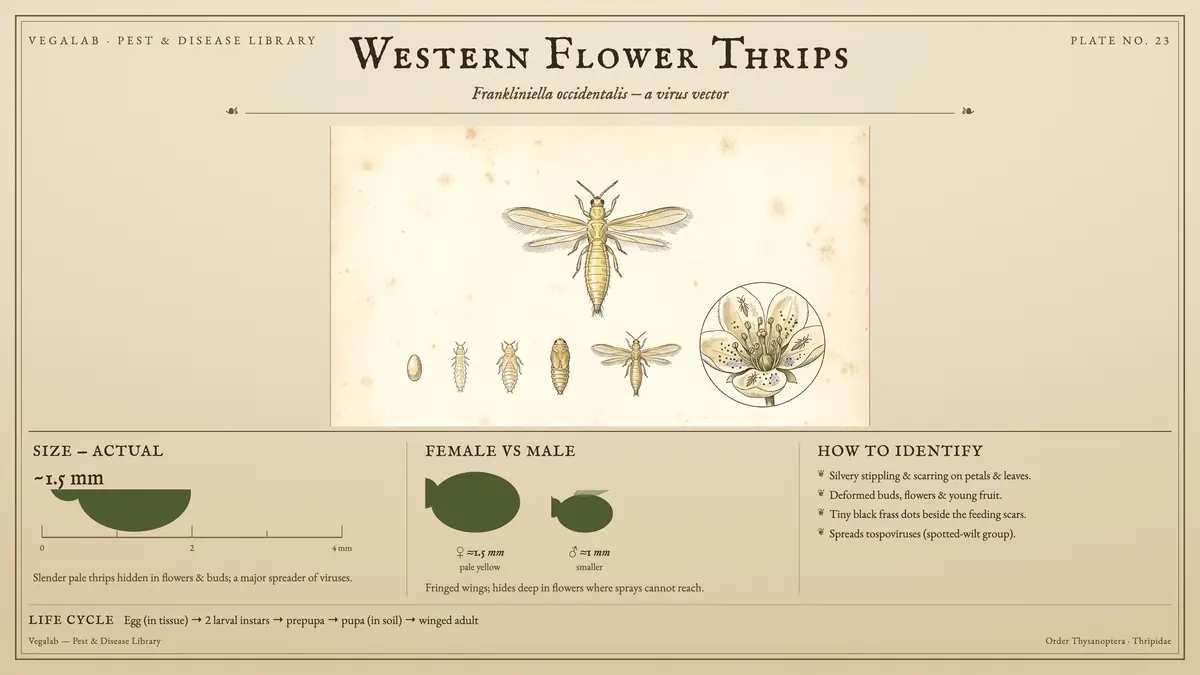
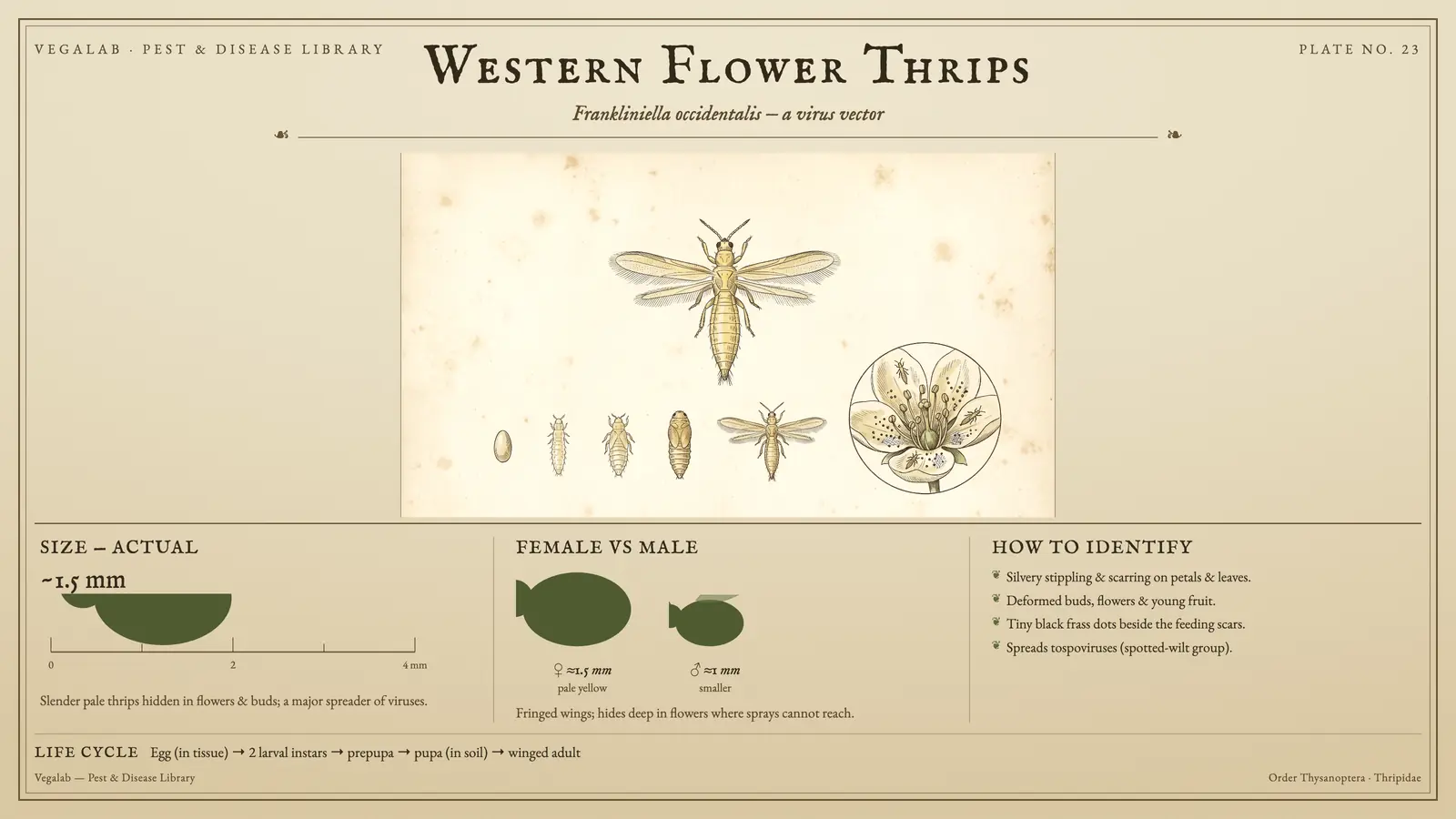
- Silvery stippling & scarring on petals & leaves.
Life cycle. Egg (in tissue) → 2 larval instars → prepupa → pupa (in soil) → winged adult
What is it?
Western flower thrips is one of the world's most damaging and insecticide-resistant thrips. It feeds inside flowers and buds and on young tissue, and is a key vector of tospoviruses such as tomato spotted wilt · so disease risk compounds the feeding damage.
How to identify it
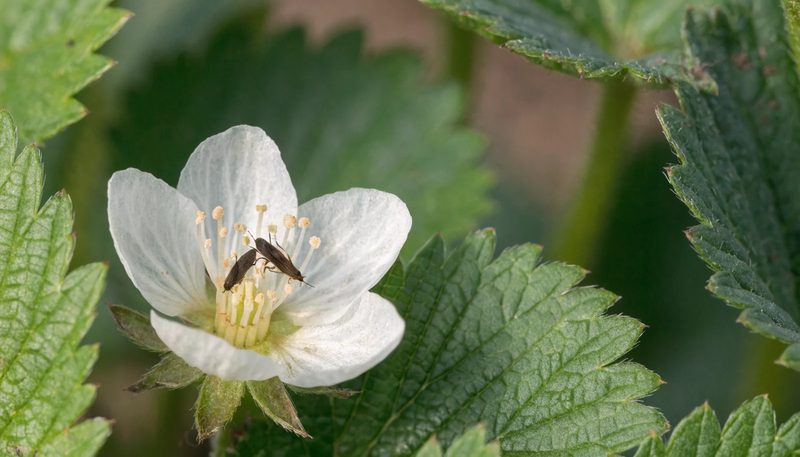
- Tiny (~1.5 mm) slender insects, pale yellow to brown, hiding in flowers, buds and growing points.
- Silvery, stippled or scarred leaf and petal surfaces with tiny black frass specks.
- Deformed flowers, scarred fruit and distorted new growth.
- Sudden tospovirus symptoms (ring spots, necrosis) signalling thrips-vectored virus.
Life cycle & spread
Very short life cycle with many overlapping generations; pupation often in the soil/media. Rapid turnover is why resistance develops quickly under repeated single-chemistry use.
Conditions that favour it
Warm conditions, flowering crops and protected (greenhouse) environments favour explosive build-up; nearby flowering weeds are reservoirs.
Damage and how it spreads
Direct scarring downgrades flowers, fruit and foliage; tospovirus transmission can cause losses far beyond the feeding damage, sometimes destroying whole plantings.
Monitoring & scouting
Use blue/yellow sticky traps and flower tapping to detect early; scout buds and growing points; act on larvae before populations and virus spread build.
How to control it
- Target the exposed larval and adult stages with thorough coverage of flowers and growing points;
- rotate modes of action;
- remove flowering weed reservoirs;
- use a natural mode of action to slow resistance.
How to manage western flower thrips
- Accept that two life stages are unreachable. Eggs are inserted into plant tissue and pupae are in the growing medium or soil. A foliar-only programme addresses perhaps half the population at any time, which is why intervals must be short and why soil-directed and biological measures matter.
- Introduce predators early and preventively, not as a rescue. Amblyseius swirskii and Neoseiulus cucumeris predatory mites feed on thrips larvae, and Orius predatory bugs on larvae and adults. Both work well when established before the population builds and poorly afterwards.
- Target the soil stage. Predatory mites such as Stratiolaelaps and entomopathogenic nematodes attack pupae in the medium - one of the few measures that reaches that stage.
- Use blue sticky traps for monitoring, and understand that they monitor rather than control. Blue is more attractive to WFT than yellow.
- Screen and exclude. Thrips-proof mesh, double doors and a strict host-free period between crops. Exclusion is far more effective than suppression for this pest.
- Rogue and remove infested plant material and spent flowers, where thrips and eggs concentrate.
- Rotate modes of action rigorously, and treat any control failure as a resistance signal rather than a rate problem.
- Manage virus risk separately. Where tospovirus is the threat, keeping thrips out of the crop matters more than reducing numbers inside it.
Western flower thrips is the most damaging thrips species in protected cropping and one of the most insecticide-resistant insects in horticulture. It is managed as a programme, and programmes that rely on repeated spraying of a single mode of action have consistently failed against it.
This species has documented resistance to pyrethroids, organophosphates, carbamates, spinosyns and others. Biological control combined with exclusion is not the alternative approach for WFT - in protected crops it is the mainstream one, because chemistry alone stopped working.
Tospoviruses: why the threshold is so low
Western flower thrips is the principal vector of the tospoviruses - tomato spotted wilt virus (TSWV) and impatiens necrotic spot virus (INSV) - and this is where most of its economic damage originates rather than in feeding.
The transmission biology sets the threshold. Larvae acquire the virus by feeding on an infected plant, and once acquired the insect transmits for the rest of its life. Only larvae can acquire it; adults that acquired it as larvae are the main transmitters. Because a single viruliferous adult can infect a plant in a short feeding period, and because infection is systemic and incurable, a population far below any feeding-damage threshold can destroy a crop's value.
The practical consequences are specific and differ from ordinary pest logic. Roguing infected plants immediately removes the acquisition source and matters more than reducing thrips numbers. Weed and ornamental reservoirs around the house are a primary risk, since INSV in particular persists in bedding plants. And clean propagation material and a genuine host-free break between crops are worth more than any spray programme.
See Mosaic Virus and Leaf Curl Viruses for other virus groups and their different vector relationships.
Western flower thrips or another thrips?
- Western flower thrips (Frankliniella occidentalis): variable pale yellow to dark brown; found deep in flowers; the dominant protected-crop species; transmits TSWV and INSV; heavily resistant
- Onion thrips (Thrips tabaci): smaller, pale, more often on foliage and in leaf axils than in flowers; a major allium and brassica pest; transmits iris yellow spot virus
- Chilli thrips (Scirtothrips dorsalis): attacks young growth and fruit surfaces causing bronzing and scarring rather than flower damage; a serious pest in warm regions
- Thrips palmi: melon thrips, a quarantine concern in several regions, on cucurbits and solanaceous crops
- Predatory thrips (Aeolothrips, banded thrips): larger, faster, banded wings - a beneficial that is frequently killed by mistake
Species identification changes the crop risk, the virus risk and the resistance expectations. Where it matters commercially, a laboratory identification is inexpensive. See Thrips for the general entry.
Recommended Vegalab solution: MultiMite Control
MultiMite Control · natural broad-spectrum product (oxymatrine, from Sophora flavescens) that controls western flower thrips and other sucking pests on contact; spray with thorough coverage of flowers and growing points, repeated per pressure.
| Role | Product | Use |
|---|---|---|
| Primary control | MultiMite Control |
By crop
Preventing it next season
Sticky-trap monitoring, weed/reservoir management, mode-of-action rotation, and early treatment before flowers and virus spread build.
Claims and product availability vary by jurisdiction. Always read and follow the product label.