

Larva BioControl
Larva BioControl is a biological broad-spectrum larvicide that uses live Steinernema carpocapsae nematodes (50% w/w) to kill soil-dwelling larvae. The nematodes actively seek out and infect cutworms, webworms, fungus gnats, weevils and beetle grubs in the soil, delivering chemical-free control that spares beneficial species and leaves no chemical residue.
Biological broad-spectrum larvicide · Living biocontrol, Self-perpetuating.
- Zero REINo re-entry wait
- Zero PHIHarvest the same day
Biological broad-spectrum larvicide from Vegalab Crop Science, powered by Steinernema carpocapsae (live infective juveniles, 50% w/w). Larva BioControl targets Soil-dwelling larvae - cutworm, webworm, fungus gnat, weevil, beetle grubs.
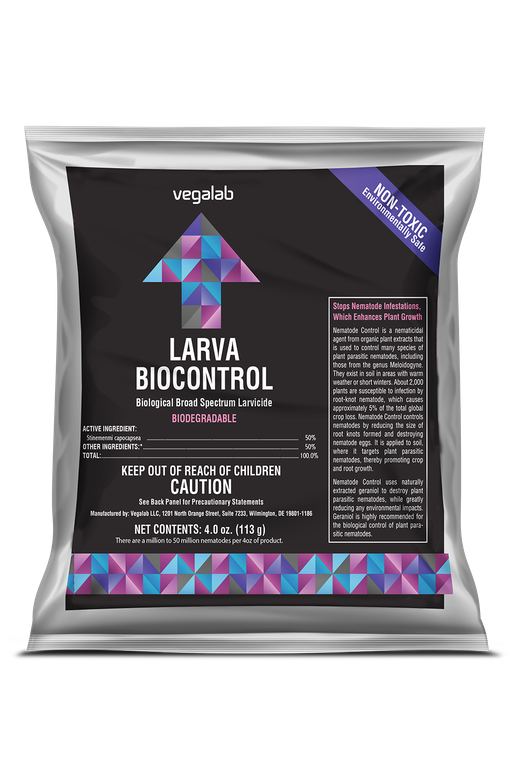
Live entomopathogenic nematodes infect larval pests through natural openings and release symbiotic bacteria that kill the host within 24-48 hours. The nematode population self-perpetuates on infected hosts, providing season-long control. Pollinator-safe.
| Active | Steinernema carpocapsae (live infective juveniles, 50% w/w) |
|---|---|
| Targets | Soil-dwelling larvae · cutworm, webworm, fungus gnat, weevil, beetle grubs |
| Dilution rate | 113 g (4 oz) per 68 L (18 gal) water · ~1M–50M nematodes per pack |
| Application | Soil drench at dusk or in cloud cover; keep soil moist post-application |
| Line · Category | Bio · Biological broad-spectrum larvicide |
- Fungus gnat larvae
- Western flower thrips (soil-dwelling stages)
- Vine weevil larvae
- Cutworm, Armyworm soil stages
What soil pests does Larva BioControl target?
Larva BioControl is built for the larvae that live and feed below the surface, where sprays rarely reach. It controls cutworms, webworms, fungus gnats, weevils and a range of beetle grubs across greenhouse crops, strawberry, ornamentals and turf. These soil-stage pests cut seedlings, sever roots and tunnel through the root zone, causing damage that often shows up above ground as wilting or patchy stands long after the larvae have done their work.
How do the nematodes kill larvae?
The active is live Steinernema carpocapsae infective juveniles. Released into moist soil, they hunt down larvae using heat and CO2 cues, enter the host through natural openings, and release symbiotic bacteria that kill it within days. Because this is a living biological control rather than a chemical toxin, there is no chemical residue, no pre-harvest interval driven by chemistry, and no single-site resistance pathway for pests to evolve around.
How and when should it be applied?
- Apply when
- At transplanting, at first sign of damage, or as a preventive drench in known hotspots
- Condition
- Moist soil - the nematodes move through the water film between soil particles
- Method
- Soil drench
- Rate
- 113 g per 68 L water · ~1M–50M nematodes per pack4 oz per 18 gal water · ~1M–50M nematodes per pack · Work out your rate
- Pre-harvest interval
- Zero - harvest the same day
- Re-entry interval
- Zero - no re-entry wait
Soil moisture is the binding constraint, not growth stage.
Always read and follow the applicable product label.
Apply to moist soil where larvae are active - at transplanting, at first sign of damage, or as a preventive drench in known hotspots. Soil moisture is critical: the nematodes move through the water film between soil particles, so irrigate before and after application and avoid the hottest part of the day. As a living product, follow the label's storage and mixing guidance closely so the juveniles stay viable through to application.
Why choose a biological larvicide over a chemical one?
Soil larvae are hard to reach and quick to rebound, and repeated chemical drenches can disrupt soil biology and select for resistance. A nematode-based control sidesteps both problems: it actively seeks the pest, leaves beneficial organisms and pollinators largely unaffected, and fits organic and IPM programs. It pairs well with Vegalab's foliar Larva Control for growers who need to hit both the soil and foliar stages of a pest's life cycle.
Which crops and settings is it suited to?
Larva BioControl has been used on greenhouse crops, strawberry, ornamentals and turf - settings where soil-dwelling larvae are a recurring, high-value problem and where chemical residue is least welcome. It is well suited to protected cropping and high-care turf, where moist, managed soil conditions keep the nematodes most effective.
Need a recommendation for your crop or pest?
Contact usCrop-specific solutions using this product
Frequently asked questions
What is the application rate for Larva BioControl?
113 g (4 oz) per 68 L (18 gal) water · ~1M–50M nematodes per pack Application: Soil drench at dusk or in cloud cover; keep soil moist post-application.
Is Larva BioControl suitable for natural or organic programs?
Larva BioControl supplies Steinernema carpocapsae (live infective juveniles, 50% w/w) in a formulation designed to fit low-residue and IPM programs.
Which crops is Larva BioControl used on?
Greenhouse crops · Strawberry · Ornamentals · Turf
What pests does it control?
Soil-dwelling larvae including cutworm, webworm, fungus gnat, weevil and beetle grubs.
Is it chemical-free?
Yes · it uses live Steinernema carpocapsae nematodes and leaves no chemical residue.
Where is it used?
Greenhouse crops, strawberry, ornamentals and turf.
How do I keep the nematodes effective?
Apply to moist soil, irrigate before and after, avoid midday heat, and follow the storage and mixing instructions so the juveniles stay alive.
Can I use it with Vegalab Larva Control?
Yes · Larva BioControl targets soil larvae while the foliar Larva Control targets larvae on the plant, so they complement each other across the pest's life cycle.
Problems addressed
Pest & disease library
See all plant pests & diseases →
Reference links to identification and management guides. Claims and product availability vary by jurisdiction - always read and follow the product label.
Last updated: