

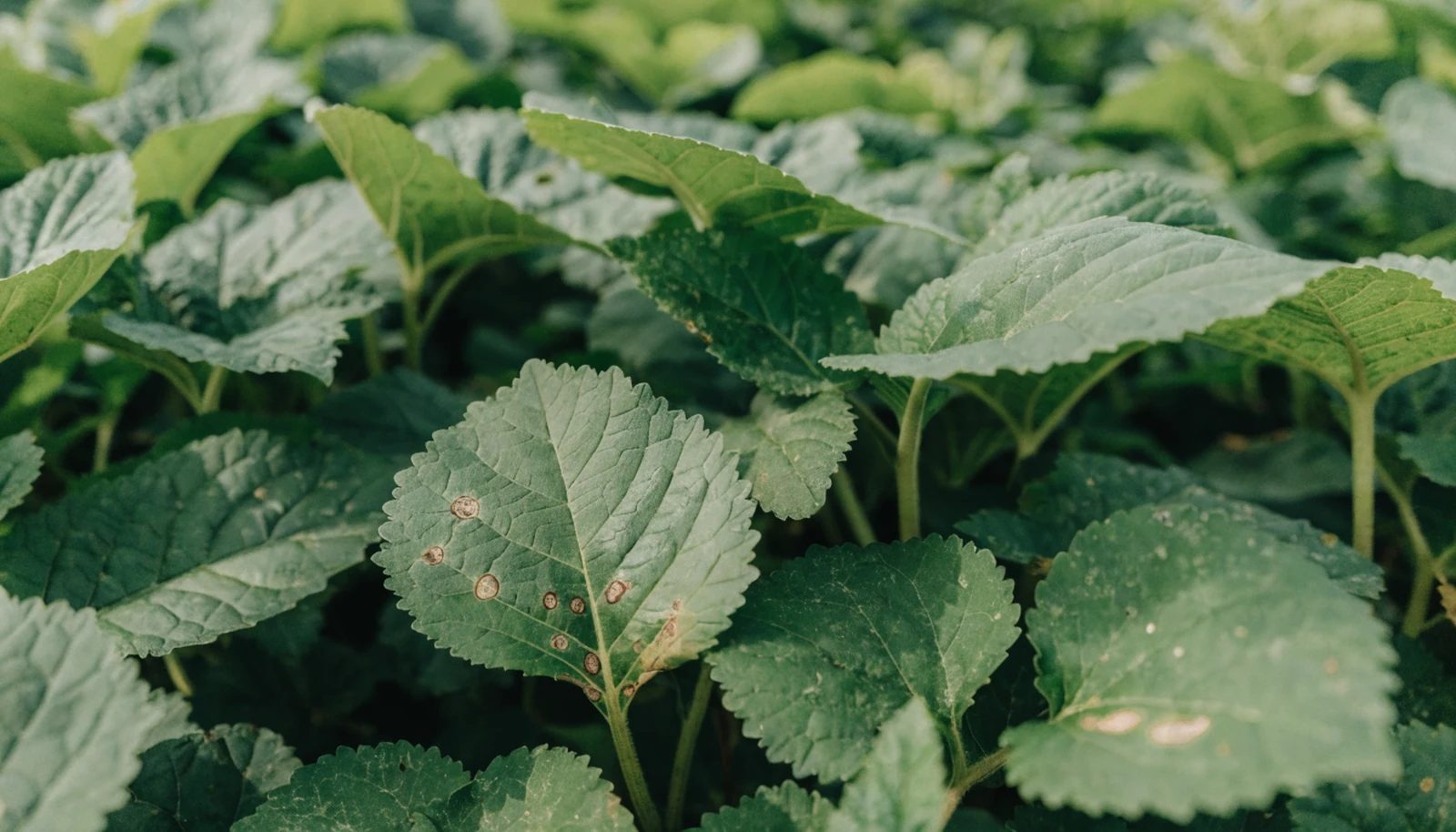
Crops affected
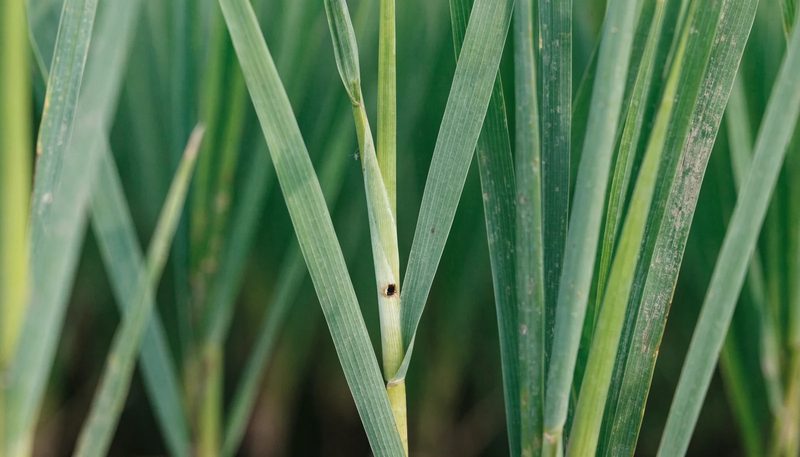
How to identify stem borers
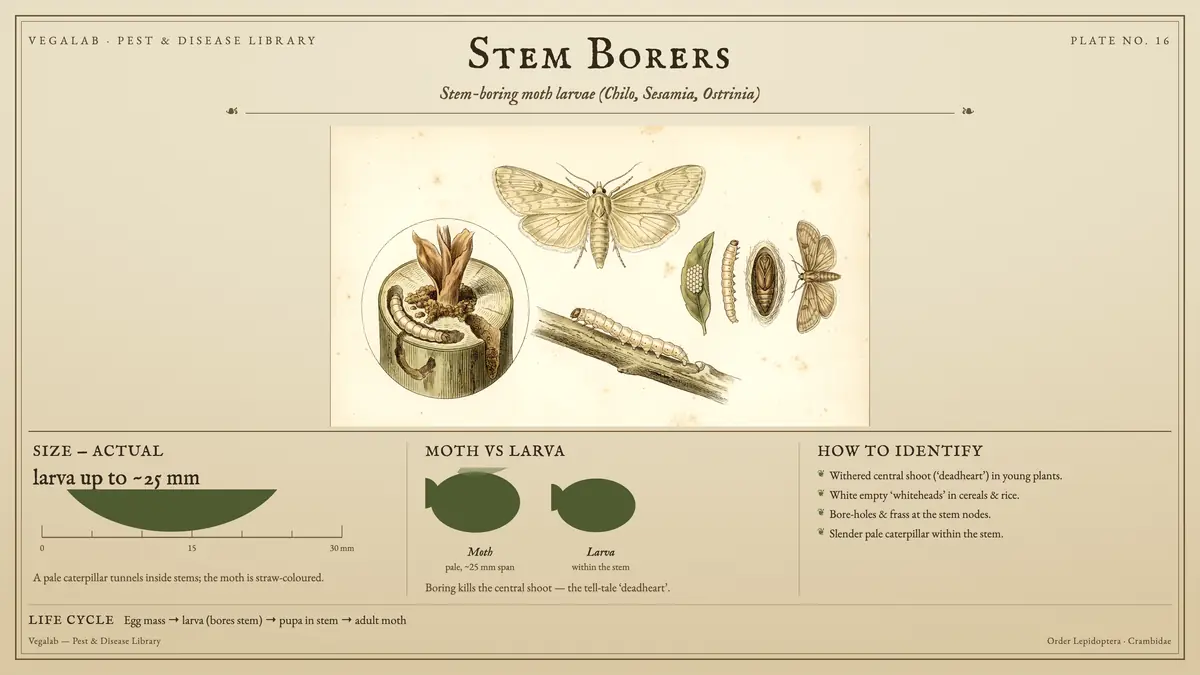
Size. larva up to ~25 mm A pale caterpillar tunnels inside stems; the moth is straw-coloured.
Moth and larva. Moth, pale, ~25 mm span; Larva, within the stem.
- Slender pale caterpillar within the stem.
What is it?
Stem borers are the larvae of several moth species. After hatching on leaves or whorls, young larvae feed briefly in the open, then bore into stems and tunnel - which is why early timing is essential for control.
How to identify it
- “Deadheart” · the central whorl/shoot dies while outer leaves stay green.
- Shot-hole feeding and frass in whorls and leaf sheaths.
- Entry/exit holes with frass on stems and stalks; tunnels visible when split.
- Broken, lodged stems and weakened nodes in cereals and cane.
Life cycle & spread
Moths lay egg masses on leaves; young larvae feed in whorls/sheaths before boring into stems where they complete development; multiple generations per season in warm climates.
Conditions that favour it
Warm conditions, continuous cereal/cane cropping, and carry-over in stubble and volunteer plants sustain pressure.
Damage and how it spreads
Deadheart kills tillers; stem tunnelling weakens stalks, causing lodging and yield/quality loss; entry wounds invite secondary rots.
Monitoring & scouting
Scout whorls and leaf sheaths for egg masses and young larvae; use pheromone traps for moth flights; target the pre-boring window.
How to control it
- Time applications to egg-hatch/early instars before larvae bore in;
- manage stubble to reduce carry-over;
- conserve natural enemies.
How to manage stem borers
- Destroy crop residue after harvest. Shred, plough or remove stalks and stubble. Overwintering larvae in residue are next season's infestation, and this is the highest-return measure available.
- Target the pre-entry window. Applications timed to egg hatch and directed into the whorl or leaf sheath reach larvae before they bore in. High water volume matters - the placement is inside a funnel, not on a leaf surface.
- Plant early and uniformly where the local pest phenology allows, and avoid staggered planting that gives the pest a continuous supply of susceptible-stage crop.
- Use tolerant or resistant cultivars, including Bt maize where it is grown and permitted, with the associated refuge requirements.
- Encourage the natural enemies. Trichogramma egg parasitoids, Cotesia larval parasitoids and predatory earwigs and ants take a substantial share; broad-spectrum sprays remove them for little gain against a protected larva.
- Control volunteer and wild grass hosts, and manage field margins that carry populations between seasons.
- Consider trap and border crops such as Napier grass in push-pull systems, which draw egg-laying away from the cash crop.
Because the larva is inside the stem for almost all of its feeding life, stem borer management is built on sanitation, timing to the pre-entry window, and cultivar choice - not on reaching the insect where it lives.
Once frass is visible at an entry hole, that stem is compromised and the larva inside is unreachable. Everything effective happens before that point or between crops.
Deadheart, whitehead and lodging: reading the symptom
- Deadheart · the central whorl dies and pulls out easily; caused by early attack destroying the growing point. The plant may tiller in compensation but the main stem is lost.
- Whitehead · the panicle or head emerges white and empty because the stem below it was severed during grain fill. Highly visible at maturity and diagnostic of late attack.
- Lodging and stem breakage · tunnelling weakens the stem so it snaps in wind or under grain weight; often the largest single component of yield loss.
- Frass extrusion · sawdust-like frass pushed out of entry holes; the most reliable external sign that a stem is occupied.
- Windowing and shot holes in whorl leaves · the earliest sign, produced before boring, and the signal that the treatable window is open now.
See Weak Stems & Lodging for the non-insect causes, which are frequently confused with borer damage at harvest.
The main species and their crops
- ***Chilo* spp.** · spotted and yellow stem borers of rice, maize and sugarcane across Asia and Africa
- ***Sesamia* spp.** · pink stem borers, often attacking below the soil line, which makes them still harder to reach
- Ostrinia nubilalis · European corn borer; maize, pepper and beans; also bores ears and fruit
- Diatraea saccharalis · sugarcane borer of the Americas; also maize and sorghum
- Scirpophaga incertulas · yellow stem borer, the dominant rice borer in much of South and Southeast Asia
- Busseola fusca · African maize stalk borer, a major constraint in smallholder maize
Species identification changes the timing and sometimes the placement - Sesamia attacking below ground cannot be reached by a whorl application at all. See Leaffolder for the other main rice foliage pest and Cotton Bollworm for the fruiting-structure borers.
Push-pull: managing borers with plant choice
- Push: Desmodium intercropped between cereal rows · repels ovipositing moths, fixes nitrogen, suppresses Striga
- Pull: Napier or molasses grass as a border - attracts egg-laying, larvae fail to develop
- Requires adequate rainfall and the establishment effort of a perennial intercrop
- Not a quick fix · the benefit accrues over seasons as the intercrop establishes
Push-pull is one of the more successful cultural systems developed against stem borers, and it is worth describing because it works without inputs and has been adopted at scale in African smallholder maize.
The principle uses two sets of plants. A push component intercropped with the cereal - typically Desmodium · releases volatiles that repel egg-laying female moths and drive them out of the crop. A pull component planted as a border - typically Napier or molasses grass - is more attractive for egg-laying than the maize, drawing the displaced females to lay there instead. Critically, the larvae that hatch on Napier grass largely fail to complete development, so the border acts as a dead-end trap rather than a reservoir.
Desmodium brings additional benefits that explain the adoption rate: it fixes nitrogen, suppresses the parasitic weed Striga, provides fodder, and covers the soil. That combination of pest, weed, soil and fodder benefits from one intercrop is what makes the system economically attractive rather than merely biologically interesting.
Where push-pull is not practical, the transferable element is the trap border: a more attractive grass host at the field edge intercepts a share of the egg load and, if larvae cannot complete development on it, removes them.
Recommended Vegalab solution: Larva Control
Larva Control · natural broad-spectrum larvicide (oxymatrine) applied to whorls and foliage at egg-hatch/early-instar stage, before larvae bore into stems.
| Role | Product | Use |
|---|---|---|
| Primary control | Larva Control |
By crop
Preventing it next season
Stubble/volunteer management, pheromone monitoring, and timely first sprays before larvae enter the stem.
Claims and product availability vary by jurisdiction. Always read and follow the product label.