

Last updated:
Crops affected

How to identify phytophthora root rot of avocado
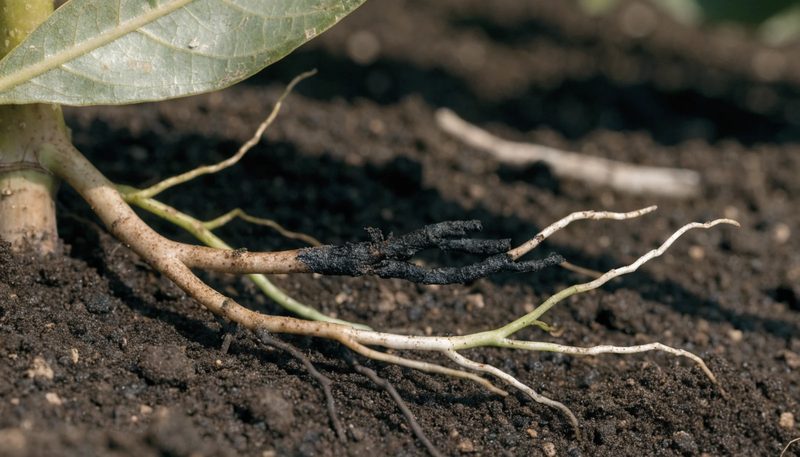
- Blackened, brittle, rotted feeder roots.
What is it?
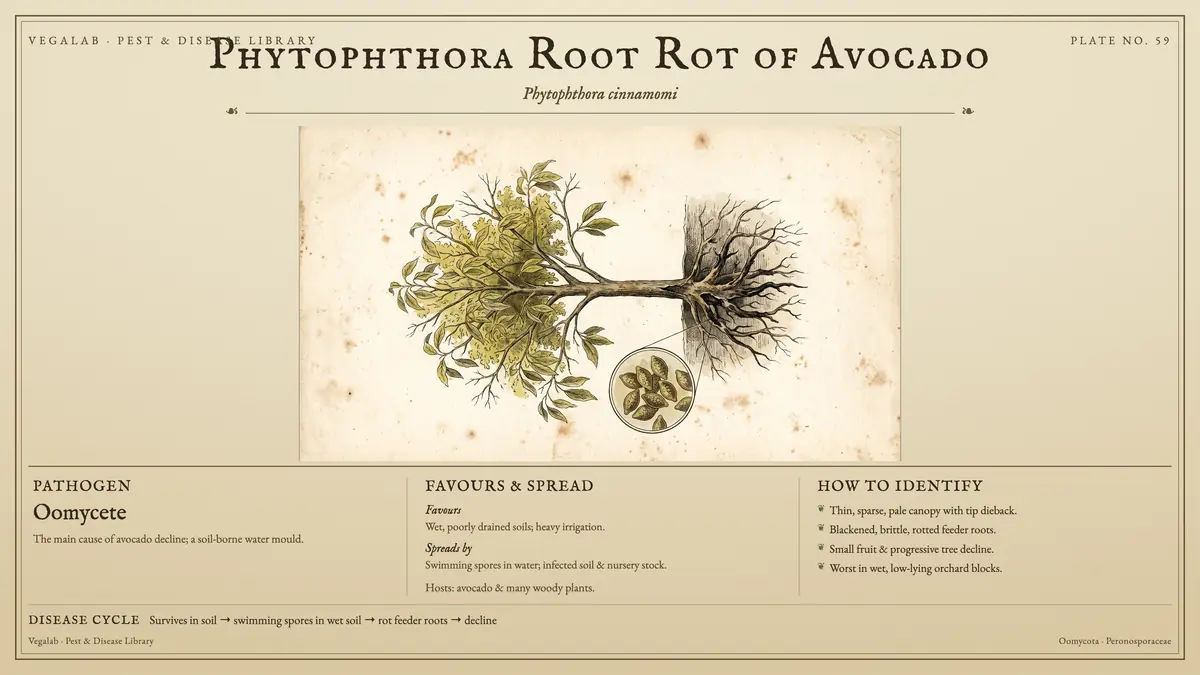
Phytophthora cinnamomi is an oomycete, not a true fungus, and that distinction is not academic - it determines which chemistry can possibly work. Oomycetes have cellulose in their cell walls rather than chitin, and they do not synthesise sterols de novo. Because the DMI and triazole fungicides work by blocking sterol biosynthesis, they are useless here. So are the benzimidazoles and the SDHIs. Only a narrow set of chemistries has activity: phenylamides (FRAC 4), phosphonates (FRAC 33 / P07), CAA fungicides (40), benzamides (43), OSBPI (49) and ethaboxam (22).
The organism has four spore stages, and each one explains a different part of its behaviour. Sporangia form in wet soil and each releases roughly 30 to 40 zoospores. Zoospores swim, and they are not swimming at random - they are chemotactically attracted to root exudates and are steered by the weak electric fields that growing root tips generate, which is why they arrive precisely at the most valuable tissue. Chlamydospores are thick-walled survival structures, and oospores are the sexual survival stage.
The survival stages are why this is a permanent site problem. P. cinnamomi persists in root debris for three to six years, and its host range is enormous - UC IPM cites more than 1,000 hosts, and the invasion-biology literature puts the figure at 3,000 to 5,000. You cannot rotate or fallow your way out of it. A few crops are genuinely resistant and can be used on an infested site: cherimoya, citrus and persimmon among them.
How to identify it
The canopy tells you a tree is in trouble; the roots tell you why. In the canopy, look for small pale leaves with brown necrotic tips, a thin canopy with visibly reduced leaf litter beneath it, dieback starting at the top of the tree, and sunburn on newly exposed limbs. A heavy set of undersized fruit is characteristic - the tree is responding to stress. Wilting on soil that is adequately moist is the observation that should trigger a root inspection immediately, because it separates this disease from ordinary water stress.
Secondary salt burn is a frequently missed clue. Infected roots lose their ability to exclude chloride, so leaf margins burn even where irrigation water quality has not changed. A grower who has had no salinity problem for years and suddenly sees leaf burn should check roots before adjusting the leaching fraction.
Dig feeder roots 10 to 15 cm deep under the drip line. Healthy avocado feeder roots are cream-white, 1 to 2 mm in diameter, flexible, and form a dense fibrous mat. Infected roots are black, brittle and snap when bent rather than flexing, and the cortex sloughs off leaving a bare stele - the "rat-tailing" appearance. In an advanced case the fibrous mat is simply absent.
Soil baiting confirms it. Take soil from three locations within the drip line, below the top inch, flood it, and float a green avocado fruit on the surface for four to five days. A positive result shows firm brown or purplish spots developing at the water line on the fruit within four to eight days.
What to rule out first
Phytophthora trunk canker, caused by P. mengei, is the closest relative and the most consequential confusion, because the management differs. In trunk canker the feeder roots are still present and healthy and leaves are normal-sized; the diagnostic is a red resin exudate over an orange-tan lesion on the trunk, often with a fruity odour. Root rot with a healthy feeder root mat is not root rot.
Avocado black streak has no known cause and is associated with water and salt stress. It produces a brownish exudate that dries to a white powder - a different exudate character from the red resin of trunk canker.
Verticillium wilt has one very reliable sign: dead leaves stay attached to the branch for months rather than dropping. Cut the wood and look for brown-grey xylem streaking. Critically, Verticillium-affected avocado trees often recover completely, which is not true of root rot, so the diagnosis changes what you tell the grower to expect.
Salinity produces marginal leaf burn with a uniform field gradient and healthy roots. Waterlogging produces mushy, sour-smelling roots and a collapse that follows a discrete event such as a flood or an irrigation failure, rather than a slow decline. Armillaria root rot shows white mycelial fans under the bark at the crown - look for them before concluding Phytophthora.
Life cycle & spread
The cycle runs on free water. Saturated soil triggers sporangium formation; sporangia release zoospores; zoospores swim through water-filled pores to root tips, encyst, and infect. Each infected root then produces more sporangia when the soil is next saturated. Every irrigation that leaves the soil saturated for an extended period is a reproductive event for the pathogen.
Between wet periods the organism persists as chlamydospores and oospores in root debris, for three to six years. This is why removing a declining tree does not clean the site, and why replanting into the same hole without changing the water regime and the rootstock reproduces the outcome.
Movement onto a clean orchard is almost always human. Infested nursery stock is the classic route, which is why certification schemes exist - the ANVAS scheme run by Avocados Australia, established in 1977–78 and revised in 2018, and the voluntary CDFA Avocado Certification Program under California Code of Regulations sections 3030 to 3033. There is no "ANSI" avocado certification scheme, despite the term appearing in some secondary sources. Beyond nursery stock, the pathogen moves on soil carried by machinery, boots and tools, and in surface water and runoff, which is why the low corner of a block is so often where decline starts.
Conditions that favour it
Excess soil water is the dominant driver - poor drainage, heavy or compacted soil, over-irrigation, low spots, and hardpans that perch water in the root zone. Site selection is the first spoke of the Pegg wheel for exactly this reason.
High soil pH favours the disease. This has a direct practical consequence for how calcium is supplied, covered below.
Low soil biological activity favours it. Soils with high organic matter and active microbial populations suppress the pathogen measurably, which is why organic amendment is a disease-control input in avocado rather than a fertility one.
Susceptible rootstocks are a condition too, in the sense that they determine how much of the above the tree can tolerate. Trees on a rating-5 rootstock in wet soil still decline; trees on a rating-0 rootstock decline in soil that a tolerant tree would survive.
Damage and how it spreads
The damage is a progressive loss of feeder root surface area. Because avocado has no root hairs and depends entirely on a dense fibrous mat of fine roots, the loss translates directly into water stress, nutrient deficiency and the chloride exclusion failure described above. The tree defoliates from the top, sets a heavy crop of small fruit as a stress response, and declines over several seasons.
Yield falls long before the tree looks dramatic. A tree at the early stages of canopy decline is already producing well below potential, which is why the canopy rating scales are used to trigger action rather than to record it. The Ciba-Geigy scale is the standard: it is a 0–10 canopy decline rating, though 0–8 and simplified four-level variants also circulate - always state which scale a rating refers to, because a "4" means different things on different scales.
Within an orchard, spread follows water. Decline moves downslope, along irrigation lines, and outward from low or poorly drained spots. Tree-to-tree spread through root contact occurs but is slower than the water-borne route.
Monitoring & scouting
Rate canopies on a defined scale at a consistent time each year, and record which scale you used. Mapping the ratings shows whether decline is following a drainage pattern, which is diagnostic in itself.
Assess feeder roots directly. Dig at 10 to 15 cm under the drip line on a sample of trees, including trees that look healthy, because feeder root loss precedes canopy symptoms.
Use green-fruit baiting to confirm presence before committing to a program. Soil from three locations within the drip line, taken below the top inch, flooded for four to five days, with a positive read as firm brown or purplish spots at the water line within four to eight days.
Where a phosphite program is in place, measure root phosphite concentration - that is the key performance indicator, not the amount applied. More than 25 mg/kg in roots is the widely cited minimum. A 2023 revision to the Australian best practice resource proposed 80 ppm or above as the optimum, but the AV19005 field trials never exceeded 75 ppm, so both figures are presented here and the higher one should be treated as a target rather than an established achievable level.
How to control it
The framework is the Pegg wheel - developed by Ken Pegg at the Queensland Department of Primary Industries in the 1980s, with the canonical current statement given by Wolstenholme in 2010. Its six spokes are site selection, resistant rootstocks, organic amendments, inorganic nutrition, irrigation management and chemical control. No spoke works alone, and a program missing any of them tends to fail.
Rootstocks first, because they are the decision you cannot revisit. Ratings below are UC IPM's 0–5 scale for P. cinnamomi tolerance. Always use clonal rootstocks, never seedlings, since seedling populations do not carry the tolerance reliably. And note the standing caveat: resistant rootstocks are not immune. They buy tolerance, not exemption from the rest of the program.
Water management is the spoke growers control most directly. Irrigate to avoid saturation rather than to a fixed schedule, fix drainage before planting, and treat every prolonged saturation event as a reproductive event for the pathogen.
On calcium: use gypsum, not lime. Calcium ions suppress sporangium formation and act as a mild fungicidal agent, but high pH favours the disease - so liming to supply calcium would work against you. Gypsum supplies calcium pH-neutrally. Cited rates vary with the source and the units: approximately 25 lb per medium tree (UC IPM), 1,500 to 3,000 kg/ha (UC ANR), or approximately 0.5 t/ha/yr or 7 g/m² per month (Pegg).
Mulch is a disease-control input in this crop, not a moisture-conservation nicety. Coarse hardwood chips or composted greenwaste outperform naturally dropped avocado leaf litter. Depth guidance is 4 to 6 inches (UC IPM) or 15 to 30 cm (UC ANR), with a C:N ratio in the range 25:1 to 100:1, kept several inches clear of the trunk.
Do not fumigate. Soil fumigation is explicitly not recommended for avocado root rot: it destroys the suppressive soil biology along with the target, and root rot returns worse than before.
How to manage Phytophthora root rot of avocado
Phosphite deserves its own explanation because it is so widely misunderstood. Phosphite (H₂PO₃⁻) has one fewer oxygen atom than phosphate and cannot enter plant phosphorus metabolism. The claim that "phosphonate is just a fertiliser" is false. It is ambimobile, moving both up in the xylem and down in the phloem, which is what allows a foliar or trunk application to reach roots. It is fungistatic rather than fungicidal - it suppresses the pathogen, it does not eliminate it - and it works through a dual mode of action, acting directly on the organism and priming the plant's own defences through suppression of MAPK4, an effect active at under 60 mg/kg.
Timing changes the result by roughly threefold, and this is the most actionable fact in the phosphite literature. Trunk injection at spring shoot emergence produced root concentrations of about 9 mg/kg; the same injection at shoot maturity produced about 28 mg/kg. The rule is to apply when approximately three-quarters of the flush is complete - in California that generally means May and August. Injecting into an actively expanding flush sends the material to the shoot, not the root.
Application methods and rates differ by region. Australian practice for trunk injection is 15 mL per metre of canopy diameter at 20% concentration; South African practice is 1 mL of 50% buffered product per m² of drip area, equating to 0.5 g active ingredient per m², applied twice annually. Injection causes a weeping canker at the injection site, so rotate injection sites between applications. For foliar application, Australian practice is 0.5 to 0.6% buffered to pH 7.2 across three to five sprays; South African practice is 0.8 to 1% across four to six.
Two methods that do not work are worth naming explicitly, because growers try both. Soil application and drenching do not sustain root phosphite levels and are described as not effective. Bark spraying does not work for root rot.
Copper timing matters if you use both. Allow 10 days before applying copper after phosphorous acid, and 20 days before applying phosphorous acid after copper.
Mefenoxam (FRAC 4) is a replant and young-tree tool. It gives roughly three months of protection per application and carries a genuine resistance risk, so it belongs in establishment programs rather than as a mature-orchard maintenance product.
Newer actives exist and are potent in vitro - oxathiapiprolin (FRAC 49) has a reported EC₅₀ of 0.0002 to 0.0007 µg/mL, alongside fluopicolide (43), mandipropamid (40) and ethaboxam (22). Registration status for avocado is sourced here from a research presentation rather than from a regulatory document, so confirm registration in your jurisdiction before naming any of them in a program.
Why the rootstock decision outranks everything else
Every other spoke of the Pegg wheel is adjustable. You can change irrigation next week, add mulch this month, start gypsum this season and begin phosphite at the next flush maturity. The rootstock is fixed for the life of the orchard, and it sets the ceiling on how much benefit the adjustable spokes can deliver.
The ratings also carry a trap: tolerance to P. cinnamomi and tolerance to salinity are separate traits and do not travel together. Zentmyer (PP4) rates 5 for root rot but only 1 for salinity. Thomas rates 4.5 for root rot and 1 for salinity. Latas rates 4.5 for root rot and 5 for salinity. Toro Canyon rates only 2.5 for P. cinnamomi but 5 for P. mengei - so a block chosen for trunk canker resistance may be poorly chosen for root rot. Picking on a single number produces predictable failures.
Two naming points cause real confusion in ordering. Latas is Merensky 1 and Dusa is Merensky 2 - these are commonly stated backwards. Leola is Merensky 6 and Zerala is Merensky 5, both released in 2020, with breeder tolerance claims that remain unverified in independent trials.
Duke 7 deserves a specific note because it is still requested by name. It rates only 3 on the UC IPM scale and is a historical choice rather than current best practice; Dusa has become the global default at a rating of 5. If a grower asks for Duke 7 out of familiarity, that is worth a conversation before the order is placed.
Rootstock tolerance to Phytophthora cinnamomi (UC IPM 0–5 scale)
| Rootstock | P. cinnamomi rating | Notes |
|---|---|---|
| Dusa (Merensky 2) | 5 | The global default choice |
| Uzi (PP15) | 5 | Clonal; high tolerance |
| Zentmyer (PP4) | 5 | Salinity tolerance only 1 · poor choice on saline sites |
| Martin Grande | 5 | High tolerance |
| Latas (Merensky 1) | 4.5 | Salinity tolerance 5 · the pick where salinity is also a problem |
| Thomas | 4.5 | Salinity tolerance 1 |
| Barr Duke | 3.5 | Moderate |
| Duke 9 | 3.5 | Moderate |
| Duke 7 | 3 | Historical choice, not current best practice |
| Toro Canyon | 2.5 | Rates 5 against P. mengei - chosen for trunk canker, weak for root rot |
| G-6 | 2 | Low tolerance |
| Borchard | 0.5 | Very low |
| Topa Topa | 0 | No tolerance |
Recommended Vegalab solution: Root Boost
Integrated management. Phytophthora root rot is a soil-borne, no-cure problem - Vegalab products play a supporting role in an integrated program (plant health, root-zone support, soil biology) and are not a control or a cure for this disease. The foundation is the Pegg wheel: site and drainage selection, a clonal tolerant rootstock, organic amendment and mulch, calcium supplied as gypsum rather than lime, irrigation that avoids saturation, and a properly timed phosphite program. The items below support root-zone condition and soil biological activity alongside that framework.
| Role | Product | Use |
|---|---|---|
| Roots | Root Boost | Root-zone support to rebuild fine feeder roots |
| Soil biology | Charge BioBoost | Root-zone support to build suppressive soil biology |
| Calcium correction | Calcium Boost | Calcium nutrition alongside a gypsum program |
| Plant resilience | Armour Boost | Silica for resilient tissue |
Preventing it next season
Prevention in this disease is mostly about decisions made before planting, because the pathogen persists in root debris for three to six years and has a host range measured in thousands of species - you cannot rotate or fallow it out. Choose the site for drainage and fix drainage problems before trees go in, not after. Buy certified nursery stock: ANVAS in Australia or the CDFA Avocado Certification Program in California, and always clonal rootstocks rather than seedlings. Choose the rootstock on both root rot tolerance and salinity tolerance, since the two traits do not travel together. Establish mulch and organic amendment early, since suppressive soil biology takes time to build. Set irrigation to avoid saturation rather than to a calendar. Supply calcium as gypsum rather than lime, because high pH favours the disease. And keep the pathogen out: it moves on soil carried by machinery, boots and tools, and in surface water and runoff, so restrict traffic from known infested blocks and think about which way water runs across your orchard.
Claims and product availability vary by jurisdiction. Always read and follow the product label.