

Root Boost
Root Boost builds root mass and fine-root development and speeds transplant recovery. Indole-3-butyric acid with calcium nitrate and seaweed extract stimulates rooting and helps young plants establish faster.
Root development accelerant · Root accelerator, Auxin-supporting.
- Zero REINo re-entry wait
- Zero PHIHarvest the same day
Root development accelerant from Vegalab Crop Science, powered by indole-3-butyric acid (IBA) · calcium nitrate · Sargassum seaweed extract. Root Boost targets Root mass, fine-root development, transplant recovery.
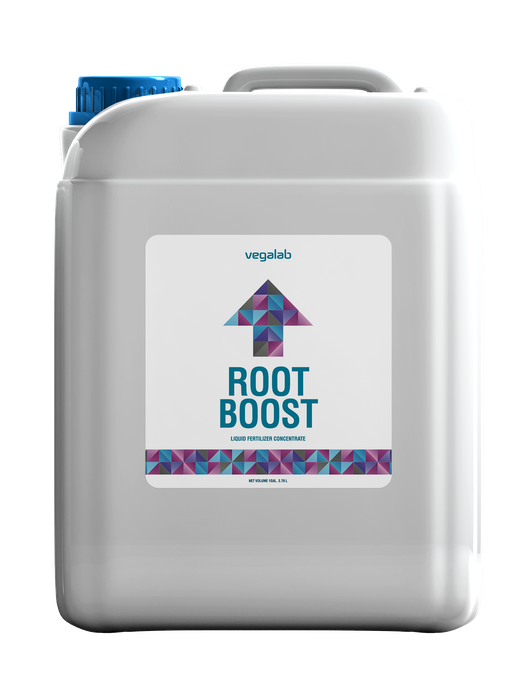
Indole-3-butyric acid, a root-promoting auxin, applied with calcium nitrate and Sargassum seaweed extract at the root zone. IBA drives root initiation and lateral branching directly; the calcium supports cell-wall development in the new roots. Plants establish quickly after transplant and develop a denser, deeper root architecture.
| Active | Indole-3-butyric acid (IBA) · calcium nitrate · Sargassum seaweed extract |
|---|---|
| Targets | Root mass, fine-root development, transplant recovery |
| Dilution rate | 1:1,000–1:800 · 1–1.25 mL/L (3.8–4.7 mL/gal) · 0.75–2.0 L/ha (10.4–27.7 fl oz/acre) |
| Application | Soil drench at planting and during early vegetative growth |
| Line · Category | Boost · Root development fertilizer |
- Accelerates root initiation
- Promotes lateral root branching
- Improves transplant establishment
- Increases root biomass
| Nutrient | Content |
|---|---|
| Total Nitrogen (N) | 2.00% |
| Calcium (Ca) | 1.50% |
| Boron (B) | 0.02% |
| Iron (Fe) | 0.10% |
| Molybdenum (Mo) | 0.025% |
| Zinc (Zn) | 0.10% |
Derived from: Calcium nitrate · Indole-3-butyric acid · Sargassum seaweed extract
Contains: Citric acid · Chelated iron (EDTA)
Why invest in roots at transplant?
The first weeks after transplanting set up the whole crop. A plant that quickly builds a strong, branching root system establishes faster, takes up more water and nutrition, and is far more resilient to early stress. Slow rooters stall, suffer transplant shock and never quite catch up - so supporting rooting early pays off across the season.
How does Root Boost drive rooting?
Root Boost (2-0-0; N 2.00%, Ca 1.50%) combines indole-3-butyric acid, calcium nitrate and Sargassum seaweed extract. IBA is a root-promoting auxin and initiates roots directly, the calcium supports cell-wall development in the new roots, and seaweed compounds support stress recovery - together building root mass, fine-root development and faster transplant establishment.
When and how should it be applied?
- Transplant and early establishmentEstablishment
- Early growthVegetative
- Pre-flower
- Flowering
- Fruit set
- Fruit development
- Ripening
- Harvest
Apply during Establishment and Vegetative.
- Method
- Soil or root zone
- Rate
- 1:1,000–1:800 · 1–1.25 mL/L · 0.75–2.0 L/ha1:1,000–1:800 · 3.8–4.7 mL/gal · 10.4–27.7 fl oz/acre · Work out your rate
- Frequency
- Repeat through early growth
- Pre-harvest interval
- Zero - harvest the same day
- Re-entry interval
- Zero - no re-entry wait
Always read and follow the applicable product label.
Apply to the soil or root zone at transplanting and through early establishment - the window where root stimulation translates most directly into a stronger, more resilient plant. Repeat through early growth to sustain fine-root development as the crop establishes.
Which crops is it for?
Root Boost has been tested on all transplants, tree fruit, vines and berries. It is most valuable for any transplanted crop and for young plantings of perennials, where establishment speed and root capacity shape the years that follow.
What does calcium nitrate add?
Calcium supports cell-wall development in the new roots, so the roots the plant builds are better formed and can work more effectively. Combined with the rooting stimulus of Indole-3-butyric acid and the stress support of seaweed, it helps the whole root-soil system establish well.
Need a recommendation for your crop or pest?
Contact usCrop-specific solutions using this product
- Root-knot nematode on cucumbers
- Root growth & uptake
- Transplant establishment
- Soil health & tired soil
- Damping-off on tomatoes
- Yield
- Lesion nematode on tree fruit
- Root-knot nematode on tomatoes
- Root-knot nematode on peppers
- Root-knot nematode on strawberries
- Root-knot nematode on cannabis & hemp
- Root-knot nematode on turf & ornamentals
Frequently asked questions
What is the application rate for Root Boost?
1:1,000–1:800 · 1–1.25 mL/L (3.8–4.7 mL/gal) · 0.75–2.0 L/ha (10.4–27.7 fl oz/acre) Application: Soil drench at planting and during early vegetative growth.
Is Root Boost suitable for natural or organic programs?
Root Boost supplies Indole-3-butyric acid (IBA) · calcium nitrate · Sargassum seaweed extract in a formulation designed to fit low-residue and IPM programs.
What does Root Boost do?
Builds root mass and fine-root development and speeds transplant recovery.
What's in it?
Indole-3-butyric acid, calcium nitrate and Sargassum seaweed extract.
When should I apply it?
At transplanting and through early establishment.
Which crops is it for?
All transplants, tree fruit, vines and berries.
What does calcium nitrate do?
It improves nutrient availability, structure and moisture around the root zone so roots work more effectively.
Problems addressed
Supports the root zone where these problems establish. Reference links only - see the label for approved uses.
Pest & disease library
See all plant pests & diseases →
Reference links to identification and management guides. Claims and product availability vary by jurisdiction - always read and follow the product label.
Last updated: