


Crops affected
What is it?
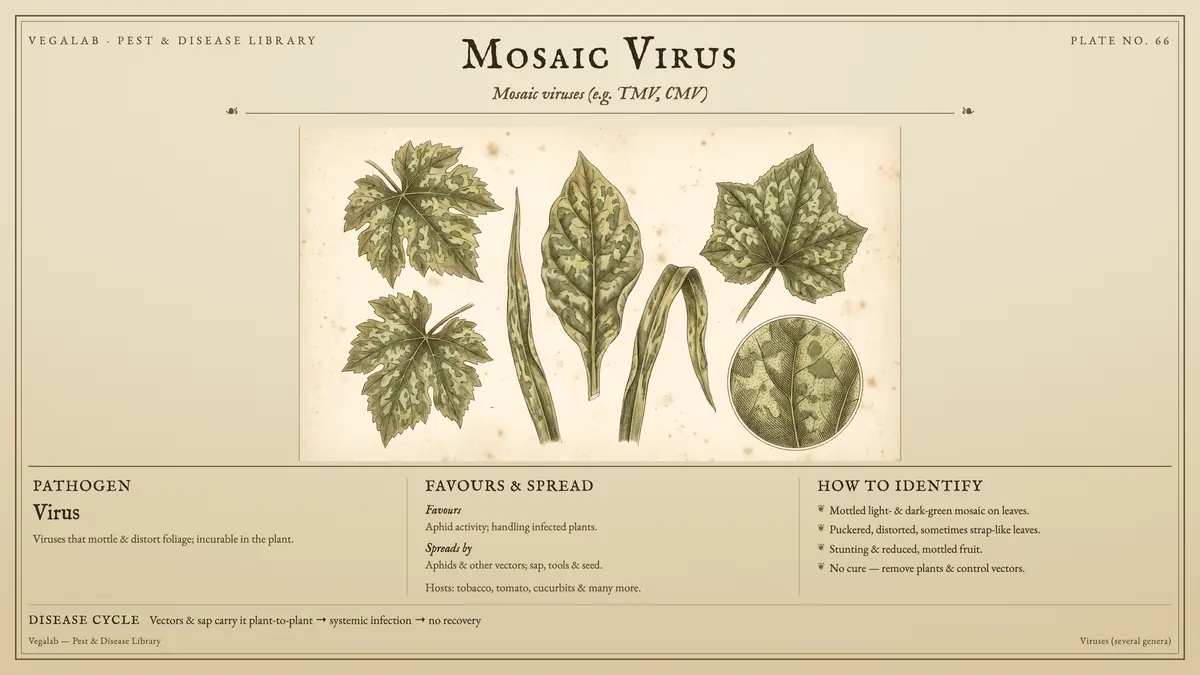
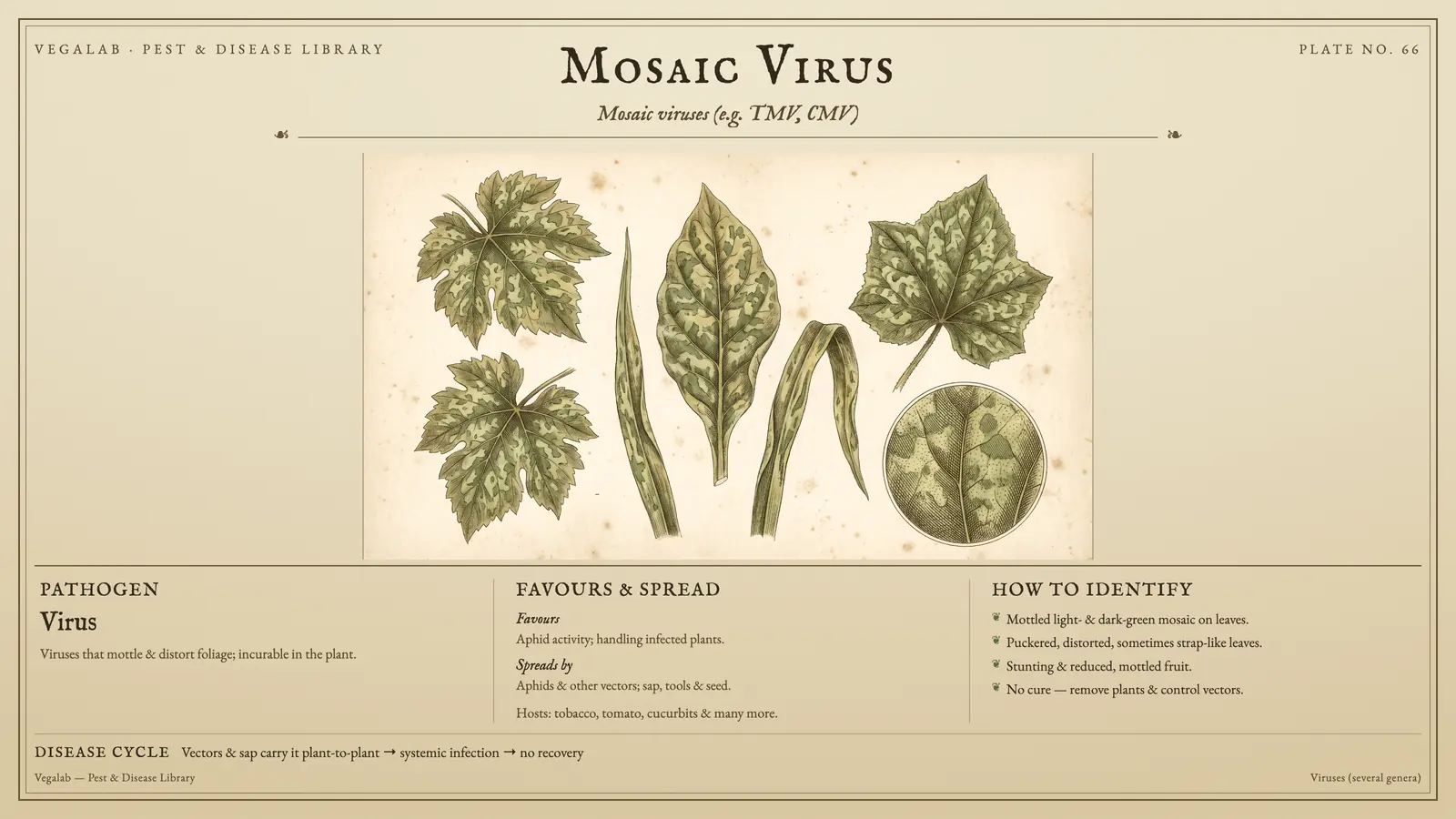
Mosaic viruses are a group of plant viruses (such as tobacco mosaic and cucumber mosaic) that infect plant cells and disrupt normal growth. They spread mainly through insect vectors - especially aphids and thrips · and also via infected seed, tools, hands, and plant-to-plant contact. Once a plant is infected, it stays infected for life.
How to identify it
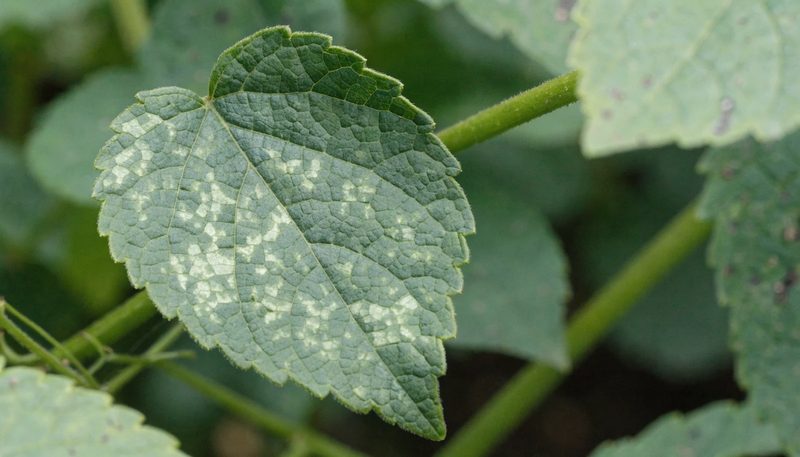
- Mottled mosaic pattern of light and dark green or yellow on leaves
- Distorted, puckered, curled, or stunted new growth
- Reduced yield and mottled, misshapen fruit
- Spread radiating from initial infected plants, often following aphid or thrips activity
Life cycle & spread
Viruses have no life cycle of their own in the sense a fungus or insect does - they cannot grow, move or reproduce outside a living cell. Every stage depends on the host or a vector, which is why the management logic is completely different from every other entry in this library.
Once inside a cell, the virus replicates using the plant's own machinery, moves cell to cell through plasmodesmata, and then travels systemically through the phloem to the growing points. Within days to a few weeks the whole plant is infected, including tissue showing no symptoms. **The infection is permanent - there is no cure, and no product will clear a virus from an infected plant.**
Transmission is the only stage you can intervene at. Tobacco mosaic virus is exceptionally stable and spreads mechanically - on hands, tools, clothing, and by leaf-to-leaf contact - and survives for months or years in dried debris and on surfaces. Cucumber mosaic virus is aphid-transmitted in seconds of probing. Several mosaic viruses are also seed-borne, and many are carried in vegetative propagation material.
Conditions that favour it
Risk is driven by the transmission route rather than by weather. For mechanically transmitted viruses like TMV and ToMV, the drivers are handling frequency, tool hygiene, workers who smoke or handle tobacco, and dense plantings where leaves touch - high-touch crops such as staked and pruned tomatoes are the highest risk.
For vector-transmitted mosaics, the drivers are aphid and thrips pressure, nearby infected crops or weed reservoirs, and season timing of vector flights. Warm conditions that favour vector activity indirectly raise risk. Infected seed or propagation material introduces the virus regardless of any field condition.
Damage and how it spreads
Mosaic viruses reduce vigor, yield, and fruit quality and cannot be cured, so an infected plant remains a source of infection for the rest of the crop. Because spread is driven by insect vectors and handling, the practical priorities are removing infected plants and controlling the aphids and thrips that move the virus around.
Monitoring & scouting
Inspect the youngest growth, where symptoms are clearest: mottled light and dark green mosaic patterning, leaf distortion, blistering, narrowing or fern-leaf, stunting, and uneven fruit ripening or internal browning.
Map affected plants rather than just counting them. Scattered random plants suggest vector transmission from outside; plants in a line along a row strongly suggests mechanical spread on hands and tools during work.
Rule out the mimics before concluding virus - herbicide drift, nutrient deficiency and genetic variegation all produce mottling. Where the decision has commercial consequences, laboratory confirmation by ELISA or PCR is inexpensive relative to the cost of acting wrongly.
How to control it
- Remove and destroy infected plants promptly to cut the source of spread.
- Control insect vectors (aphids, thrips) that transmit the virus.
- Sanitize hands and tools, and avoid handling healthy plants after infected ones.
- Use virus-free seed and resistant varieties, and manage weeds that host the virus.
How to manage mosaic virus
- Rogue infected plants early. Remove and destroy them as soon as they are identified, and bag them rather than carrying them through the crop. One infected plant is a reservoir that every subsequent worker pass can spread.
- Wash hands and disinfect tools between plants in high-touch crops. TMV survives on surfaces and is spread by the routine work of pruning, tying and harvesting - this single habit prevents more mosaic spread than anything else in tomato production.
- Ban tobacco in the crop. TMV is present in cured tobacco products and transfers from a worker's hands to plants. This is a real and well-documented route, not folklore.
- Use certified virus-free seed and propagation material, and resistant varieties where they exist - resistance is available for several of the important mosaics and is the most reliable protection there is.
- Control the vector, but understand the limit. For aphid-borne non-persistent mosaics, insecticides do not prevent transmission because it happens within seconds of probing. Exclusion - screening, covers, reflective mulches - and removing weed reservoirs work better.
- Work clean plants first. Order operations so that healthy blocks are handled before suspect ones, never the reverse.
- Sanitise between crops. Remove all debris, and disinfect structures, benches, stakes and tools. TMV persists in dried debris for a long time.
- Support the plant. A vigorous infected plant may still yield something; nutrition and root-zone support help it tolerate infection but do not reduce the virus.
This is the entry where being blunt serves the reader best: there is no treatment for a virus-infected plant. No spray, biological, nutrient or amendment will cure it. Everything below is about preventing transmission and limiting spread from plants that are already infected - and the most important action is usually removal.
No field-applied product eradicates a systemic plant-virus infection from a living crop plant. Management relies on prevention, clean or resistant planting material, vector and reservoir control, rogueing, and sanitation. Heat or meristem therapy can clean propagation material in specialized programs; it is not a field cure.
Mosaic virus or something that looks like it?
- Mosaic virus: irregular light/dark green mottling that does not respect leaf veins, usually with distortion, blistering or narrowing of the leaf, and worst on the youngest growth. Symptoms often vary with temperature and can appear to fade in heat.
- Nutrient deficiency: patterns that follow the veins - interveinal chlorosis for magnesium and iron - and progress predictably from older or younger leaves depending on element mobility. No distortion of leaf shape.
- Herbicide drift: distortion and cupping affecting the whole plant or one side of a block uniformly, often with a clear gradient from a field edge. Growth-regulator herbicides produce strapped, twisted growth without mosaic mottling.
- Spider mite or thrips feeding: fine stippling and bronzing rather than green mottling; the pests are findable on inspection.
- Genetic variegation: stable, symmetrical, present from the start and identical on every plant of that variety.
Mottled leaves are produced by several non-viral causes, and misdiagnosis is costly in both directions - either destroying healthy plants or leaving a reservoir in place.
See Magnesium Deficiency and Micronutrient Deficiency. Vein-bounded pattern means nutrition; vein-crossing mottle plus distortion means virus.
The main mosaic viruses and how each arrives
- Tobacco mosaic virus (TMV) · extremely stable; mechanical spread on hands, tools and debris; tomato, pepper, tobacco, ornamentals
- Tomato mosaic virus (ToMV) · closely related, also mechanically transmitted and seed-borne
- Cucumber mosaic virus (CMV) · one of the widest host ranges of any plant virus; aphid-transmitted non-persistently, so vector control does not stop it
- Cassava mosaic viruses · whitefly-transmitted; among the most economically damaging plant diseases in Africa
- Bean common mosaic virus · seed-borne and aphid-transmitted; clean seed is the primary control
- Zucchini yellow mosaic virus · aphid-transmitted; severe fruit distortion in cucurbits
The transmission route dictates the entire strategy: mechanical viruses call for hygiene, vector-borne ones for exclusion, seed-borne ones for certified material. Identifying which you have is the first decision, not an academic detail.
Recommended Vegalab solution: Spider Mite Control
There is no product that cures a plant virus, so honesty matters here: the goal is to stop spread. Vegalab Spider Mite Control helps by controlling the aphids and thrips that transmit mosaic viruses, and MultiMite Control broadens vector coverage. Combine vector control with prompt removal of infected plants, strict sanitation, and resistant varieties. Supporting overall plant resilience with Armour Boost helps healthy plants withstand pressure.
| Role | Product | Use |
|---|---|---|
| Primary control | Spider Mite Control | Contact miticide / insecticide |
| Companion / broader pressure | MultiMite Control | Broader mixed mite & insect pressure |
| Plant support | Armour Boost | Silica for tissue resilience |
Preventing it next season
Use virus-free seed and resistant varieties, control aphids and thrips, sanitize hands and tools, manage weed hosts, and rogue out infected plants early. Strong, resilient plants cope better - support them with Armour Boost.
Claims and product availability vary by jurisdiction. Always read and follow the product label.