

Last updated:
Phosphorus deficiency shows first on older, lower leaves as stunted, dark green growth with a purple or reddish tint, often strongest on the undersides and veins.1,4 In tomatoes the most common cause is cold soil, which slows phosphorus uptake even where soil levels are adequate, so confirm with a soil or tissue test before adding fertilizer.1,2,5
What does phosphorus deficiency look like?
Phosphorus (P) is mobile inside the plant: when supply runs short, the plant moves it from older tissue to new growth, so deficiency symptoms appear first on older, lower leaves.5 Deficient plants are smaller and grow more slowly, and in corn they are dark green with reddish-purple leaf tips and margins on older leaves while newly emerging leaves show no color.4 In soybeans, stunted plants with dark green, purple or bluish leaves appear first on the lower leaves, and root development may be limited.5
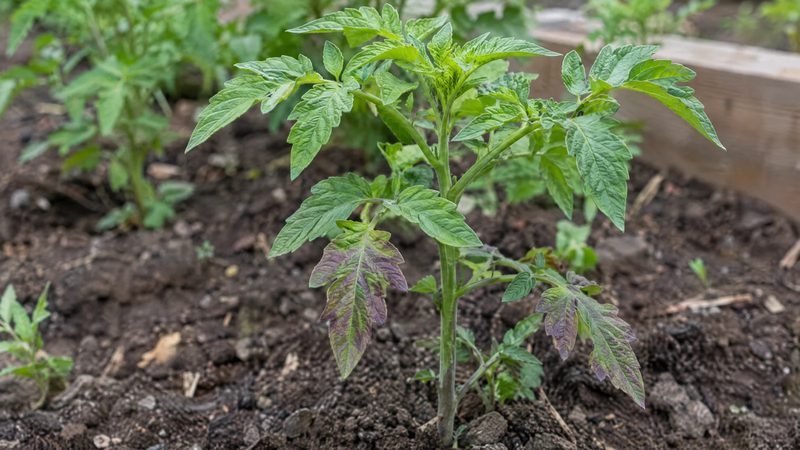
In tomatoes, lower leaves and stems turn dark green or purple-red, often more on the undersides and veins, alongside reduced root growth, delayed flowering and premature bud drop.1 In severe cases the whole plant can take on a purple hue, and deficient plants lose vigor and yield poorly.2 A review of nutrient-stressed leaves describes the typical sequence: stems, petioles, leaf bases and veins redden or purple first, and unlike nitrogen deficiency, phosphorus starvation often raises chlorophyll density, so leaves look dark bluish-green rather than yellow.7
In North America phosphorus deficiency symptoms are most frequent in spring, and in winter, when soils are cool, and tomatoes do best planted once soil is above 60°F3. In the Southern Hemisphere the same cool-soil risk falls from about June to October.
Why do phosphorus-deficient leaves turn purple?
The purple comes from anthocyanins, red to purple pigments that accumulate in the leaves.1,7 In a classic study, phosphorus deficiency raised anthocyanin content in tomato plants in every experiment, regardless of variety or growing conditions, to about five times the normal level on average, and growth was inhibited by 18%.6 Anthocyanin formation in that study was limited by temperature, with none synthesized above 30°C (86°F), and light intensity also influenced the results.6
Purple is a signal, not a diagnosis. A 2023 review in New Phytologist notes that the belief that only nitrogen or phosphorus deficiency causes leaf purpling has led to overuse of fertilizers, and that several other nutritional imbalances, including magnesium and sulfur deficiency, also trigger anthocyanin buildup.7 Some corn hybrids even show purple color early in the season when phosphorus is adequate, while others show none when phosphorus severely limits yield.4
Why are my tomato leaves turning purple?
Most often because the soil is too cold. Tomato roots in cold soil, in the field or the greenhouse, take up phosphorus poorly, and Texas A&M AgriLife states that purpling is most likely a result of cool root zone temperatures rather than poor fertility.2 University of Georgia guidance notes that phosphorus becomes less available when soil temperature is below 60°F, that deficiency occurs most often in spring and winter when soils are cool, and that tomatoes planted into soil below 60°F have a range of problems.3 Transplant shock, from a large temperature change, can also turn tomato leaves purple.1
True phosphorus shortage is more likely in hydroponic systems, containers and some sandy soils.2 For early field plantings, plastic mulch warms the root zone and alleviates the problem; in greenhouses and pots, a balanced liquid feed does.2
| Likely cause | What points to it | Next step |
|---|---|---|
| Cold root zone | Early-season plantings, soil below 60°F | Warm the soil, for example with plastic mulch; plant after soil warms |
| Transplant shock | Large temperature change after planting out | Rule out before fertilizing |
| True phosphorus deficiency | Containers, hydroponics, sandy soil, soil pH too high or too low | Soil or tissue test, then correct pH and phosphorus |
| Magnesium deficiency | Yellowing between veins of older leaves, purpling from the margins | Soil or tissue test |
What causes phosphorus deficiency in soil?
Low soil phosphorus is only one cause. Deficiency is favored by cold soils that are too wet or too dry, phosphorus placed where roots cannot reach it, root growth restricted by compaction, and roots injured by insects, herbicides, fertilizers or cultivation.4 It is likely in low-pH soils, where phosphorus is less available, and young plants in cold, wet soils can show temporary deficiency even when a soil test shows adequate phosphorus.5 Soil pH that is either too high or too low can limit phosphorus.3
Many cultivated soils carry more phosphorus than plants need. In North Carolina, native soils are low in phosphorus, but after decades of fertilizer use it is rare to find agricultural soils that test low.5 Auburn University soil-test records show that more than 40 percent of Alabama garden soils have very high or excessive phosphorus, built up by years of complete fertilizers, manures and composts, because phosphorus does not leach out the way nitrogen and potassium do.8
How do you fix phosphorus deficiency?
Confirm it first. Visual diagnosis has limits: different deficiencies look alike, more than one nutrient can be short at once, species express symptoms differently, and diseases, drought, insects and herbicides can mimic deficiencies, so soil and tissue tests are needed to identify the problem.5 A true phosphorus deficiency is confirmed with a soil or tissue test.1
- If the cause is a cold root zone, the fix is warmer soil rather than more phosphorus, since young plants in cold soil can show deficiency even when the soil holds enough.2,5
- Correct soil pH; for tomatoes, UConn advises a pH of 6.5 to 6.8 for high nutrient availability.1
- Where a test shows low phosphorus, phosphorus fertilizers such as rock phosphate or ammonium phosphate raise levels, but they can take time to break down and show on a follow-up test.1
- Animal manures are typically high in phosphorus, so track how much you add.1
- In field crops, foliar or granular phosphorus applied early in vegetative growth may help the current crop, but the most effective correction is a soil-test-based fertility and liming program for future crops.5
- Follow the product label for any fertilizer rate.
Key takeaways
- Phosphorus is mobile in the plant, so deficiency shows first on older leaves as dark green to purple color and stunting.
- The purple is anthocyanin, and other nutrient imbalances, cold and stress can cause it too.
- In tomatoes, cold soil below about 60°F is the most common cause of purple leaves.
- Confirm with a soil or tissue test before adding phosphorus, since many garden soils already test high.
References
- Tomato: Phosphorous Deficiency
- Phosphorus Deficiency (Tomato Problem Solver)
- Troubleshooting Cultural Problems in Tomatoes (Circular 1089)
- Nutrient Deficiencies and Application Injuries in Field Crops (IPM 42)
- Mid-Season Soybean Phosphorus (P) Deficiency
- Effect of phosphorus deficiency on anthocyanin content in tomato plants
- Why do plants blush when they are hungry?
- Excessive Phosphorus In Garden Soils (excerpt from The Alabama Vegetable Gardener, ANR-0479)