

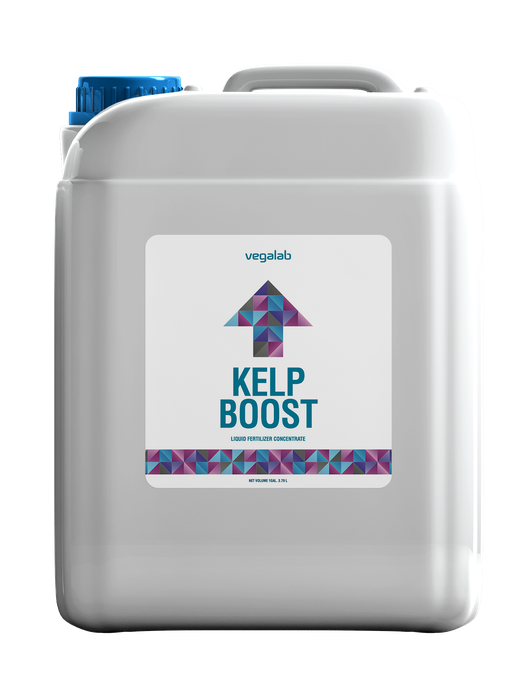
Kelp Boost
Kelp Boost is a microbial food for fast-growing plants that builds root mass and secondary-root growth. L-tryptophan and a blend of seaweed extracts feed soil microbial activity and stimulate root development for stronger establishment.
Microbial food for fast-growing plants - Kelp extract, Natural phytohormones.
- Zero REINo re-entry wait
- Zero PHIHarvest the same day
Microbial food for fast-growing plants from Vegalab Crop Science, powered by L-tryptophan · seaweed extract (Ascophyllum, Sargassum, Laminaria) · citric acid. Kelp Boost targets Root mass, secondary root growth, microbial activity.
Amplified Ascophyllum nodosum extract delivers cytokinins, auxins and other natural growth regulators that drive cell division and stress tolerance. Food for soil microbes; bridges plant and microbial systems.
| Active | L-tryptophan · seaweed extract (Ascophyllum, Sargassum, Laminaria) · citric acid |
|---|---|
| Targets | Root mass, secondary root growth, microbial activity |
| Dilution rate | 1:1,000 · 1 mL/L (3.8 mL/gal) · 5–7 L/ha (66.6–103.3 fl oz/acre) soil |
| Application | Soil irrigation, 3–4 times per cropping season |
| Line · Category | Boost · Seaweed extract fertilizer |
- Stress tolerance under heat and drought
- Microbial food for rhizosphere
- Improved nutrient uptake
- Faster recovery from transplant shock
| Nutrient | Content |
|---|---|
| Soluble Potash (K2O) | 1.00% |
Derived from: Ascophyllum nodosum
Contains: Cytokinins · L-tryptophan (auxin precursor) · Alginic acid
Why does root development matter so much?
Roots determine how much water and nutrition a plant can capture, how well it anchors, and how it copes with stress. A bigger, denser root system - especially fine secondary roots - means a more productive, more resilient crop. Investing in roots early pays back through the rest of the season.
How does Kelp Boost build roots and soil life?
Kelp Boost (0-0-1; K 1%) combines L-tryptophan with seaweed extracts from Ascophyllum, Sargassum and Laminaria. L-tryptophan is a precursor in the plant's auxin pathway that supports root initiation, while the seaweed compounds feed soil microbial activity. Together they drive root mass and secondary-root growth, giving stronger establishment and better nutrient capture.
When and how should it be applied?
- Establishment and active root growthEstablishment
- Active root growthVegetative
- Pre-flower
- Flowering
- Fruit set
- Fruit development
- Ripening
- Harvest
Apply during Establishment and Vegetative.
- Method
- Soil or root zone
- Rate
- 1:1,000 · 1 mL/L · 5–7 L/ha soil1:1,000 · 3.8 mL/gal · 66.6–103.3 fl oz/acre soil · Work out your rate
- Frequency
- Repeat through active root development
- Pre-harvest interval
- Zero - harvest the same day
- Re-entry interval
- Zero - no re-entry wait
Always read and follow the applicable product label.
Apply to the soil or root zone during establishment and active root growth. Pairing it with transplanting and early-season feeding supports a deeper, denser root system from the start. Repeat through periods of active root development for sustained effect.
Which crops is it for?
Kelp Boost has been tested on vegetables, berries, tree fruit and vines - crops where strong establishment and root capacity underpin yield. It is especially useful at transplant and in young plantings where roots are still building.
How does feeding soil microbes help the crop?
Healthy soil microbial activity improves nutrient cycling and root-zone health, so the plant gets more out of the soil around it. By feeding those microbes as well as stimulating roots directly, Kelp Boost supports the whole root-soil system rather than just the plant in isolation.
Need a recommendation for your crop or pest?
Contact usCrop-specific solutions using this product
Frequently asked questions
What is the application rate for Kelp Boost?
1:1,000 · 1 mL/L (3.8 mL/gal) · 5–7 L/ha (66.6–103.3 fl oz/acre) soil Application: Soil irrigation, 3–4 times per cropping season.
Is Kelp Boost suitable for natural or organic programs?
Kelp Boost supplies Indole-3-butyric acid · seaweed extract (Ascophyllum, Sargassum, Laminaria) · citric acid in a formulation designed to fit low-residue and IPM programs.
What does Kelp Boost do?
Builds root mass and secondary-root growth while feeding soil microbial activity.
What's in it?
L-tryptophan with seaweed extracts (Ascophyllum, Sargassum, Laminaria).
When should I apply it?
During establishment and active root growth, including at transplant.
Which crops is it for?
Vegetables, berries, tree fruit and vines.
What is the analysis?
K 1% (NPK 0-0-1).
Problems addressed
Supports the root zone where these problems establish. Reference links only - see the label for approved uses.
Pest & disease library
See all plant pests & diseases →
Reference links to identification and management guides. Claims and product availability vary by jurisdiction - always read and follow the product label.
Last updated: