

Crops affected
How to identify lesion nematode
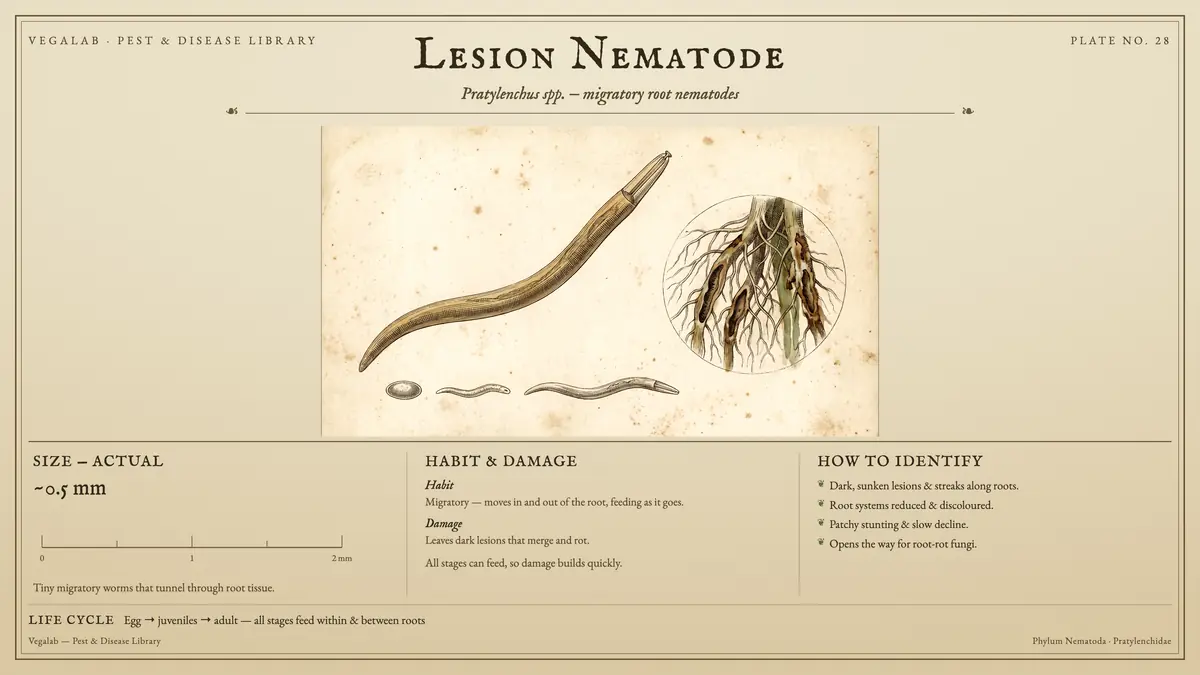
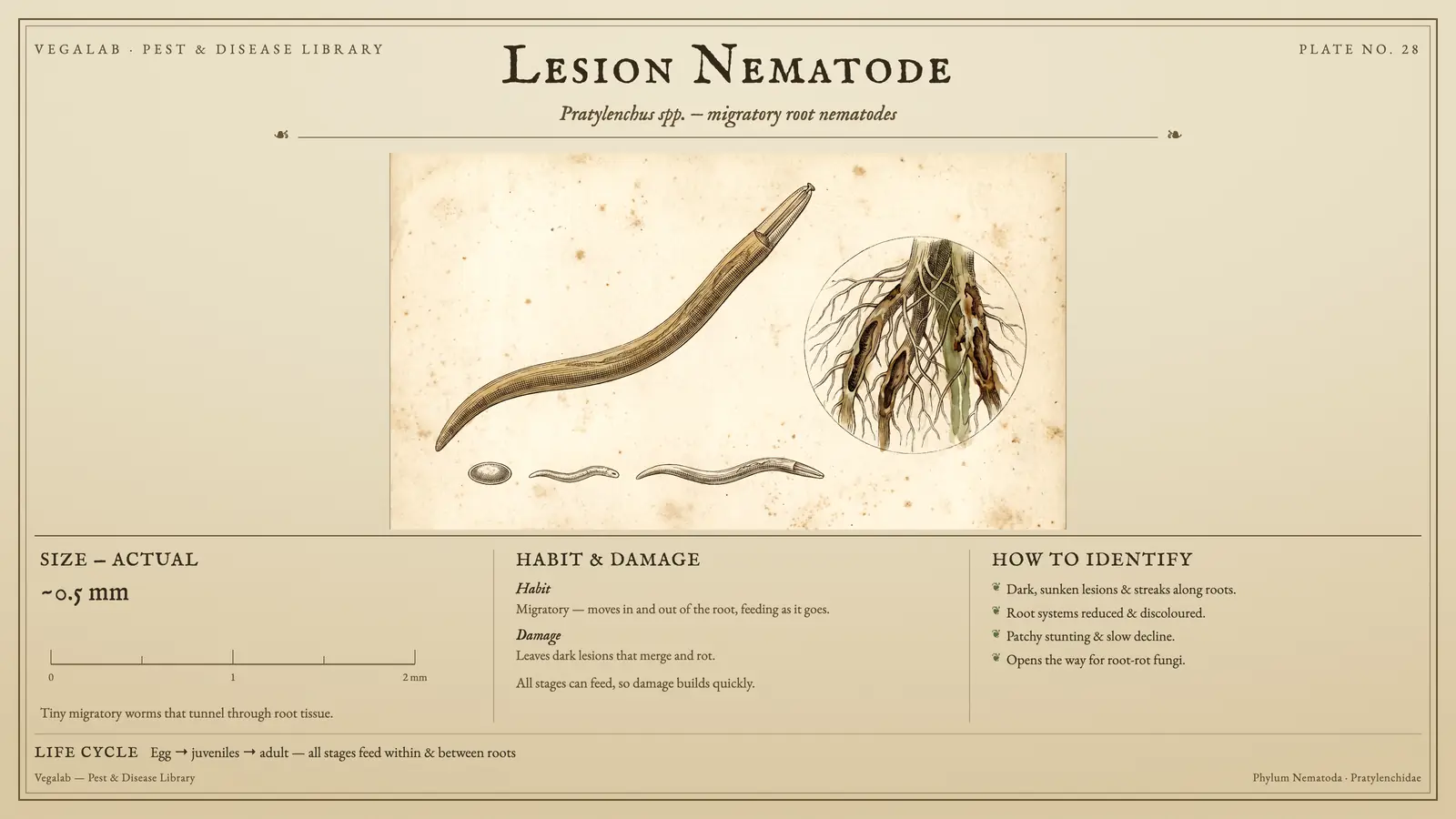
Size. ~0.5 mm Tiny migratory worms that tunnel through root tissue.
- Root systems reduced & discoloured.
What is it?
Lesion nematodes are migratory endoparasites - they move in and out of roots as they feed, destroying root cells along the way. The wounds they create are gateways for fungi and bacteria, so damage is often a nematode-plus-rot complex.
How to identify it
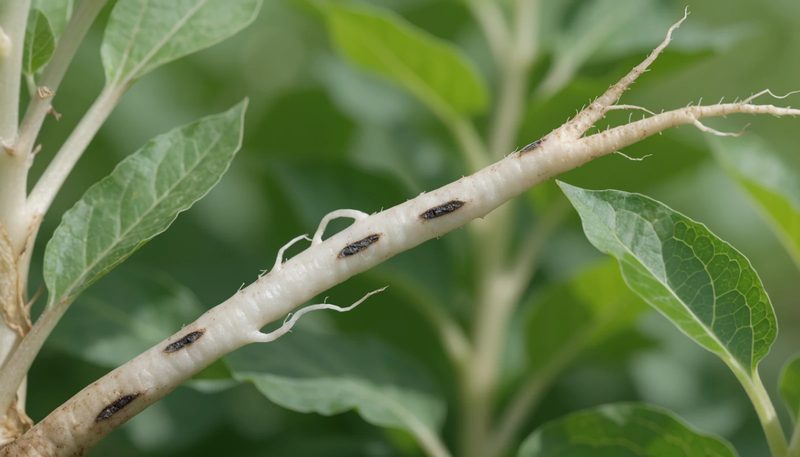
- Dark, elongated root lesions; reduced fine roots
- Patchy decline and stunting
- No galls (distinguishes from root-knot) - confirm by assay
Life cycle & spread
All mobile stages can infect; they migrate through soil and roots, reproduce within the season, and survive in roots and debris between crops. Multiple generations occur in warm conditions.
Conditions that favour it
Continuous susceptible cropping, orchard replant sites, and warm soils favour build-up; cool-season species damage cereals.
Damage and how it spreads
Reduces root mass and function and opens roots to rot pathogens, cutting yield and causing orchard replant failure. The combined nematode-plus-rot effect can be severe.
Monitoring & scouting
Soil/root assays in problem areas; check fine roots for lesions; flag orchard replant sites for at-plant treatment.
How to control it
- Treat at planting, rotate where possible, manage the secondary-rot complex with sanitation and soil health, and support vigorous root regrowth.
How to manage lesion nematode
- Assay the soil before planting. With no above-ground diagnostic and no galls, a pre-plant nematode assay is the only reliable way to know your population. This is particularly important before establishing a perennial crop, where the decision is irreversible.
- Rotate to non-hosts, recognising that Pratylenchus species have wide and differing host ranges - species identification determines which rotation actually works.
- Use resistant or tolerant rootstocks and varieties where available; in tree fruit and vine crops rootstock choice is the main long-term lever.
- Manage the root environment. Because damage is to the fine root system, anything that supports root regeneration - good structure, adequate moisture, balanced nutrition, relieved compaction - reduces the yield impact of a population you cannot remove.
- Use cover crops and green manures with suppressive effects where they fit the system, and avoid cover crops that are good hosts.
- Control weeds, many of which host lesion nematode and sustain populations through a fallow or a non-host crop.
- Sanitise equipment and use clean planting material, since nematodes move in soil on machinery and in transplant root balls.
- Account for the disease complex. Lesion nematode feeding wounds are entry points for Verticillium and other soil pathogens, and the combined damage exceeds either alone.
Pratylenchus species are migratory endoparasites: unlike root-knot nematodes they do not settle permanently in one place, but move through root tissue feeding and destroying cells as they go. That mobility means they produce no galls - which is precisely why they are so frequently missed.
Because there are no galls and no distinctive foliar symptom, lesion nematode is most often diagnosed as 'poor soil', replant problem, or a fertility issue. If a block underperforms without explanation, assay it.
Replant disease and the lesion nematode's role
- Assay before replanting · this is a decision worth data
- Plant off the old row where layout permits, since populations concentrate there
- Use tolerant rootstocks as the primary long-term measure
- Allow a genuine non-host break rather than an immediate replant
- Support root development aggressively in the establishment years
When a perennial crop is removed and the same species replanted on the same site, the new planting frequently performs badly - poor establishment, stunted growth, delayed cropping. This is replant disease, and lesion nematode is one of its principal components.
The mechanism is straightforward once the biology is clear. The previous crop supported a large Pratylenchus population on its root system for years. When it is removed, that population persists in the soil and in root fragments, and the new young tree or vine - with a small root system and no established reserves - meets a nematode pressure calibrated to a mature plant. Its fine roots are destroyed as fast as it produces them.
Lesion nematode rarely acts alone in replant disease: it typically operates alongside other nematodes, soil fungi such as Pythium and Cylindrocarpon, and the physical and chemical legacy of the previous crop. That is why replant problems respond better to a combination of measures than to any single one.
Practically, the options are to assay and know what you are dealing with, to leave a genuine break with a non-host, to use tolerant rootstocks, to plant into a different position rather than the old tree row where the population is concentrated, and to give the young plant every advantage in root development.
See Poor Root Development and Verticillium & Fusarium Wilt, both of which interact with lesion nematode in replant situations.
Lesion nematode or root-knot nematode?
- **Lesion nematode (Pratylenchus): migratory · moves through root tissue; produces no galls**; causes dark sunken lesions and general fine-root destruction; wide host range including cereals and grasses
- **Root-knot nematode (Meloidogyne): sedentary** · settles permanently and induces galls; the swellings are diagnostic and cannot be rubbed off; host range excludes most cereals for common species
- Diagnostic consequence: root-knot can be diagnosed by washing roots and looking; lesion nematode usually cannot, and needs a laboratory assay
- Rotation consequence: cereals are a useful break against common root-knot species but are often good hosts for lesion nematode, so the same rotation can succeed against one and fail against the other
See Root-Knot Nematodes and Soil Nematodes. This distinction is the most consequential one in nematode management because it changes the rotation.
Recommended Vegalab solution: Nematode Control
Vegalab Nematode Control · Root-zone Nematode Control on the label interval; sustained programs and sanitation matter because lesion nematodes move in and out of roots.
Observed results: identified among the harmful species suppressed under Nematode Control programs in grape trials.
| Role | Product | Use |
|---|---|---|
| Primary control | Nematode Control | |
| Also apply | Root Boost |
By crop
Preventing it next season
Rotation, clean planting sites, at-plant treatment (especially orchard replant), and root-zone health support.
Claims and product availability vary by jurisdiction. Always read and follow the product label.