

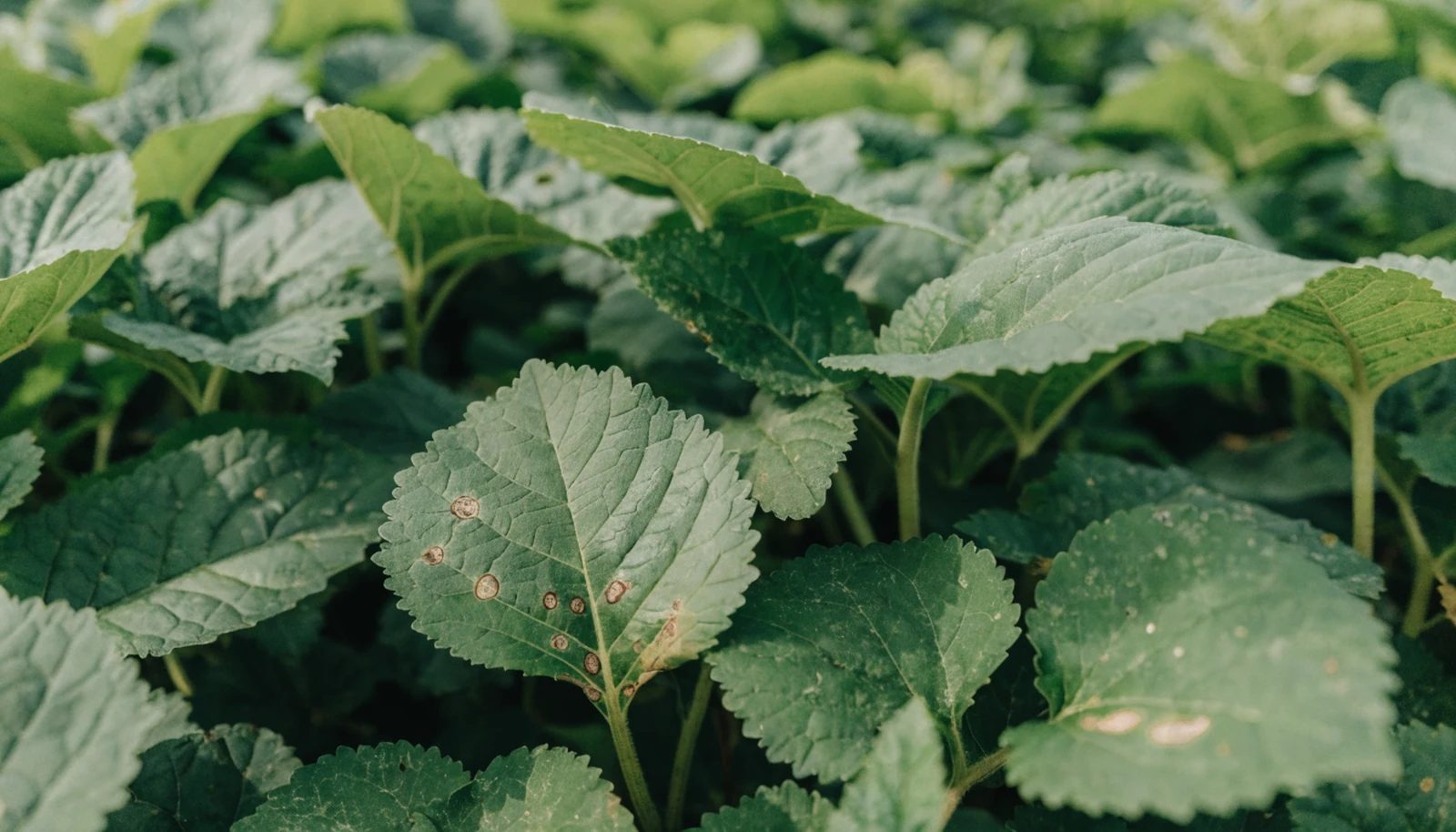
Crops affected
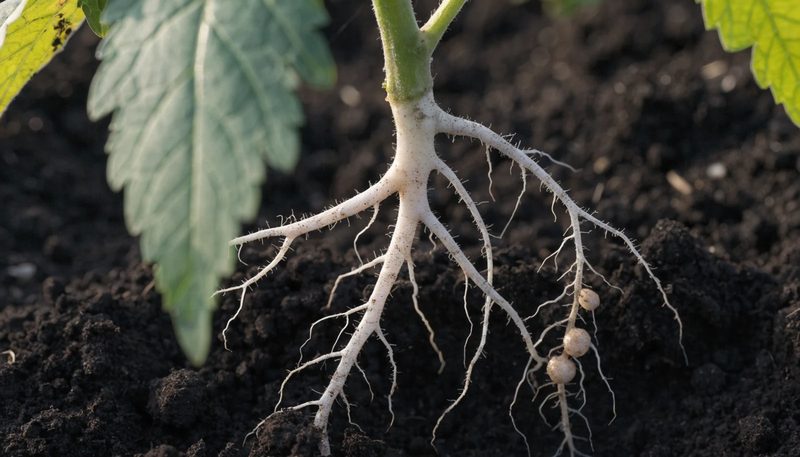
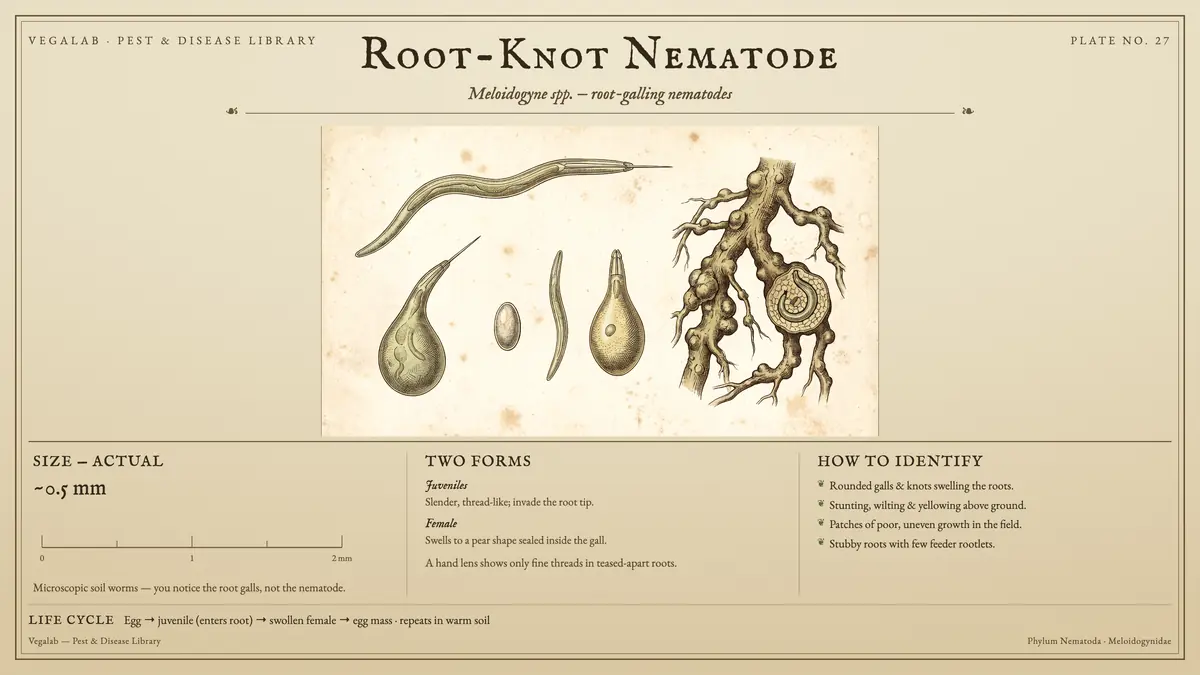
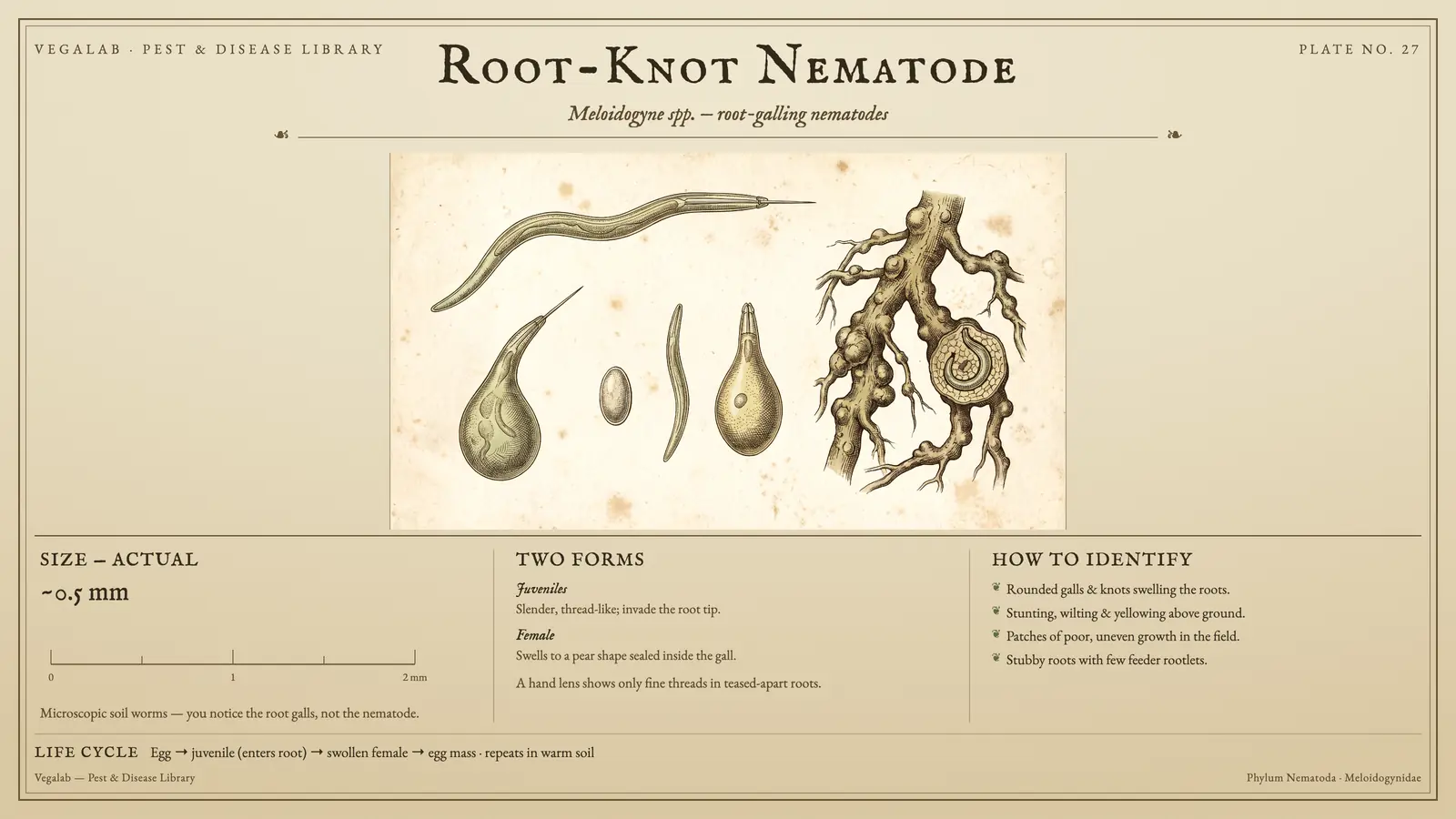
How to identify root-knot nematode
Size. ~0.5 mm Microscopic soil worms - you notice the root galls, not the nematode.
- Patches of poor, uneven growth in the field.
- Stubby roots with few feeder rootlets.
What are root-knot nematodes?
Root-knot nematodes (Meloidogyne spp.) are microscopic roundworms that infect the roots of a wide range of crops - tomatoes, cucurbits, strawberries, peppers, cannabis and more. The infective juvenile enters a young root and triggers giant feeding cells, which the plant walls off as galls. The nematode feeds inside, matures, and lays the next generation, so populations build season after season.
How to identify root-knot damage
- Galls on roots: swollen knots along the root system - the definitive sign. Lift a plant and wash the roots to check.
- Patchy above-ground symptoms: stunting, midday wilting despite moisture, and unresponsive nutrient-deficiency symptoms
- Decline over seasons: gradually worsening performance in the same areas as populations accumulate
Galling is easy to confuse with beneficial nitrogen-fixing nodules on legumes - nodules rub off easily, galls are part of the root. A lab assay confirms species and pressure.
Why they are so persistent
Each female can lay hundreds of eggs, often in protective masses that survive between crops, and warm soils allow several generations per season. Control focuses on disrupting feeding and reducing egg hatch - not simply reacting to visible symptoms. For the full life cycle, see our Soil Nematodes overview.
Life cycle & spread
Second-stage juveniles hatch in the soil and locate a root by following chemical gradients from root exudates. The juvenile penetrates just behind the root tip, migrates to the developing vascular tissue and then stops moving for the rest of its life.
What happens next is the reason this pest is so damaging. The nematode secretes proteins that reprogramme a small group of root cells into enlarged, multinucleate "giant cells" that feed it continuously. The surrounding tissue proliferates into the visible gall. The female swells into a pear shape and lays 500–1,000 eggs into a gelatinous mass, usually on the root surface.
A generation closes in as little as three to four weeks in warm soil, so several generations stack within one crop. Because the females are sealed inside root tissue and the eggs are protected in a gel matrix, most of the population is unreachable by anything applied to the soil surface - which is why timing against the mobile juvenile stage is the whole game.
Conditions that favour it
Warm, light-textured soil is the classic combination: sandy and sandy-loam soils with good drainage and soil temperatures above roughly 18 °C. Heavy clays slow movement and suppress populations, which is why the same farm can have a severe problem in one field and none in the next.
Continuous cropping of susceptible hosts is what turns a low population into an economic one. The host range covers most vegetables, many fruit crops and a wide set of weeds, so a rotation that looks varied on paper can be four susceptible hosts in sequence. Populations also concentrate where irrigation is consistent and roots are dense.
Monitoring & scouting
You cannot scout this pest from above ground. Symptoms - stunting, patchy vigour, midday wilting on adequate moisture, and poor response to fertiliser - all mimic drought, compaction and nutrient deficiency, which is why root-knot is routinely misdiagnosed as an irrigation or fertility problem.
Lift plants and wash the roots. Galls are swellings *of* the root itself and cannot be rubbed off - this is the key distinction from the nitrogen-fixing nodules on legumes, which detach cleanly and are pink or red inside.
Take a soil assay before planting a high-value crop, sampling the root zone at 15–30 cm from several points and keeping samples cool. A pre-plant count is the only way to make an informed decision, because by the time symptoms appear the crop's yield is already set.
How to get rid of root-knot nematodes
- Rotate to a genuine non-host. Cereals and grasses are poor hosts for most Meloidogyne species; a season out of susceptible vegetables measurably reduces the population. Check which species you have, because host status varies between them.
- Mi-mediated tomato resistance to root-knot nematodes can weaken under sustained soil temperatures around 28°C (82°F) or higher. The response varies by cultivar, nematode species or population, and exposure duration.
- Plant a biofumigant or trap crop. Mustards and other brassicas release glucosinolate breakdown products when macerated and incorporated; certain marigolds suppress populations. Both need to be grown as a crop and incorporated, not sown as a token strip.
- Keep fallow clean. Weeds are hosts. A weedy fallow is not a fallow, and this is where many rotations quietly fail.
- Solarise where the climate allows. Clear plastic over moist soil through the hottest weeks reduces populations in the upper profile.
- Support root recovery. Damaged roots cannot take up water or nutrients efficiently, so root-zone support and careful irrigation and fertility management help the crop carry a population it cannot escape.
- Sanitise between blocks. Nematodes move in soil on equipment, boots and transplants. Buy clean transplants and clean machinery moving off an infested field.
No approach eradicates root-knot nematodes from a field. The realistic goal is holding the population below the level where it costs yield, and the levers that do that are mostly non-chemical.
Anyone offering eradication is overselling. The honest measures are pre-plant population reduction, resistant genetics, and a crop supported well enough to yield despite residual pressure.
Root-knot galls or nitrogen nodules?
This is the most common diagnostic error on legumes, and getting it wrong is expensive in both directions - growers treat beneficial nodulation, or ignore a real infestation.
Nodules are attached to the outside of the root and pull off cleanly between finger and thumb, leaving the root intact. Cut one open and it is pink, red or brown inside. They are usually round and sit on the finer roots.
Root-knot galls are swellings of the root tissue itself - the root passes through the gall, so it cannot be detached without breaking the root. Cut one open and it is the same colour as the root, with tiny pearly-white females visible under a hand lens. Galls are often irregular and beaded along the root.
If it comes off cleanly, it is nitrogen fixation and it is doing you good. If the root runs through it, it is root-knot.
Which species, and why it changes the plan
- M. incognita · southern root-knot nematode, the most widespread; vegetables, cotton, tobacco
- M. javanica · warm regions; very wide host range including many grasses, which narrows rotation options
- M. arenaria · peanut, groundnut and vegetables
- M. hapla · northern root-knot nematode, tolerant of cooler soils; carrot, potato, lettuce, strawberry
- M. chitwoodi · Columbia root-knot nematode; a quarantine concern in potato because it blemishes tubers directly
Rotation and resistance decisions both depend on species: M. javanica hosts many grasses, so a cereal break that works against M. incognita may not work against it. A laboratory identification is worth the cost before committing to a multi-year rotation.
Recommended Vegalab solution: Nematode Control
Vegalab Nematode Control is a natural nematicide built on the nano-encapsulation platform. Its active, geraniol (a plant-derived terpene), is delivered as a nano-emulsion that distributes through the soil profile to the root zone, disrupting nematode feeding and reproduction, reducing egg hatch, and helping minimise root-knot galling - while leaving the surrounding rhizosphere and beneficial microbiota intact. Independent and internal evaluations support 90%+ efficacy against target nematodes when applied as directed. Applied as a soil drench through irrigation, it carries zero pre-harvest and zero re-entry interval. Results vary by crop, region, nematode species and pressure; claims and availability vary by jurisdiction - always read and follow the applicable product label.
| Role | Product | Use |
|---|---|---|
| Primary control | Nematode Control | Soil-applied nematicide (irrigation) |
| Companion / broader pressure | Root Boost | Root development / establishment |
| Plant support | Charge Bioboost | Soil biology / suppressive soil |
By crop
Claims and product availability vary by jurisdiction. Always read and follow the product label.