

How to identify asian hornet
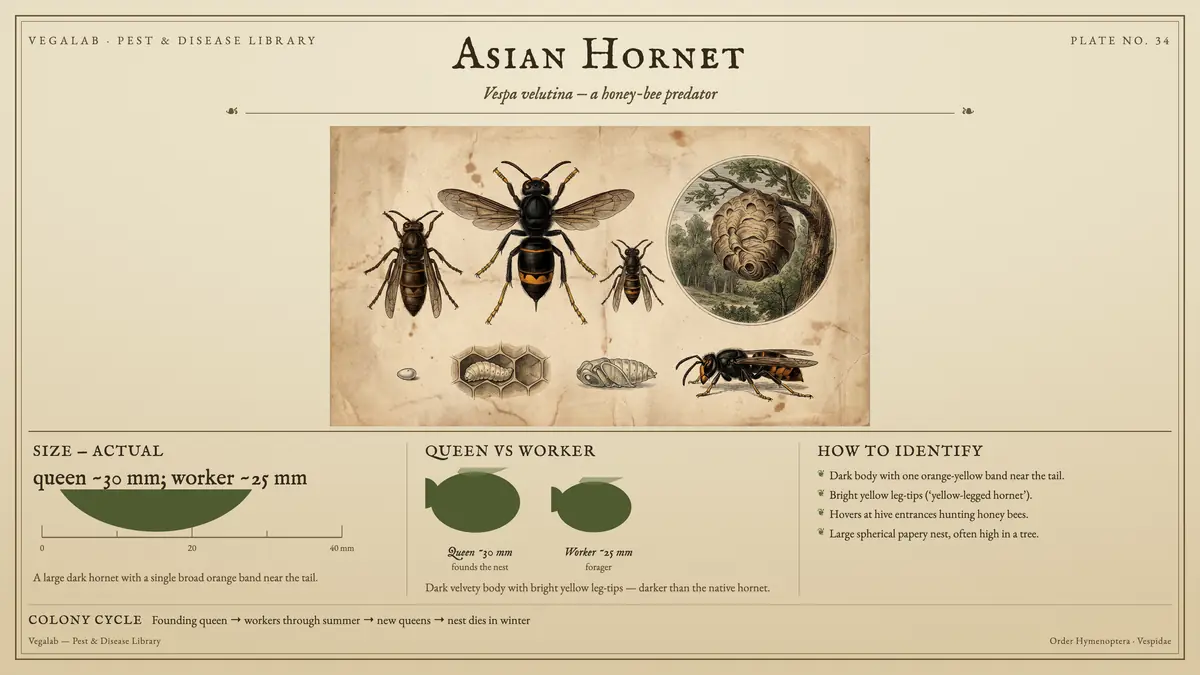
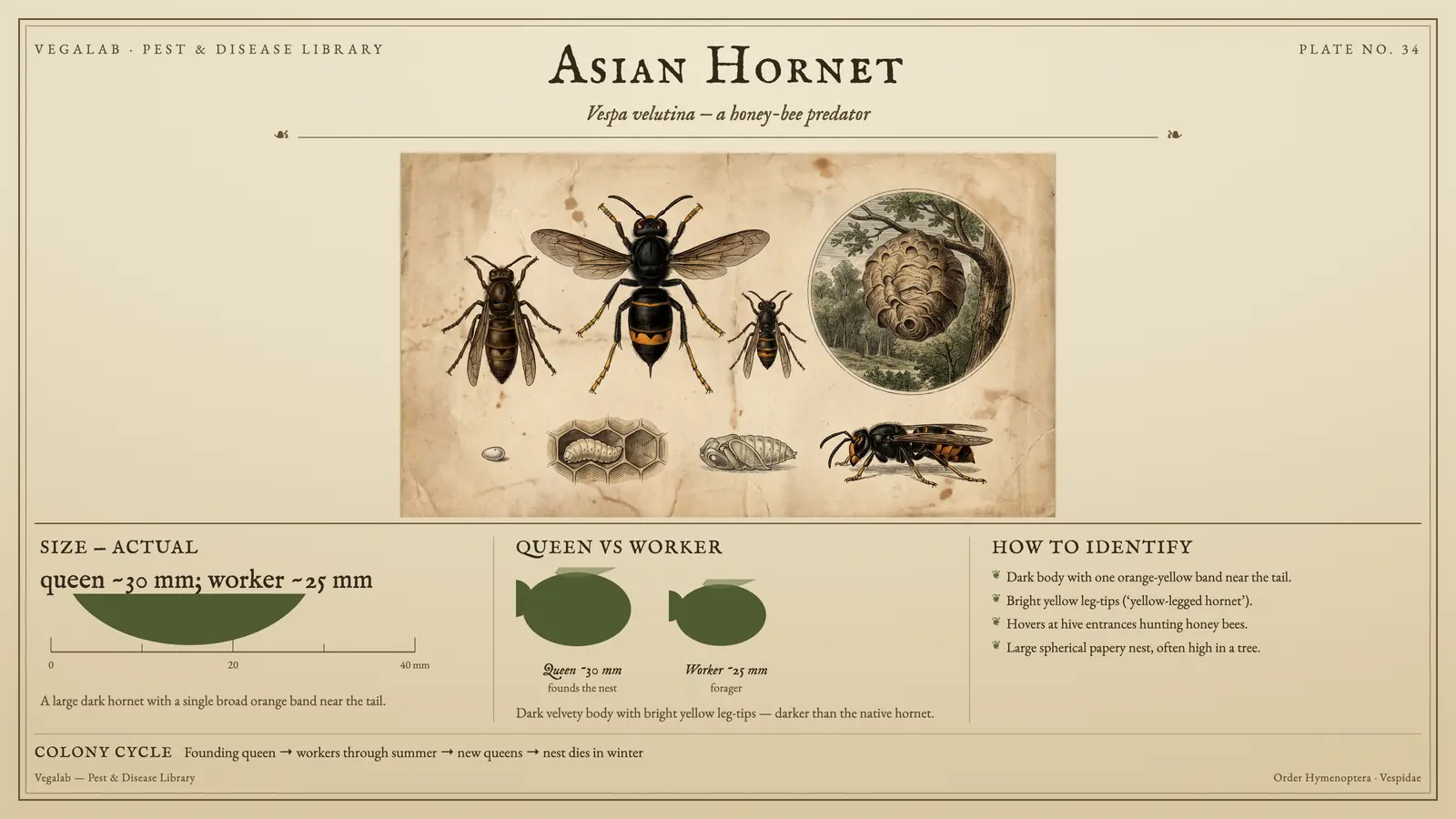
Queen and worker. Queen ~30 mm, founds the nest; Worker ~25 mm, forager.
- Bright yellow leg-tips (‘yellow-legged hornet’).
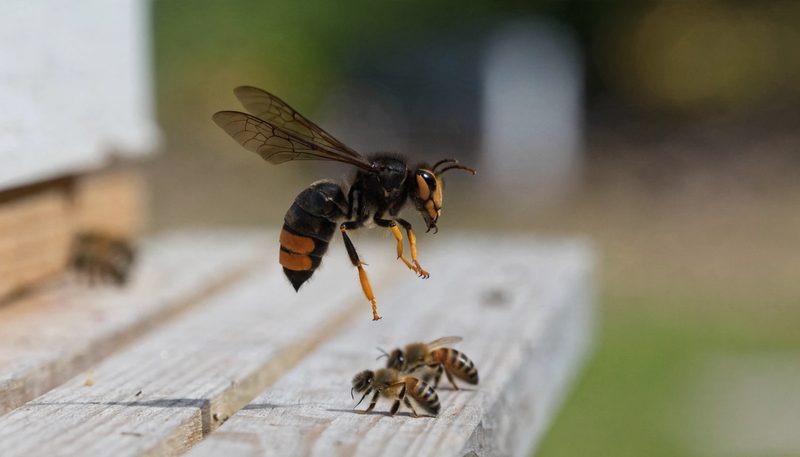
- Hovers at hive entrances hunting honey bees.
Colony cycle. Founding queen → workers through summer → new queens → nest dies in winter
Bee-safety rules
The agent is not selective - these protect honey bees:
- Nest only · never the hive; never broadcast over an area or onto flowers.
- After dark · treat at dusk/night when foragers are inside.
- No wind, no drift · don't spray where drift can reach foraging areas.
- Contain to the nest · a targeted tool for located nests, not an area treatment.
- Keep distance from apiaries · maintain a buffer from managed hives.
What is it?
Vespa velutina is a large social wasp that builds aerial nests and preys on honey bees, hawking them at the hive entrance to feed its colony. It is distinct from the larger 'murder hornet' (Vespa mandarinia), which was declared eradicated in the US in December 2024 - Vespa velutina is the live, expanding threat. Because the nest is spatially separate from the bee hive, a nest can be treated directly without exposing foraging bees.
Vegalab Spider Mite Control kills by blocking insects' breathing holes (spiracles) - physical suffocation, not a nerve agent. That mechanism works on any air-breathing insect, including large, hard-cuticle hornets, when enough active reaches the spiracles, and it carries no resistance risk because it is physical rather than metabolic.
How to identify it
- Adult hornets with distinctive yellow lower legs and a dark body with a fine orange band
- Hornets hovering and hawking honey bees at the hive entrance
- Large rounded aerial nests, often high in trees or on structures
- A sudden drop in foraging activity and bees clustering defensively at the hive
- Reported sightings or trapped queens in your area (state apiary programs track these)
Damage and how it spreads
A single Vespa velutina colony can decimate honey bee foragers and weaken or collapse hives, threatening both managed apiaries and pollination services. Because it spreads through new queens each year and a projected 30–45 miles beyond the current line per season, early nest destruction is the key control point.
Crucially, the hornet is a threat to a beneficial insect (the honey bee) - so any control method has to protect bees, not just kill hornets. That is why application discipline, not chemical selectivity, is the safety mechanism.
How to control it
- Locate and report nests · work with your state apiary or agriculture nest-removal program where one exists.
- Treat the nest directly, at dusk or after dark, when the whole colony is inside and bees have stopped flying.
- Mix Spider Mite Control at the stronger nest rate and drench the nest entrance in one thorough, soaking pass - not several light passes.
- Never broadcast over an area or onto flowers; keep a buffer from managed hives, and don't spray in wind or where drift can reach foraging areas.
- Wear full protective gear with a clear exit path; for high or large nests, use a professional or the state program.
Why the Asian hornet matters to growers
Vespa velutina is an invasive predator that has spread across much of western Europe since arriving in France in the mid-2000s, and its significance for agriculture is largely indirect: it preys heavily on honeybees and other pollinators. A single established nest consumes a substantial quantity of insect prey through a season, and honeybees form a large share of it in agricultural landscapes.
For crop production the consequence is pollination risk rather than direct crop damage. Hornets hawk at hive entrances, taking foragers as they return, and heavy predation both reduces colony strength and suppresses foraging behaviour - bees stop leaving the hive. In fruit, cucurbit, oilseed and seed crops dependent on managed pollination, that is a yield issue that will not be diagnosed as one unless someone connects it to the hornets.
There is also a direct but minor fruit effect: hornets feed on ripe fruit, particularly grapes and stone fruit, causing damage and contamination in late season, and their presence around a harvest crew is a genuine safety and labour concern.
In many jurisdictions V. velutina is a regulated invasive species with reporting requirements, so a suspected sighting has an administrative dimension as well as a practical one.
This entry sits in the library because of the pollination link. If your crop depends on managed or wild pollinators, hornet pressure is a production variable.
Identification · and what it is confused with
- **Asian hornet (Vespa velutina): roughly 25–30 mm; dark brown to black thorax and abdomen with a single broad orange-yellow band near the rear; distinctly yellow lower legs** · the clearest field mark; dark head with orange face
- **European hornet (Vespa crabro): larger, up to 35 mm; much more extensively yellow** abdomen with brown markings; reddish-brown thorax; legs not yellow-tipped; a native species that should be protected, not destroyed
- **Asian giant hornet (Vespa mandarinia):** much larger with a broad orange-yellow head; a separate species and a separate regulatory concern where it occurs
- Common wasps and hornets: smaller, more extensively yellow-and-black banded
- Hoverflies and bee mimics: harmless, and frequently destroyed in error
Correct identification matters because control effort and official reporting both depend on it, and because native hornets and wasps are frequently killed by mistake.
The yellow lower legs on a dark-bodied large hornet are the practical identifier for V. velutina. Where reporting is mandatory, photograph rather than assume - official schemes prefer an image.
What growers and beekeepers can do
- Report suspected sightings to the relevant plant health or invasive species authority. In regions with active eradication programmes, early reporting of nests is the mechanism that works, and locating nests is the objective.
- Do not attempt to destroy a nest yourself. Nests are often high in trees, colonies are large, and disturbance provokes a defensive response. Nest destruction is a job for trained operators.
- Protect hive entrances where hornets are hawking · entrance restrictors and muzzles reduce predation and allow bees to keep foraging.
- Support colony strength, since strong colonies withstand predation pressure far better than weak ones.
- Use monitored trapping carefully. Spring queen trapping is used in some programmes, but poorly designed traps kill large numbers of native insects, so selective trap designs and monitoring rather than indiscriminate trapping are the responsible approach.
- Coordinate locally. As with any invasive species, area-wide detection and nest removal is effective where individual effort is not.
- Consider pollination contingency in dependent crops in affected regions - additional hives, or wild pollinator habitat, to buffer the risk.
The most useful thing most growers can do is report accurately and protect their pollinators. Indiscriminate trapping does more harm than good and is not a control strategy.
Recommended Vegalab solution: Spider Mite Control
Vegalab Spider Mite Control (geraniol-led, plant-derived) is the recommended nest-treatment agent. It suffocates the hornet colony on contact by blocking spiracles, with a zero re-entry interval and no resistance risk. For nest knockdown it is used at a stronger rate than foliar mite control - a 1:50 dilution (about 2.6 fl oz per gallon) drenched into the nest entrance, versus the 1:1,000 foliar mite rate. One thorough night-time treatment typically clears the colony. Bee safety comes entirely from how and when it is applied: the agent is not selective, so it is contained to the nest and applied after dark when foraging bees are inside and never in the spray path. Treat the nest, never the hive.
| Role | Product | Use |
|---|---|---|
| Nest knockdown | Spider Mite Control | Suffocation agent at the 1:50 nest rate, applied at night, nest-only |
Preventing it next season
Monitor for hornets and nests early in the season, support queen-trapping efforts where your state program runs them, and report sightings promptly so nests are found and destroyed before the colony matures. Maintain a buffer between any treated nest and managed apiaries.
Claims and product availability vary by jurisdiction. Always read and follow the product label.