

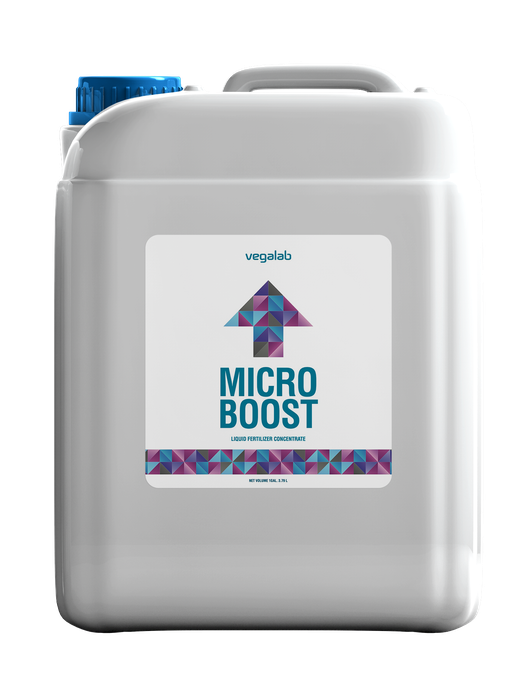
Micro Boost
Chelated micronutrient fertilizer · Iron, zinc and molybdenum, EDTA chelated.
- Zero REINo re-entry wait
- Zero PHIHarvest the same day
Micronutrient blend with chelating agents from Vegalab Crop Science, powered by Fe (EDTA), B, Cu, Mn, Mo, Zn + glutamic, citric acids. Micro Boost targets Micronutrient deficiencies, pollination, fruit-set.
Shipping $20 + $5 per gallon, calculated at checkout. Online orders up to 50 gallons; contact us for larger loads. Not available for delivery to Canada.
Secure checkout on Shopify. Each store keeps its own bag.
A chelated micronutrient fertilizer delivering iron, zinc and molybdenum together, with nitrogen and sulfur. EDTA chelation maintains bioavailability across a wide pH range, reducing the lock-up that limits uptake from non-chelated products, and foliar uptake is rapid. Glutamic and citric acids support absorption.
| Active | Fe (EDTA), Zn, Mo + glutamic, citric acids |
|---|---|
| Targets | Micronutrient deficiencies, pollination, fruit-set |
| Dilution rate | 1:1,000 · 1 mL/L (3.8 mL/gal) · 0.75–2.0 L/ha (10.4–27.7 fl oz/acre) |
| Application | Foliar or soil application · 1–5 times per season |
| Line · Category | Boost · Chelated micronutrient fertilizer |
- Corrects iron-deficiency chlorosis
- Supports nitrogen metabolism (Mo)
- Improves enzyme function across pathways
| Nutrient | Content |
|---|---|
| Total Nitrogen (N) | 2.00% |
| Sulfur (S) | 1.00% |
| Iron (Fe) | 0.20% |
| Molybdenum (Mo) | 0.20% |
| Zinc (Zn) | 1.25% |
CAUTION: This fertilizer is to be used only on soil which responds to Molybdenum (Mo). Crops high in Molybdenum (Mo) are toxic to grazing animals (ruminants).
Derived from: Protein hydrolysate · Nitric acid · Urea · Iron EDTA · Zinc sulfate · Ammonium molybdate
Contains: Citric acid
What is Micro Boost and which micronutrients does it supply?
Micro Boost is a chelated micronutrient fertilizer that delivers three micronutrients together: iron (Fe), zinc (Zn) and molybdenum (Mo), with nitrogen and sulfur, supported by glutamic and citric acids. It is formulated to correct micronutrient deficiencies and to support pollination and fruit-set across field crops, vegetables and vines.
Why does chelation matter for micronutrient uptake?
Micronutrients like iron are easily “locked up” in the soil - made unavailable to the plant - especially at high pH. Micro Boost uses EDTA chelation to keep these nutrients bioavailable across a wide pH range, so the plant can actually absorb what you apply. Foliar uptake is rapid, which makes it effective for correcting a visible deficiency quickly as well as for routine maintenance.
What deficiency symptoms does it address?
Iron deficiency shows as interveinal chlorosis (yellowing between leaf veins) on new growth; zinc and other shortfalls produce their own patterns of discoloration, distortion and poor fruit-set. Micro Boost corrects iron-deficiency chlorosis, supports nitrogen metabolism through molybdenum, improves enzyme function across plant pathways, and addresses multi-deficiency disorders where several micronutrients are short at once.
How and when should it be applied?
- Window
- Any growth stage
- Interval
- 1-5 times per season depending on crop and need
- Method
- Foliar or soil
- Rate
- 1:1,000 · 1 mL/L · 0.75–2.0 L/ha1:1,000 · 3.8 mL/gal · 10.4–27.7 fl oz/acre
- Rate
- Stated on the product label · Work out your rate
- Pack sizes
- 3.8 L, 9.5 L1 gal, 2.5 gal
- Area treated
- 3.8 L treats 1.9-5 ha; 9.5 L treats 4.7-12.6 ha1 gal treats 4.7-12.5 acres; 2.5 gal treats 11.7-31.2 acres
- Pre-harvest interval
- Zero - harvest the same day
- Re-entry interval
- Zero - no re-entry wait
Always read and follow the applicable product label.
Micro Boost can be applied foliar or to the soil, typically 1–5 times per season depending on crop and need. The standard rate is 1:1,000 - 1 mL/L (3.8 mL/gal), or 0.75–2.0 L/ha (10.4–27.7 fl oz/acre). For correcting an active deficiency, foliar application gives the fastest response.
Need a recommendation for your crop or pest?
Contact usCrop-specific solutions using this product
Frequently asked questions
What does Micro Boost target?
Micronutrient deficiencies, pollination, fruit-set
What is the application rate for Micro Boost?
1:1,000 · 1 mL/L (3.8 mL/gal) · 0.75–2.0 L/ha (10.4–27.7 fl oz/acre) Application: Foliar or soil application - 1–5 times per season.
Is Micro Boost suitable for natural or organic programs?
Micro Boost supplies Fe (EDTA), Zn, Mo + glutamic, citric acids in a formulation designed to fit low-residue and IPM programs.
Which crops is Micro Boost for?
It is used across all field crops, vegetables and vines - anywhere micronutrient deficiency limits growth, pollination or fruit-set.
Can it be foliar-applied?
Yes. Foliar application gives rapid uptake and is the fastest way to correct a visible deficiency; it can also be applied to the soil, 1–5 times per season.
Can it be tank-mixed with my other fertilizers?
Yes. Micro Boost is itself a fertilizer, and it complements standard NPK programs by supplying the micronutrients those programs often lack. Confirm tank-mix compatibility with a jar test, and consult an agronomist for your specific inputs.
How is it different from a standard micronutrient mix?
It delivers iron, zinc and molybdenum in EDTA-chelated form, which keeps them bioavailable across a wide pH range - reducing the lock-up that limits uptake from non-chelated products - with glutamic and citric acids supporting absorption.
Problems addressed
Supports the root zone where these problems establish. Reference links only - see the label for approved uses.
Pest & disease library
See all plant pests & diseases →
Reference links to identification and management guides. Claims and product availability vary by jurisdiction - always read and follow the product label.
Last updated: