

Magnesium Boost
Magnesium Boost is a soluble magnesium supplement that corrects magnesium deficiency and supports chlorophyll synthesis and photosynthesis. Magnesium sulfate with urea and nitric acid delivers readily available magnesium to keep foliage green and productive.
Soluble magnesium supplement · Soluble Mg²⁺, Foliar-active.
- Zero REINo re-entry wait
- Zero PHIHarvest the same day
Soluble magnesium supplement from Vegalab Crop Science, powered by Magnesium sulfate · urea · nitric acid. Magnesium Boost targets Magnesium deficiency, chlorophyll synthesis, photosynthesis.
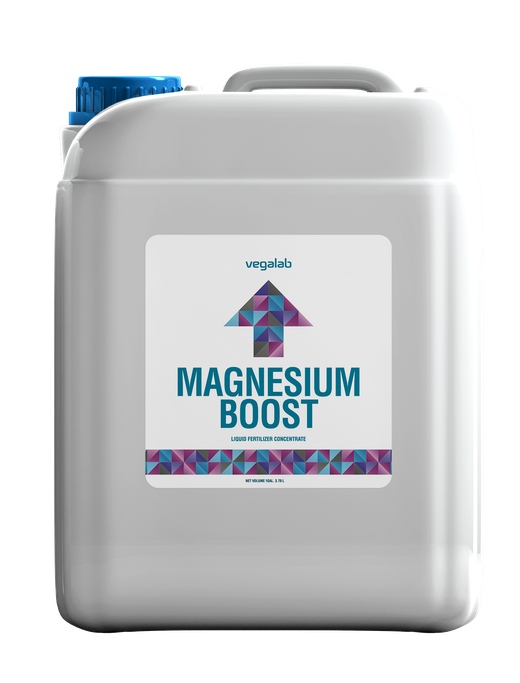
Soluble magnesium reaches chloroplasts via foliar absorption and corrects chlorophyll-deficiency chlorosis. Photosynthetic capacity restores within days; interveinal yellowing reverses.
| Active | Magnesium sulfate · urea · nitric acid |
|---|---|
| Targets | Magnesium deficiency, chlorophyll synthesis, photosynthesis |
| Dilution rate | 1:1,000–1:500 · 1–2 mL/L (3.8–7.6 mL/gal) · 1.5–3.0 L/ha (20.0–40.0 fl oz/acre) |
| Application | Foliar or soil application, 1–4 times during fruit set |
| Line · Category | Boost · Soluble magnesium fertilizer |
- Corrects interveinal chlorosis
- Restores photosynthetic activity
- Supports chlorophyll synthesis
- Particularly effective on grapes, tomatoes
| Nutrient | Content |
|---|---|
| Total Nitrogen (N) | 4.00% |
| Magnesium (Mg) | 4.50% |
| Sulfur (S) | 1.00% |
| Boron (B) | 0.02% |
| Molybdenum (Mo) | 0.01% |
Derived from: Urea · Nitric acid · Magnesium sulfate
Contains: Citric acid
Why is magnesium so important?
Magnesium sits at the centre of every chlorophyll molecule, so without enough of it a plant cannot photosynthesise efficiently. A deficiency shows as interveinal yellowing on older leaves - the tissue between the veins fades while the veins stay green - and it directly cuts the energy the plant can produce, limiting yield and quality.
How does Magnesium Boost work?
Magnesium Boost (4-0-0; N 4%, Mg 4.5%) supplies soluble magnesium with urea and nitric acid for rapid foliar uptake. Delivered to the leaf, the magnesium is incorporated into chlorophyll, restoring photosynthetic capacity and reversing the interveinal yellowing of deficiency. The small nitrogen component supports the recovery of green, active foliage.
When and how should it be applied?
- Apply when
- At the first signs of magnesium deficiency
- What to look for
- Interveinal yellowing on older leaves
- Method
- Foliar spray
- Rate
- 1:1,000–1:500 · 1–2 mL/L · 1.5–3.0 L/ha1:1,000–1:500 · 3.8–7.6 mL/gal · 20.0–40.0 fl oz/acre · Work out your rate
- Frequency
- Repeat as needed
- Pre-harvest interval
- Zero - harvest the same day
- Re-entry interval
- Zero - no re-entry wait
Foliar application corrects fastest because it bypasses the soil.
Always read and follow the applicable product label.
Apply as a foliar spray at the first signs of magnesium deficiency - interveinal yellowing on older leaves - and repeat as needed to maintain green, productive foliage. Foliar application gives the fastest correction because it bypasses any soil tie-up and gets magnesium straight into the leaf.
Which crops is it for?
Magnesium Boost has been tested on grapes, tomatoes, citrus and cucurbits - crops with high magnesium demand and a tendency to show deficiency, especially on sandy or high-potassium soils where magnesium uptake is restricted.
How do I recognise magnesium deficiency?
The classic sign is interveinal chlorosis on older, lower leaves: the area between the veins yellows while the veins themselves remain green, often progressing up the plant if untreated. Catching it early and applying Magnesium Boost foliarly restores chlorophyll and protects yield before photosynthesis is badly affected.
Need a recommendation for your crop or pest?
Contact usCrop-specific solutions using this product
Frequently asked questions
What is the application rate for Magnesium Boost?
1:1,000–1:500 · 1–2 mL/L (3.8–7.6 mL/gal) · 1.5–3.0 L/ha (20.0–40.0 fl oz/acre) Application: Foliar or soil application, 1–4 times during fruit set.
Is Magnesium Boost suitable for natural or organic programs?
Magnesium Boost supplies Magnesium sulfate · urea · nitric acid in a formulation designed to fit low-residue and IPM programs.
What does Magnesium Boost correct?
Magnesium deficiency, restoring chlorophyll synthesis and photosynthesis.
What is the analysis?
N 4%, Mg 4.5% (NPK 4-0-0).
How do I spot magnesium deficiency?
Interveinal yellowing on older leaves - yellow between the veins, with veins staying green.
Which crops is it for?
Grapes, tomatoes, citrus and cucurbits.
Why foliar application?
Foliar uptake corrects deficiency fastest by getting magnesium straight into the leaf, bypassing soil tie-up.
Problems addressed
Supports the root zone where these problems establish. Reference links only - see the label for approved uses.
Pest & disease library
See all plant pests & diseases →
Reference links to identification and management guides. Claims and product availability vary by jurisdiction - always read and follow the product label.
Last updated: