


Nitrogen sources: urea and nitric acid
Last updated:
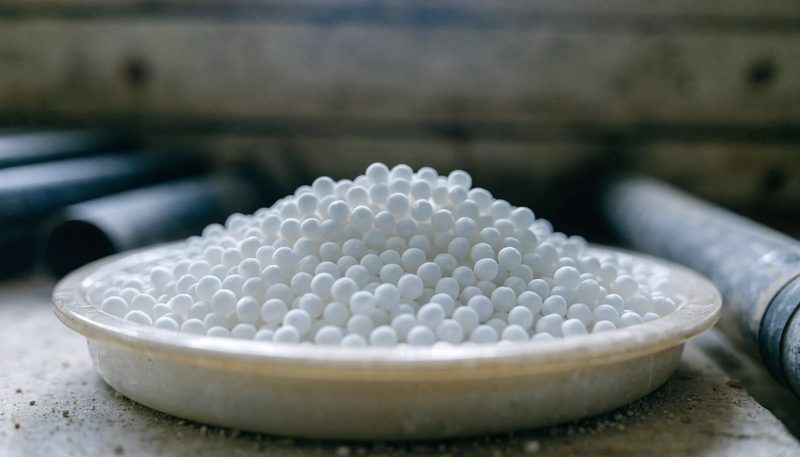
Urea
Urea is an organic compound in the chemical sense - it contains carbon and is the nitrogenous waste product of mammalian metabolism. Fertiliser urea is manufactured industrially from ammonia and carbon dioxide via the Haber-Bosch and Bosch-Meiser processes. It is not naturally derived in any meaningful sense, whatever its biological occurrence.
Agronomically it is attractive: 46% nitrogen, highly soluble, and relatively inexpensive per unit N. Applied to soil it is hydrolysed by the urease enzyme to ammonium, then nitrified to nitrate.
That hydrolysis step is where the practical problems live. Urease activity is high in soils and on plant residues, and hydrolysis raises local pH, which drives ammonia volatilisation - nitrogen lost to the air, sometimes a substantial fraction if urea is left on a warm, moist surface without incorporation or irrigation. Foliar urea can also cause leaf burn, and biuret, a manufacturing contaminant, is phytotoxic, so low-biuret grades matter for foliar use.
Nitric acid
Used in Magnesium Boost with urea and magnesium sulfate. Nitric acid supplies nitrate nitrogen directly, in immediately available form, and strongly acidifies - useful for alkaline spray water and for solubilising magnesium. It is a hazardous corrosive material in concentrate, which is a manufacturing rather than an end-use consideration, but handling of the finished product still warrants the label precautions.
The claim problem, stated directly
Six products in the range contain urea: Magnesium Boost, Pollen Boost, Root Boost, Nitrogen Pro, NPK Pro and Vega Pro. The crop product pages carry a templated FAQ line describing each product as a naturally derived input, built by interpolating the active field, which on Nitrogen Pro renders as "a naturally derived input (Urea, manganese sulfate, EDTA-Fe + citric acid)".
That is not accurate and should be corrected. The defensible position is straightforward and does not weaken the range: Vegalab's natural-input positioning rests on its pesticidal actives, its nano-encapsulation platform and its low-residue profile. Its plant-nutrition products supply mineral nutrition using conventional, well-understood salts, because that is what plant nutrition is. Stating that clearly is more credible than a blanket claim that does not survive an ingredient list.
What urea does not do
It does not supply nitrogen instantly - hydrolysis and nitrification take days, depending on temperature and moisture. It does not stay where it is put if surface-applied in warm, moist conditions. And it does not improve soil organic matter, despite containing carbon.
References
Products
No direct product mapping. Nothing in the Vegalab range declares nitrogen sources in its composition, so this page has no product link - the absence is deliberate, not an omission.