

Last updated:
Crops affected
How to identify plant-parasitic nematodes
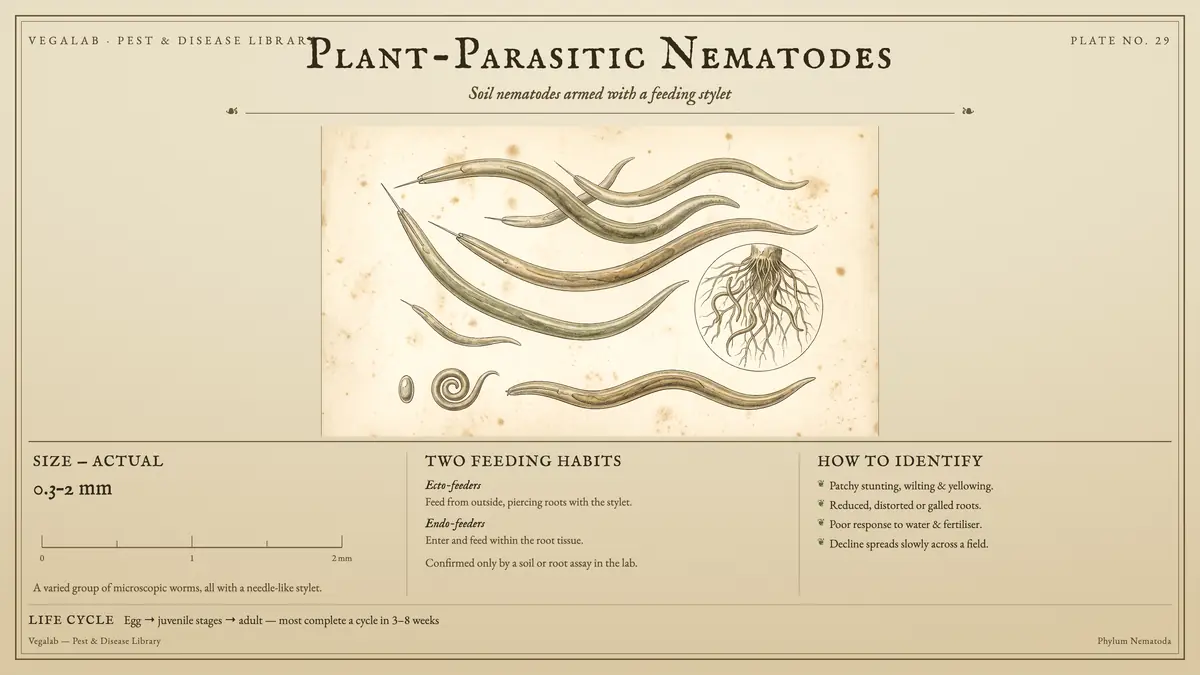
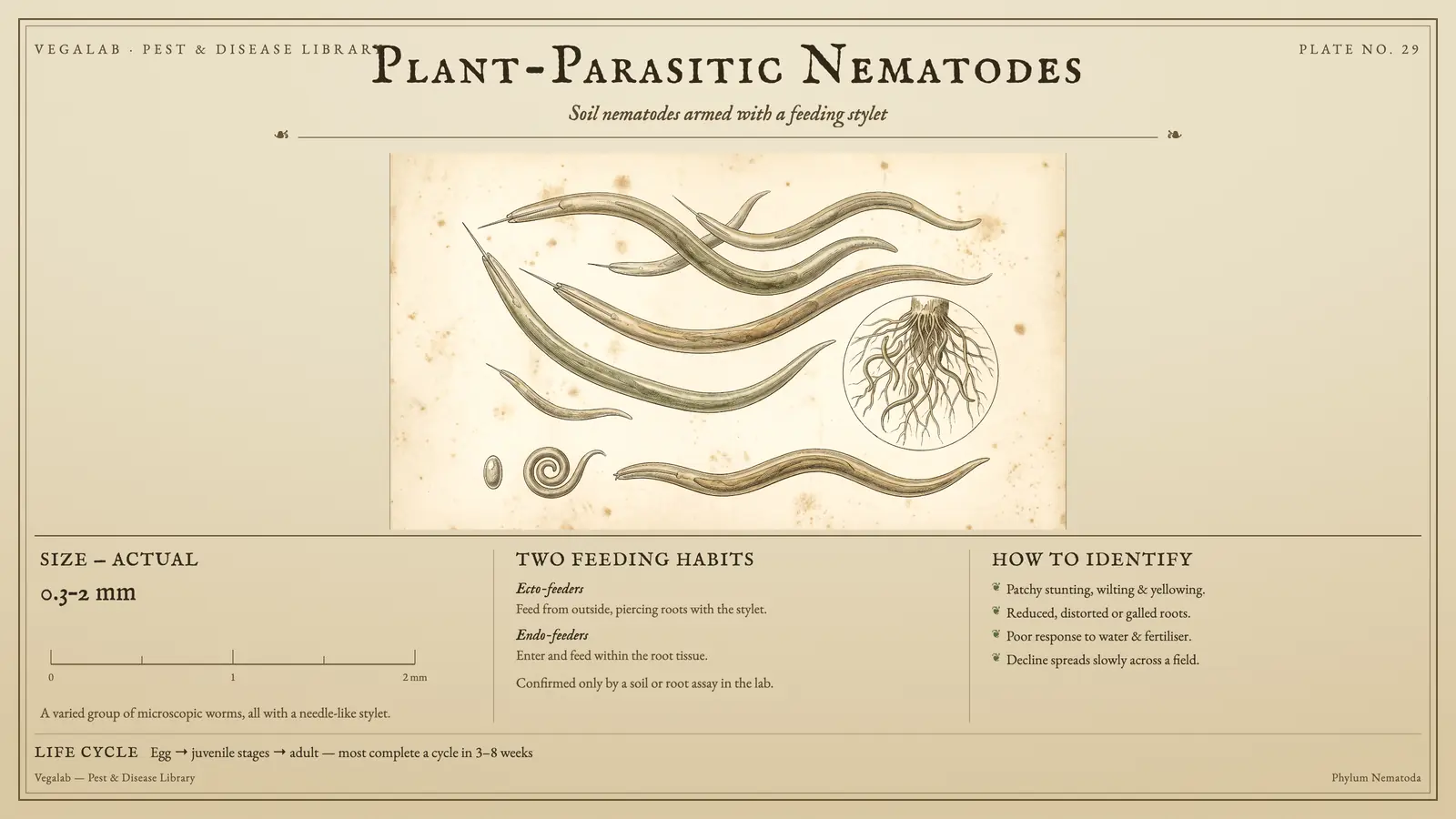
Size. 0.3 - 2 mm A varied group of microscopic worms, all with a needle-like stylet.
- Reduced, distorted or galled roots.
- Decline spreads slowly across a field.
What are soil nematodes?
Nematodes are among the most abundant animals on earth, and most soils hold thousands in every handful. The great majority are harmless or beneficial - they cycle nutrients and prey on other pests. Only a small group, the plant-parasitic nematodes, feed on living roots and cause crop losses. A soil full of nematodes is not automatically a problem; what matters is which species are present and in what numbers.
Good vs bad: not all nematodes harm crops
Beneficial and free-living species feed on bacteria, fungi and other nematodes and support soil health; some (entomopathogenic nematodes) are even used as biocontrol against insect larvae. The harmful group - root-knot (Meloidogyne), lesion (Pratylenchus), burrowing (Radopholus), pin (Paratylenchus) and spiral (Helicotylenchus) · feed on roots, reduce water and nutrient uptake, and open the door to secondary pathogens. Preserving the beneficial community while targeting the harmful species is the goal of any good program.
The nematode life cycle · and why it makes them persistent
Most plant-parasitic nematodes move through egg, several juvenile stages, and adult. Eggs are often laid in protective masses that survive between crops; infective juveniles hatch, locate a root and feed; adults lay the next generation - often several times per season in warm soils. Because each cycle multiplies the population and eggs persist, an untreated infestation compounds over seasons. Effective control disrupts feeding and reduces egg hatch, rather than just knocking down adults.
Signs of a nematode problem
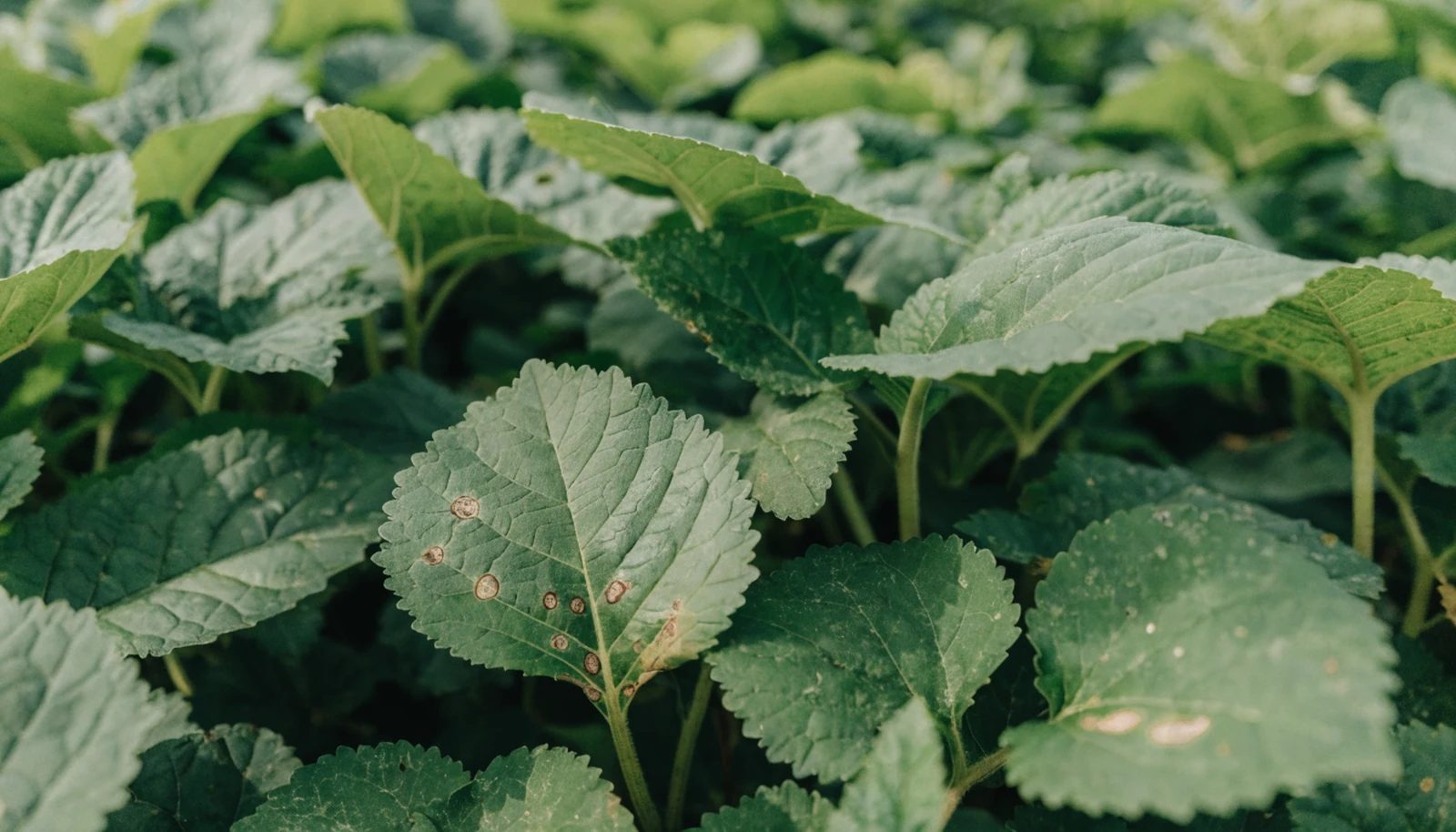
- Stunted, uneven growth in patches rather than uniformly
- Wilting during the heat of the day despite adequate soil moisture
- Yellowing or nutrient-deficiency symptoms that do not respond to feeding
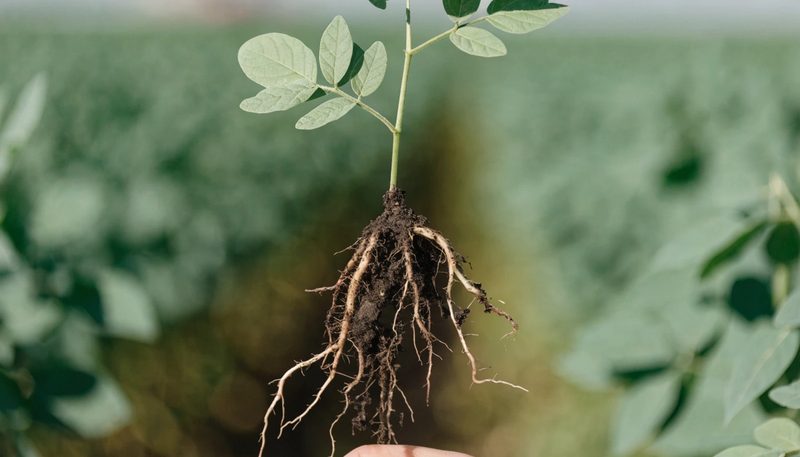
- Galls or knots on roots (root-knot), or dark lesions and stunted, branchy roots (other species)
A soil and root assay from a diagnostic lab is the only way to confirm species and pressure - worth doing before and after treatment to measure results.
How to manage soil nematodes
Durable programs combine cultural practices - crop rotation with non-host or resistant varieties, sanitation, removing infected residue, and building soil organic matter - with a targeted natural control that disrupts feeding and reproduction while leaving beneficial organisms largely intact.
Most soil nematodes are beneficial
This is the most important thing to understand about nematodes in soil, and it is routinely lost in discussion of the damaging species. A healthy soil contains enormous numbers of nematodes - often millions per square meter - and the great majority are not plant parasites at all.
Bacterial-feeding and fungal-feeding nematodes are central to nutrient cycling: by grazing on microbial populations they release nitrogen and other nutrients in plant-available forms, and their activity is a significant contributor to soil fertility. Predatory nematodes feed on other nematodes, including plant parasites, providing natural biological control. Entomopathogenic nematodes parasitise insect larvae and are sold commercially as biological control agents.
Most soil nematodes are free-living and nonparasitic; plant-parasitic species are a minority. Nonselective fumigants or soil biocides can affect nontarget soil organisms, but impact varies by product and use.
So 'nematodes in the soil' is not a diagnosis and not a problem. Specific plant-parasitic species at damaging population levels is.
Soil health assessments that report nematode community structure are reporting something useful. A high total nematode count in a productive soil is a good sign, not a warning.
The plant-parasitic groups and how they differ
- Sedentary endoparasites · Meloidogyne (root-knot) and cyst nematodes: enter the root, settle permanently, induce feeding structures. Diagnosable by eye through galls or cysts. Resistance genes and long rotation are the main tools.
- Migratory endoparasites · Pratylenchus (lesion), Radopholus (burrowing): move through root tissue destroying cells; no galls, so laboratory assay is required.
- Semi-endoparasites · Rotylenchulus (reniform), Tylenchulus (citrus): part of the body embedded in the root; no galls; deep in the profile.
- Ectoparasites · Xiphinema (dagger), Trichodorus, Belonolaimus (sting), Criconemoides (ring), Helicotylenchus (spiral), Paratylenchus (pin): feed from outside the root on root tips and surfaces; cause stunted, stubby, poorly branched root systems. Several are virus vectors, which is often their main economic significance.
- Foliar nematodes · Aphelenchoides: infest leaves and buds rather than roots, causing angular interveinal lesions bounded by veins; largely an ornamental and strawberry problem.
The plant-parasitic nematodes are conventionally grouped by feeding strategy, and the group determines both how you diagnose them and what management works.
Deeper entries for the most damaging: Root-Knot Nematodes, Lesion Nematode, Reniform Nematode.
Sting nematode (Belonolaimus longicaudatus)
Sting nematode (Belonolaimus longicaudatus) is a migratory ectoparasite adapted to coarse, sandy soils. Feeding at root tips can prune the root system, producing short, stubby roots and patchy chlorosis or wilting. It does not cause galls. Symptoms are not diagnostic; confirm with a laboratory and interpret counts using crop-, soil-, region-, and sample-specific guidance.
Against root-knot: no galls, because it never enters the root - and the action threshold is an order of magnitude lower. A count that would be unremarkable for root-knot can justify action for sting.
Ring nematode (Mesocriconema xenoplax)
Ring nematode (Mesocriconema xenoplax) is an ectoparasite associated with direct root feeding and, in some stone-fruit systems, increased risk of bacterial canker or peach tree short life. It can be important in grape and other perennial crops. Field symptoms are nonspecific; diagnose from a properly collected soil/root sample and a crop- and laboratory-specific threshold.
Against root-knot: root-knot is a direct, self-sufficient cause of yield loss and announces itself with galls. Ring is a predisposing factor in a disease complex - the loss usually arrives as canker or winter collapse, and it is easy to attribute to something else.
Spiral nematode (Helicotylenchus spp.)
Spiral nematodes (Helicotylenchus species) are common ectoparasites or semi-endoparasites and often occur in mixed populations. Their importance depends on nematode species, crop, density, soil, and co-occurring stresses. There is no unique field symptom; use a laboratory identification and crop-specific interpretation.
Against root-knot: root-knot at a damaging level is usually sufficient on its own. Spiral rarely is - treat it as part of the total parasitic load rather than as a diagnosis in itself.
Pin nematode (Paratylenchus spp.)
Pin nematodes (Paratylenchus species) are small ectoparasites commonly found near fine roots. Many detections are of low concern, but some species, hosts, and high populations can contribute to root injury and poor vigor. Diagnose and interpret counts in crop and regional context.
Against root-knot: the damage threshold is far higher and the symptom far weaker. Pin matters when it sits on top of root-knot, lesion or ring - as an addition to the load, not as the cause.
Dagger nematode (Xiphinema spp.)
Dagger nematodes (Xiphinema species) are root-feeding ectoparasites. Xiphinema index is especially important in grape because it vectors Grapevine fanleaf virus; when that virus–vector system is present, very low vector populations can matter. Use certified virus-tested planting material and a vineyard-specific sanitation and replant plan.
Against root-knot: root-knot transmits no virus. With dagger, reducing the population is only half the objective - virus-tested planting stock and removal of infected vines address the part of the problem that killing nematodes does not.
Burrowing nematode (Radopholus similis)
Burrowing nematode (Radopholus similis) is a migratory endoparasite that tunnels through root cortex and can cause severe root loss. It is associated with spreading decline of citrus in affected regions and is important in banana and some ornamentals. It does not form root-knot galls. Movement in planting material and infested soil or water is a major concern; follow applicable quarantine guidance.
Against root-knot: root-knot enters the root and settles permanently, inducing a gall. Burrowing nematode keeps moving through the tissue and leaves no gall behind, so the root shows destruction rather than swelling - and its regulatory status has no root-knot equivalent.
Citrus nematode (Tylenchulus semipenetrans)
Citrus nematode (Tylenchulus semipenetrans) is a semi-endoparasite associated with gradual citrus decline. Soil may adhere to the gelatinous egg matrix, giving roots a dirty or encrusted appearance, but this is not diagnostic. Confirm with soil/root sampling and interpret risk by rootstock, region, soil, population density, and other stresses.
Against root-knot: the female is permanent and semi-embedded like a root-knot female, but induces no gall - the sign is encrustation, not swelling. Against burrowing nematode, which shares the citrus host: slow general decline across a block, not an aggressive front advancing through it.
How to manage plant-parasitic nematodes
- Assay before you act. Species and population level together determine whether there is a problem and which measures apply. Treating without an assay is guessing, and the treatments are expensive.
- Rotate to genuine non-hosts, checked against the species present - this is the most reliable measure and the most commonly misapplied one.
- Use resistant varieties and rootstocks where they exist. For root-knot in tomato and for several perennial crops this is the strongest tool available.
- Keep fallow genuinely clean. Weeds host nematodes, and a weedy fallow is not a break.
- Use biofumigant and suppressive cover crops - mustards, certain marigolds and sorghum-sudangrass - grown as a crop and incorporated.
- Solarise where climate permits, to reduce populations in the upper profile.
- Build soil biology and organic matter, which supports predatory nematodes and microbial antagonists and improves the crop's ability to regenerate roots.
- Relieve compaction and support root health, since the yield effect of a nematode population depends heavily on the crop's capacity to replace damaged roots.
- Sanitize equipment and use clean planting material to avoid introducing species you do not have.
Nematode management is a soil and rotation discipline. No approach eradicates them, and the objective is holding populations below the level at which they cost yield while keeping the beneficial community intact.
Broad-spectrum soil treatments reduce the beneficial community along with the target and are increasingly restricted. Rotation, resistance and soil biology are where the durable gains are.
When to suspect a nematode problem
- Patchy, uneven vigor that recurs in the same parts of a field year after year
- Stunting with a poor response to fertilizer and irrigation · a damaged root system cannot use inputs, so more inputs do not help
- Midday wilting on adequate soil moisture, recovering overnight
- A decline over successive years of the same crop on the same ground, particularly in light soils
- Replant failure where a perennial crop is re-established on the same site
- Root systems that look wrong when washed · galls, dark lesions, stubby or poorly branched roots, adhering soil
- Disproportionate wilt disease incidence, since nematode wounds predispose plants to Fusarium and Verticillium
Nematode damage is chronically under-diagnosed because it produces no distinctive above-ground symptom. What it produces is underperformance, and underperformance gets attributed to almost anything else first - fertility, irrigation, soil variability, weather, or simply a difficult field.
The common thread is a crop that cannot use what it is given. Where inputs are adequate and the crop still underperforms in a recurring pattern, wash some roots and take an assay. See Poor Root Development.
Recommended Vegalab solution: Nematode Control
Vegalab Nematode Control is a natural nematicide built on the company's nano-encapsulation platform. Its active, geraniol (a plant-derived terpene), is delivered as a nano-emulsion that distributes through the soil profile to the root zone, disrupting nematode feeding and reproduction and helping reduce egg hatch and root-knot galling, while leaving the surrounding rhizosphere and beneficial microbiota intact. Independent and internal evaluations support more than 90% efficacy against target nematodes when applied as directed. Results vary by crop, region, nematode species and pressure; claims and availability vary by jurisdiction - always read and follow the applicable product label.
Claims and product availability vary by jurisdiction. Always read and follow the product label.