

How does Bacillus thuringiensis (Bt) work?
Last updated:
Bacillus thuringiensis (Bt) is a soil bacterium whose spores carry proteins that are toxic to insect larvae only when eaten1. In the alkaline gut of a susceptible larva, the protein crystals dissolve, bind to receptors on gut cells and form pores that break down the gut lining1,2. The larva stops feeding and dies within 1 to 5 days1,3. Each strain targets a narrow insect group1.
What is Bacillus thuringiensis?
Bacillus thuringiensis, usually shortened to Bt, is a bacterium found naturally in soils throughout the world1. To reproduce it forms spores, and those spores carry proteins that are toxic to insect larvae when the larvae eat them1. Because it comes from a natural source, Bt is classed as a biopesticide1.
Bt has been registered for use in pesticides by the U.S. EPA since 1961 and is found in over 130 registered products, sold as sprays, dusts, granules, concentrates and pellets1. Some of these products are approved for organic agriculture1. The same family of insecticidal proteins is used worldwide both in sprayable formulations and in transgenic crops that produce the proteins themselves2.
In North America, interest in Bt peaks in June, when young caterpillars and the first mosquito larvae appear, which is when Bt works best. In the Southern Hemisphere, the same window falls around December and January.
How does Bt kill insect larvae?
Bt works only after it is eaten. When a susceptible larva swallows the protein crystals, they dissolve in its gut2. The gut must have a high pH, 9.0 to 10.5, to activate the toxin1. Gut enzymes cut the proteins into their active form, which binds to specific receptor proteins on the surface of the midgut cells2. The bound toxins then form pores in the cell membranes and break down the cells of the gut lining2.
With its gut lining destroyed, the larva dies of infection and starvation, usually within 1 to 5 days1. Leafrollers, for example, stop eating within hours after feeding on a sprayed leaf, even though they die several days later3. Young larvae are the most affected1.
That chain of steps is also why Bt is so selective. Its specificity rests on the toxin's fit with receptor proteins in the larval gut2. The human stomach is acidic and destroys the toxins, and mammals lack both the enzymes that release them and the gut receptors they bind to1.
Which Bt strain do you need?
Strain matters more than brand. Each type of Bt toxin is specific to one target insect family, so a product made for caterpillars will not control mosquito larvae, and the reverse1.
| Strain | Target insects | Typical garden uses |
|---|---|---|
| Bt kurstaki and Bt aizawai | Caterpillars of moths and butterflies1 | Leafrollers, tent caterpillars, hornworms while larvae are small3,4,5 |
| Bt israelensis (Bti) | Larvae of mosquitoes, black flies and fungus gnats1,6 | Standing water in containers and ponds; potting mix drench for fungus gnat larvae6,7 |
| Bt tenebrionis, Bt san diego and Bt japonensis | Beetle larvae1 | Check the label for the beetle species listed |
How do you use a Bt spray on caterpillars?
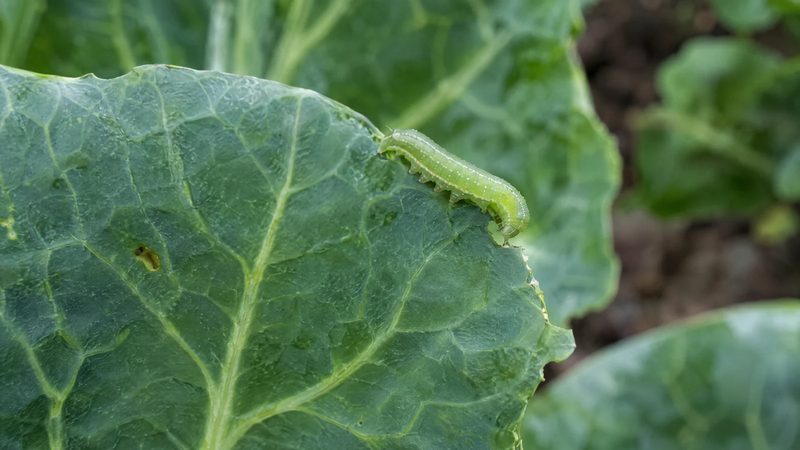
Spray early and spray thoroughly. University of California IPM guidance on leafrollers says Bt is most effective when larvae are small, under 1/2 inch long, that thorough coverage is required, and that control usually takes more than one application3. Caterpillars must eat treated foliage to be killed3. For hornworms on tomatoes, UC IPM lists Bt among the options effective against smaller larvae, alongside handpicking5.
Bt does not last long on leaves. On leaf surfaces it is broken down by ultraviolet light, weather and plant enzymes, and typical foliage half-lives are 1 to 4 days1. In one study, more than 80% of spores could no longer grow after one hour of sun exposure1. For tent caterpillars, UC IPM recommends a second application about 7 to 10 days after the first because of this short persistence, and notes that the spray has to penetrate the silk webbing4. Follow the product label for rates and intervals.
Not every caterpillar needs treating. UC IPM notes that natural enemies normally keep hornworm populations in check, and that healthy plants tolerate some leaf loss to tent caterpillars, which generally do not warrant an insecticide5,4.
How is Bti used for mosquito and fungus gnat larvae?
Bti, short for Bacillus thuringiensis subspecies israelensis, produces toxins that target the larvae of mosquitoes, black flies and fungus gnats6. The U.S. EPA has registered five Bti strains in 48 products for residential, commercial and agricultural use, mainly against mosquito larvae6. It is applied to standing water where larvae live, including flower pots, tires and bird baths around homes, and larger water bodies such as ponds and irrigation ditches6. EPA reports no documented resistance to Bti as a mosquito larvicide6. EPA also advises eliminating standing water, even tiny amounts, so mosquitoes cannot breed6.
For fungus gnats (Bradysia species), Colorado State University Extension states that the larvae may be killed by Bti applied as a drench to the growing medium, though Bti formulations sold for fungus gnats are generally unavailable through retail outlets7. Check that the label of any Bti product allows the use you intend; some products may be used on certain drinking water, such as cisterns, and others may not6.
Does Bt harm bees, beneficial insects, fish or people?
Bt strains have shown little to no toxicity to lacewings, predatory beetles, parasitic wasps or earthworms that are not their targets, and EPA concluded that the tenebrionis, israelensis and kurstaki strains are low in toxicity to bees1. A few studies have found harm to non-target moths1, and UC IPM notes that Bt kills butterfly as well as moth caterpillars that feed on sprayed foliage4.
In water, the tested strains were practically nontoxic to trout, bluegill and sheepshead minnows1. A 2023 systematic review of Bti mosquito control, covering 95 articles, nevertheless found a consistent negative effect on the abundance of non-biting midges (Chironomidae) and crustaceans8.
For people, Bt is low in toxicity when eaten or inhaled, although some Bt products have caused eye and skin irritation1. EPA exempts Bt from food residue limits because of its low toxicity1. Follow the product label for protective equipment and re-entry.
| Group | Finding |
|---|---|
| Bees | EPA: tenebrionis, israelensis and kurstaki strains low in toxicity to bees1 |
| Predators and parasitoids | Little to no toxicity to lacewings, predatory beetles and parasitic wasps that are not targets1 |
| Butterflies and non-target moths | Caterpillars that feed on sprayed foliage are affected; a few studies found non-target moths harmed1,4 |
| Fish | Tested strains practically nontoxic to trout, bluegill and sheepshead minnows1 |
| Aquatic insects and crustaceans | Consistent negative effect of Bti on midge and crustacean abundance8 |
| People | Low toxicity; some products caused eye and skin irritation1 |
Key takeaways
- Bt kills only larvae that eat it: its protein crystals dissolve in an alkaline insect gut and break down the gut lining.
- Match the strain to the pest: kurstaki for caterpillars, israelensis for mosquito and fungus gnat larvae, tenebrionis for some beetle larvae.
- Spray when caterpillars are small and cover foliage thoroughly; sunlight breaks Bt down within days.
- Bt is low in toxicity to people, bees and fish, but it also affects butterfly caterpillars, and Bti reduces midge numbers in treated water.
- Follow the product label for rates, intervals and the uses each product allows.
References
- Bacillus thuringiensis Fact Sheet
- Structural changes upon membrane insertion of the insecticidal pore-forming toxins produced by Bacillus thuringiensis
- Pest Notes: Leafrollers on Ornamental and Fruit Trees (UC ANR Publication 7473)
- Tent Caterpillars
- Hornworms
- Bti for Mosquito Control
- Fungus Gnats as Houseplant and Indoor Pests (Fact Sheet 5.584)
- Effects of mosquito control using the microbial agent Bacillus thuringiensis israelensis (Bti) on aquatic and terrestrial ecosystems: a systematic review
Frequently asked questions
Does Bt kill adult insects?
Can insects become resistant to Bt?
Can you use Bt on vegetables close to harvest?
Bt is used on many crops, and EPA exempts it from the food residue limits most pesticides need because of its low toxicity1. The crops, timing and any harvest interval are set by each product label, so follow the label on the product you use.