

How to identify mosquito larvae
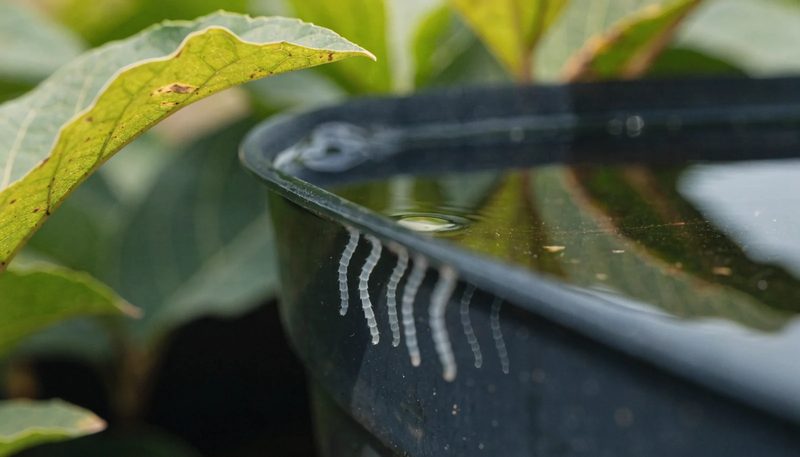
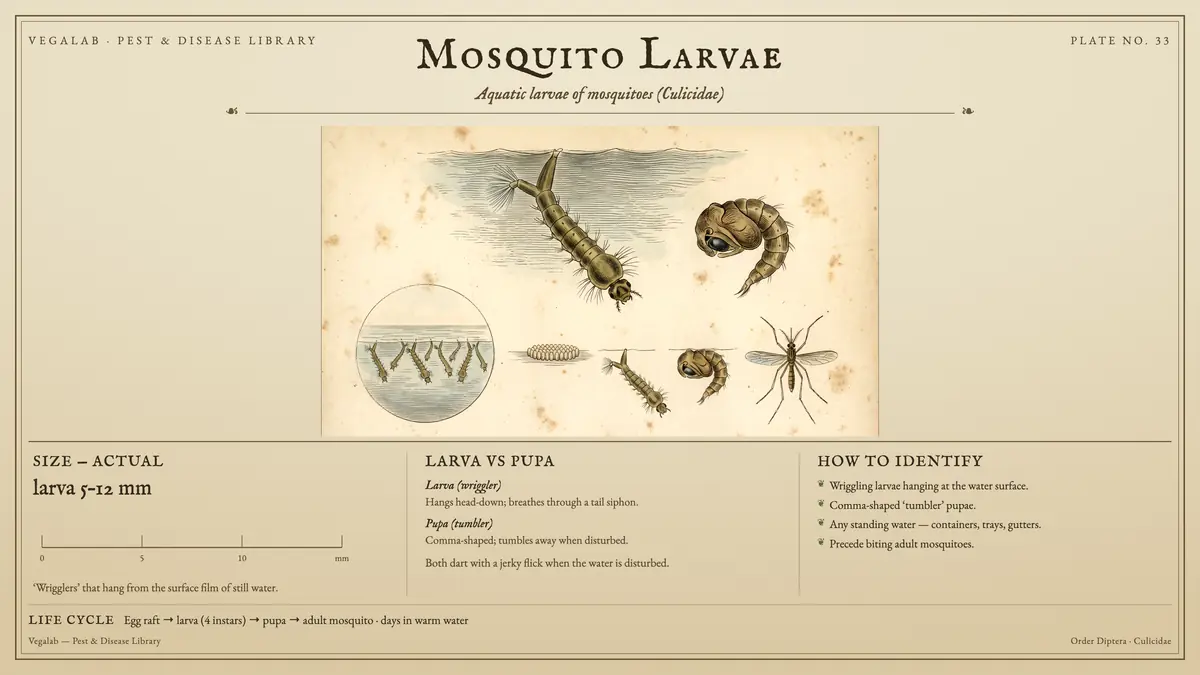
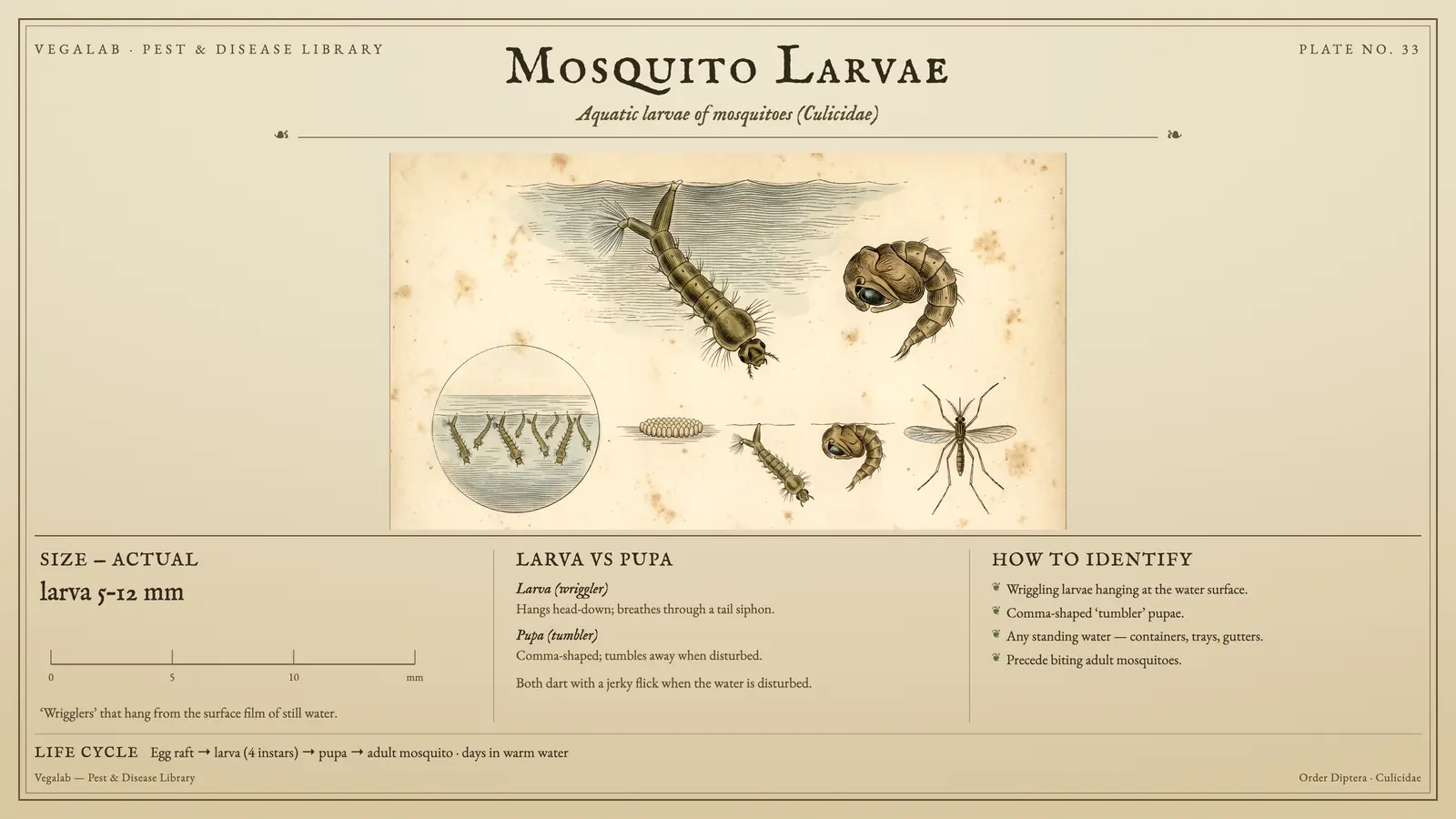
Size. larva 5 - 12 mm ‘Wrigglers’ that hang from the surface film of still water.
- Wriggling larvae hanging at the water surface.
- Comma-shaped ‘tumbler’ pupae.
What is it?
Mosquitoes lay eggs in standing or slow-moving water. The eggs hatch into aquatic larvae (wrigglers) that feed and develop in the water before pupating and emerging as adults. Eliminating or treating the water where larvae develop breaks the life cycle at its most vulnerable point.
How to identify it
- Larvae (“wrigglers”) in standing or slow water
- Rapid adult emergence in warm weather
- Biting pressure and vector-borne disease risk
- Breeding in containers, catch basins, ditches and wetlands
Damage and how it spreads
Beyond the nuisance and bites, mosquitoes can transmit disease to people and livestock, and persistent breeding sites around a farm or orchard sustain large populations. Because adults are mobile and hard to control, targeting larvae in the water is the most reliable, lowest-residue way to suppress mosquitoes.
How to control it
- Eliminate or drain unnecessary standing water and containers where possible.
- Keep troughs, tanks, and drainage moving or covered.
- Identify persistent breeding sites that cannot be drained.
- Treat those sites with a biological larvicide that interrupts the larval life cycle.
Why mosquito larvae belong in a crop library
Mosquitoes are not crop pests, and this entry exists for a different reason: agricultural water bodies are among the most productive mosquito breeding habitats there are, and growers frequently have both an obligation and a practical interest in managing them.
Irrigation reservoirs, tail-water ponds, flooded rice, drainage ditches, blocked channels, standing water in equipment and containers, and over-irrigated field margins all provide the still or slow-moving water mosquitoes require. That creates several distinct concerns: worker health and comfort, public health and neighbour relations where production is near housing, regulatory obligations in jurisdictions with mosquito abatement requirements, and livestock health where mosquito-borne diseases affect animals.
Rice production is a specific case - flooded fields are a well-studied mosquito habitat, and management of water depth, flooding and drainage schedules interacts directly with mosquito production.
The management logic is also unusually favourable: mosquito larvae are confined to water, which is a bounded, identifiable habitat that can be found, drained or treated. Unlike most pests in this library, the target does not move and its habitat can be enumerated.
Where local mosquito abatement authorities exist, they will often advise or assist on agricultural water bodies - this is frequently a cooperative rather than a private problem.
Source reduction: the measure that does most
- Eliminate unnecessary standing water. Containers, tyres, buckets, tarpaulin folds, equipment, clogged gutters and blocked drains around a yard produce large numbers of mosquitoes from very little water.
- Maintain drainage. Clear ditches and channels so water moves rather than stands; mosquitoes require still or very slow water.
- Manage irrigation to avoid pooling. Level fields, repair leaks, and avoid over-irrigation that leaves standing water at margins and low spots for more than a few days.
- Manage flood duration in rice where the system allows · intermittent drying interrupts larval development, and water management for mosquito control often aligns with water-saving practice.
- Stock permanent water bodies with larvivorous fish such as Gambusia where appropriate and legally permitted; this is highly effective in reservoirs and ornamental water.
- Keep reservoir margins free of dense emergent vegetation, which shelters larvae from fish and wave action.
- Cover tanks and water stores with tight-fitting lids or fine mesh.
Every mosquito begins as an egg laid in or near water, and the larval and pupal stages cannot leave it. That makes source reduction - removing or altering the water - the most effective and most durable intervention, and it is nearly always cheaper than repeated treatment.
A week is roughly the timescale in which many mosquito species can complete larval development in warm weather. Water that dries or moves within a few days produces very few mosquitoes.
Larval control and what it can and cannot do
- ***Bacillus thuringiensis subsp. israelensis* (Bti): highly specific to mosquito, blackfly and fungus-gnat larvae, with minimal effect on other aquatic life. Must be ingested by feeding larvae**, so it does not affect pupae - which do not feed - and it has short persistence, requiring reapplication.
- ***Lysinibacillus sphaericus*:** similar selectivity, with longer persistence in organically rich water where Bti degrades quickly.
- Surface films and monomolecular layers: work physically, preventing larvae and pupae attaching to the surface to breathe; effective against pupae, which Bti is not.
- Larvivorous fish: self-sustaining in permanent water bodies where legally permitted.
- Insect growth regulators: prevent successful emergence rather than killing larvae outright.
- What none of them do: control adult mosquitoes, or work in water you have not found. Locating the breeding sites is the prerequisite for all of it.
Where water cannot be removed, larval control is the next step and it is where the most selective options exist.
Bti is the most selective option and the most widely appropriate for agricultural water. Its two limits - no effect on pupae, short persistence - are the reasons treatment programmes need repetition and monitoring rather than a single application.
Rice systems: water management as mosquito management
- Alternate wetting and drying interrupts larval development and saves water
- Level fields properly so drainage is complete · residual pockets are major sources
- Control emergent weeds, which shelter larvae from predators
- Maintain channels and margins so water moves rather than stands
- Consider larvivorous fish where the system and regulations permit
- Coordinate with local abatement authorities, who often assist with monitoring
Flooded rice is one of the most studied agricultural mosquito habitats, and the useful insight is that the water management practices adopted for other reasons often have large mosquito consequences - which means the two objectives can frequently be aligned rather than traded off.
Mosquito larvae need standing water for long enough to complete development, which in warm conditions can be as little as a week. Continuous flooding through that period supports successive generations. Intermittent irrigation - alternate wetting and drying, adopted widely to reduce water use and methane emissions - interrupts larval development directly, because the drying phase strands and kills larvae before they emerge. The same is true of shorter flood durations and of well-timed drainage.
Other elements matter too. Dense stands and emergent weeds shelter larvae from predators and from wave action, so weed control has a mosquito benefit. Level fields drain completely; unlevel fields retain pockets that continue producing mosquitoes after the main flood is gone, and those residual pockets are often the largest source in a field that appears drained. Maintaining channels so water moves rather than stands does the same job at field margins.
Where larvivorous fish are compatible with the system - including integrated rice-fish production - they provide continuous larval control as a by-product of another enterprise.
The practical point for a rice grower is that mosquito production is largely a function of how long water stands and how completely it leaves, both of which are already being managed for water cost and agronomy.
Water that stands for less than about a week produces few adult mosquitoes. Drainage completeness matters as much as drainage timing.
Recommended Vegalab solution: Mosquito BioControl
Vegalab Mosquito BioControl · A Vegalab natural mosquito larvicide applied to breeding water per label, as part of an integrated vector-management program with source reduction.
Observed results: Mosquito BioControl has been evaluated by an independent laboratory for mosquito efficacy as part of Vegalab’s public-health portfolio.
| Role | Product | Use |
|---|---|---|
| Primary control | Mosquito BioControl | Biological larval control in water |
Preventing it next season
Reduce standing water at the source, keep water moving or covered, and treat persistent breeding sites that cannot be eliminated. Regular monitoring of likely sites keeps populations down.
Claims and product availability vary by jurisdiction. Always read and follow the product label.