

Do mosquito bits and dunks work on fungus gnats?
Last updated:
Yes, on the larvae. Mosquito Bits and Mosquito Dunks contain Bacillus thuringiensis subsp. israelensis (Bti), a bacterium toxic only to the larvae of flies such as mosquitoes, black flies and fungus gnats (Bradysia spp.).1,4 It works best on young larvae and does not persist indoors, so repeat treatments and drier soil are needed.1,2 Mosquito Bits carries a fungus gnat use on its EPA label; follow the product label.5
How does Bti kill fungus gnat larvae?
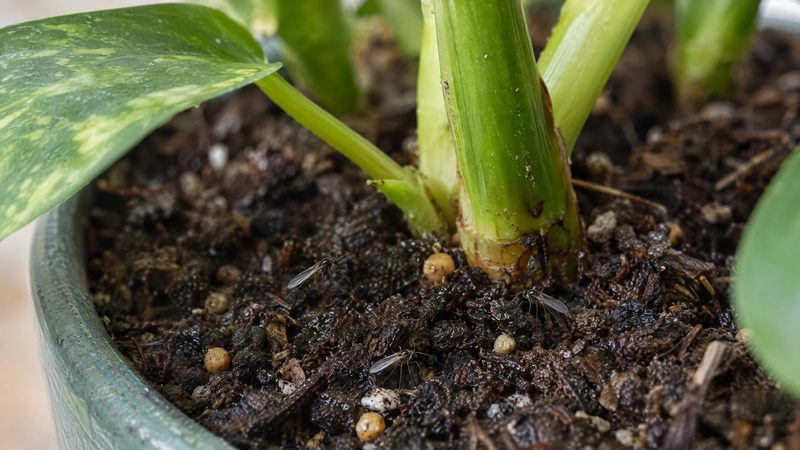
Fungus gnats (Bradysia spp.) lay their eggs in moist organic debris or potting soil, and the larvae feed on organic mulch, compost, root hairs and fungi in the growing medium.1 That makes the larva in the top of the potting mix the stage to treat. Bacillus thuringiensis subsp. israelensis (Bti) is a naturally occurring soil bacterium whose toxins affect only the larvae of mosquitoes, black flies and fungus gnats.4
Bti has to be eaten to work.2 After a larva ingests the bacteria, a toxic protein crystal is released in its gut, the larva stops feeding and then dies.2 UC IPM describes Bti as toxic only to fly larvae, so flying adults are not its target.1 The Bt sold for caterpillars on foliage is a different subspecies, and Bt labeled for caterpillars is not effective against fly larvae, so a caterpillar spray will not substitute for Bti.1
On human exposure, EPA states that Bti has no toxicity to people, that studies show minimal toxicity to honey bees, and that any Bti product should be used according to its label.4
In North America fungus gnats breed indoors year round, while outdoors in the interior valleys of California they are most common in winter and spring, when water is more available and temperatures are cooler1; indoor problems follow wet potting mix whatever the month. In the Southern Hemisphere the same cool-season outdoor peak falls from about June to November.
What is the difference between Mosquito Bits and Mosquito Dunks?
Both products carry Bti, but they are built for different jobs and their EPA labels differ.5,6 Mosquito Bits are granules, and the label accepted by EPA in December 2021 includes a fungus gnat larvae section for growing media or soil of house, garden and landscape plants and home mushroom beds.5 That label describes two ways to use them: sprinkling granules on the soil and watering them in, or steeping granules in water, skimming off the floating granules and watering the soil with the treated water.5
Mosquito Dunks are floating, sustained-release briquets.6 Their EPA-accepted label describes release of Bti for 30 days or more and lists mosquito and psychodid fly larvae, such as drain flies, as the targets; fungus gnats are not on that label.6 The household sites the Dunk label names, flower pots included, refer to standing water that collects in them, not to potting soil.6 The Dunk label also states that using the product in a manner inconsistent with its labeling violates federal law, so check the label on the package you buy before using any Bti product on plants.6
| Feature | Mosquito Bits | Mosquito Dunks |
|---|---|---|
| Form | Granules | Floating briquet |
| Active ingredient | Bti strain SUM-6218, 2.86% | Bti strain BMP 144, 10.31% |
| Fungus gnat larvae on the label | Yes, in soil or growing media | No |
| Labeled targets in water | Mosquito larvae in standing water | Mosquito and psychodid fly larvae in standing water |
| Stated duration in water | Up to 14 days in water of low to moderate organic content | 30 days or more under typical conditions |
Do mosquito bits actually work on fungus gnats?
They work on young larvae, and timing decides the result.2,3 Bti applied at labeled rates gives temporary control, and repeat applications are commonly needed for long-term control.1 A UConn Extension greenhouse fact sheet says Bti is most effective against young first-instar larvae and that one commercial Bti product is toxic to larvae for only two days, so two or three applications may be needed.2
Older larvae are harder to reach.3 In a laboratory study that drenched growing medium, Bti had no effect on second or third instar fungus gnat larvae, and the authors concluded that growers must apply it before populations build up and before generations overlap.3 A separate trial in oyster mushroom straw found that fewer fungus gnats emerged from Bti-treated straw than from straw treated with water or with Steinernema feltiae nematodes, with Bti cutting adult emergence by 40 to 89% against water across six bioassays.8 That trial used Lycoriella gnats in mushroom substrate rather than Bradysia in potting mix, so it shows the mechanism works in organic media rather than giving a figure for houseplants.8
| Source | Setting | Finding |
|---|---|---|
| UC IPM Pest Notes | Homes and potted plants | Temporary control; does not persist indoors; repeat at about five-day intervals |
| UConn Extension | Greenhouse production | Most effective on first-instar larvae; toxic to larvae for about two days |
| Laboratory drench study (2006) | Growing medium in containers | No effect on second or third instar larvae |
| Oyster mushroom trial (2021) | Pasteurized straw substrate | Adult emergence 40 to 89% lower than water; nematodes generally ineffective |
How do you use mosquito bits for fungus gnats?
Follow the product label for the amount and the repeat schedule.5 The Mosquito Bits label gives separate amounts for small and large pots and for garden areas, and it notes that its water treatment controls the larvae present in the soil at the time of application, which is why it calls for repeat treatments.5 Pair the treatment with the cultural steps that stop new larvae from developing.
- Let the surface of container soil dry between waterings and empty standing water.1
- Treat early, when you first see adults or larvae, rather than after generations overlap.3
- Place yellow sticky cards horizontally at the soil surface to detect adults, and check and change them weekly.2
- Use potato plugs on the soil surface to check for larvae, looking under them after 48 hours.2
- Avoid incompletely composted organic matter in potting mix unless it has been pasteurized, because it is often infested.1
- Repeat applications as the label directs; Bti does not reproduce or persist indoors.1,5
Why are there still fungus gnats after using mosquito bits?
Adults that were already flying are not affected, and they keep coming from pupae in the soil.1 At 75°F a fungus gnat generation takes about 17 days from egg to adult, so new adults appear for a while after larvae are treated.1 University of Wisconsin entomologists note that Bti products will not clear fungus gnats overnight but can be effective over several weeks.7 Spraying adult fungus gnats is generally not effective or recommended, because it gives only temporary relief.7
Continuing moisture is the other common reason.7 Cutting back on watering is often the single most important step against fungus gnats, and letting soil dry between waterings decreases larval survival.7 If the mix stays wet, older larvae that escape Bti and new egg-laying keep the cycle going.1,3
What can you use instead of or alongside Bti?
Steinernema feltiae nematodes are applied as a drench against fungus gnat larvae and kill them in one to two days.2 They can provide relatively long-term control, but they are live, perishable products that are usually mail-ordered and must be applied promptly.1 The soil-dwelling predatory mite Stratiolaelaps scimitus and the rove beetle Dalotia coriaria also feed on fungus gnat larvae, and all three biological controls are best used preventively on moist growing media.2
Some popular barriers do not hold up.2 A layer of coarse sand or diatomaceous earth on the growing media does not prevent egg-laying, because diatomaceous earth absorbs moisture and cracks open where larvae pupate and females lay eggs.2 Nematodes and Bti can be applied in combination, according to UC IPM.1
Key takeaways
- Mosquito Bits and Mosquito Dunks both contain Bti, a bacterium toxic only to fly larvae, including fungus gnat larvae.
- Mosquito Bits carries a fungus gnat use on its EPA label; the Dunk label covers mosquito and drain fly larvae in standing water.
- Bti works best on young larvae and does not persist indoors, so repeat applications are needed; follow the product label.
- New adults keep appearing after treatment because a generation takes about 17 days at 75°F, so expect improvement over several weeks.
- Letting the soil surface dry between waterings is the step that makes any larval treatment work.
References
- Pest Notes: Fungus Gnats (UC ANR Publication 7448)
- Managing Fungus Gnats in the Greenhouse
- Effect of Bacillus thuringiensis subsp. israelensis and neonicotinoid insecticides on the fungus gnat Bradysia sp nr. coprophila (Lintner) (Diptera: Sciaridae)
- Bti for Mosquito Control
- Mosquito Bits (EPA Reg. No. 6218-86), stamped accepted label, December 13, 2021
- Summit Mosquito Dunks / B.T.I. Briquets (EPA Reg. No. 6218-47), accepted label, March 27, 2008
- Fungus Gnats: Tiny Flies Around Your Houseplants
- Microbial Control Agents for Fungus Gnats (Diptera: Sciaridae: Lycoriella) Affecting the Production of Oyster Mushrooms, Pleurotus spp.
Frequently asked questions
How long do mosquito bits take to work on fungus gnats?
Does Bti harm people or bees?
Is the Bt in caterpillar sprays the same as Bti?
Can you get rid of fungus gnats just by watering less?
Often, yes, for plants that tolerate dry soil. Fungus gnat larvae thrive in damp potting mix, and allowing the soil to dry between waterings decreases their survival.7 For succulents and other drought-tolerant plants, cutting back on watering can correct a fungus gnat problem over time without any other step.7