

Last updated:
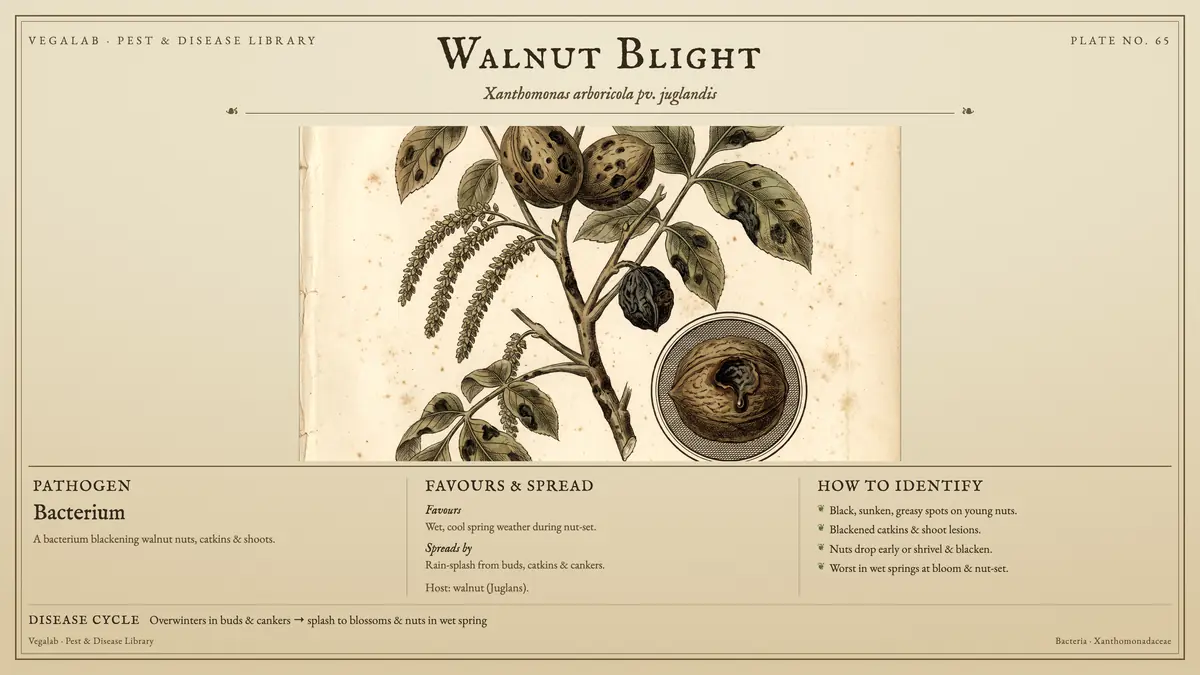
Walnut blight is a bacterial disease of English walnut caused by Xanthomonas arboricola pv. juglandis, which overwinters inside dormant buds. It causes sunken black husk lesions, angular leaf spots and dark shoot lesions. Sprays are protectant, so begin with the susceptible period, which runs from catkin emergence through nut set, and time them to warm wet events: at 25 °C only 6 to 9 hours of wetness is enough.
Crops affected

How do you identify walnut blight?
- Worst in wet springs at bloom & nut-set.
What causes walnut blight?
Xaj is a rod-shaped, yellow-pigmented bacterium that infects catkins, pistillate flowers, developing nuts, leaves, and green shoots. The older literature calls it Xanthomonas campestris pv. juglandis; that name was superseded in 1995 and both appear in extension material, so treat them as the same organism.
The primary overwintering reservoir is the dormant bud. Bacteria persist inside bud scales through the winter and are present and multiplying when the bud breaks, which means inoculum is already on the emerging tissue before any rain event occurs. Secondary reservoirs are catkins, twig cankers, mummified nuts and leaf scars, but the bud is the one that drives the season.
The consequence is a carryover loop. A wet, damaging season loads the buds, and those loaded buds start the following spring at a much higher inoculum level. The measured effect of that loading is large: crop damage of 61.4% in high bud-inoculum situations against 2.6% in low ones. A grower who had a bad blight year is not starting the next season level with a neighbor who did not.
What are the symptoms of walnut blight?
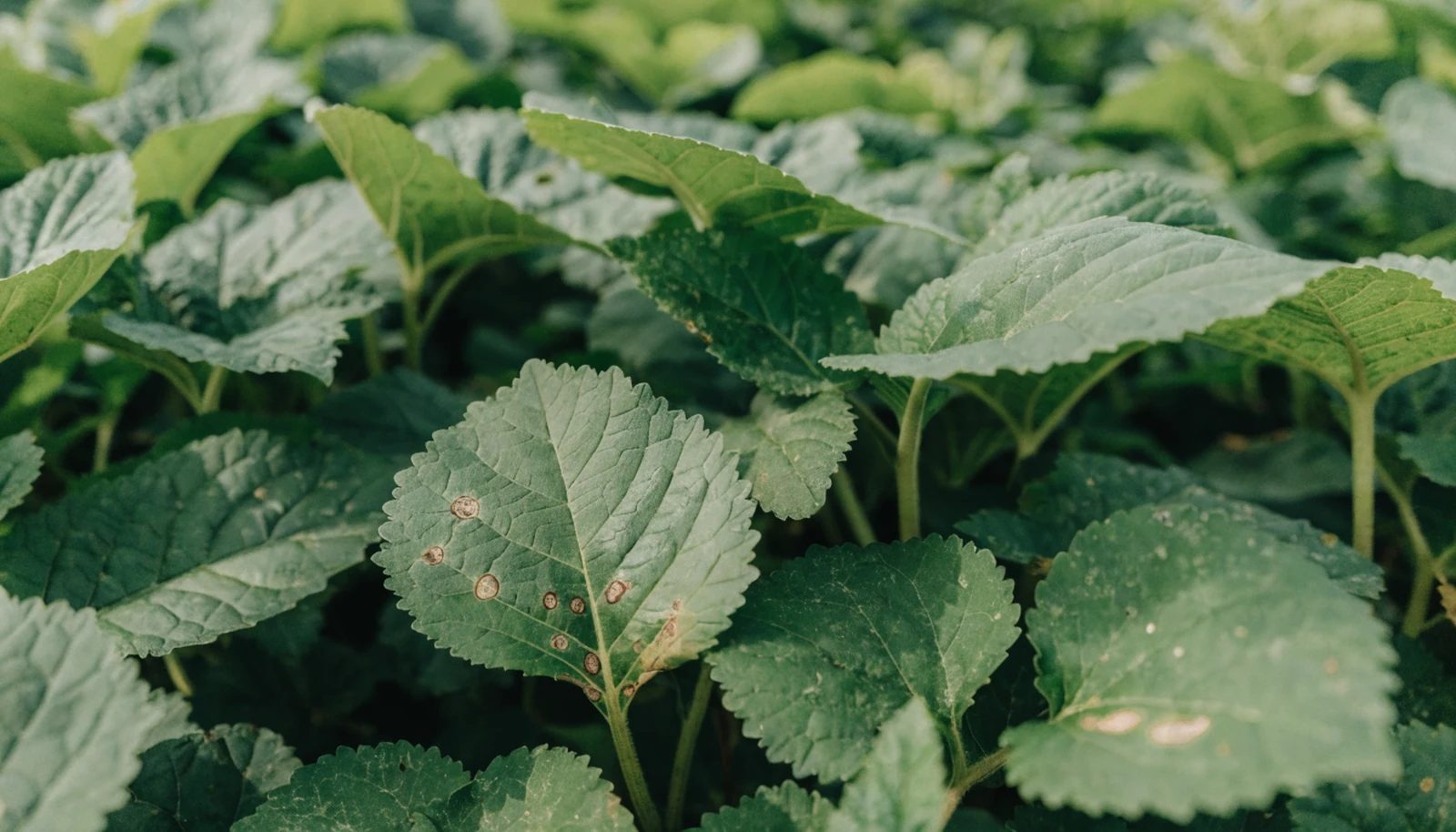
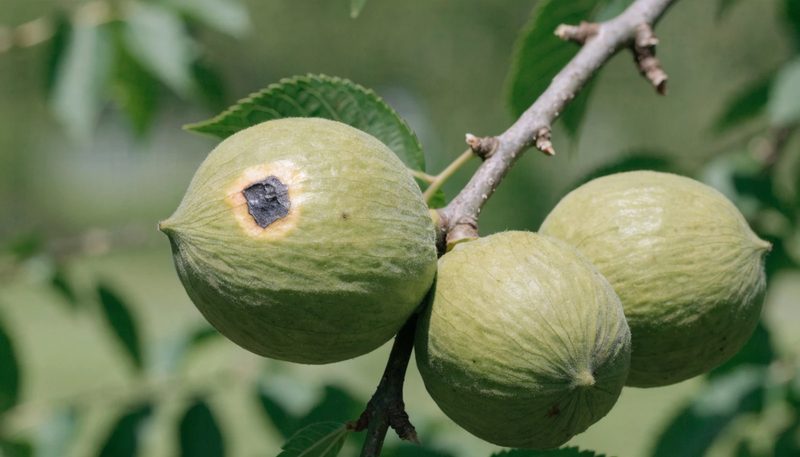
On nuts, look for small water-soaked spots on the husk that enlarge into sunken black lesions. On leaves, angular black or dark brown spots, often with a chlorotic halo, following the veins. On shoots, elongated dark lesions that can girdle and kill the shoot. On catkins, blackening and premature drop.
The critical identification step is not recognizing the lesion - it is cutting the nut. Early infection, while the shell is still soft, allows the bacterium through to the kernel: the kernel is destroyed and that nut is a yield loss. Late infection, after shell hardening (around mid-June in California), leaves a husk lesion and shell staining while the kernel remains intact: that is a grade loss, not a yield loss. These are economically different problems with the same external appearance, and only cutting the nut tells you which one you have.
Position within the tree is informative. Blight is worst low in the canopy and toward the interior, where drying is slowest - a Tehama County gradient recorded roughly 32% mid-canopy against approximately 70% low in the canopy. If your worst damage is high and on the outside of the tree, consider sunburn instead, which shows the inverse distribution.
Brown apical necrosis (BAN) is a related but distinct presentation. It appears at the blossom end of young nuts and causes drop. BAN is a complex rather than a single pathogen - Xaj together with Alternaria, Fusarium, Aspergillus niger, Colletotrichum and Phomopsis species. This matters practically: copper alone fails on BAN, because copper is only addressing one member of the complex.
What else looks like walnut blight?
Botryosphaeria and Phomopsis cankers appear in August and September rather than spring, enter through wounds, and colonize woody tissue. Pruning wounds remain susceptible for about four months, which is a long exposure window. Under a hand lens these produce pycnidia and perithecia; walnut blight produces neither.
Deep bark canker (Brenneria rubrifaciens) produces a reddish-brown ooze running from vertical cracks in the trunk and scaffolds, classically on Hartley. Shallow bark canker (B. nigrifluens) is confined to the outer bark. Neither is Xaj, and neither responds to a blight program.
Thousand cankers disease involves Geosmithia morbida vectored by the walnut twig beetle; the diagnostic sign is roughly 1 mm beetle entry holes associated with small cankers under the bark.
Sunburn on nuts is the commonest false positive. It is a dry, tan-to-brown surface injury on the sun-exposed side, concentrated high and outside in the canopy, without the water-soaked margin of a fresh bacterial lesion and without the low-canopy gradient.
How does walnut blight spread?
Bacteria overwinter in dormant buds and emerge with the developing tissue at bud break. From there, spread requires free water: rain splash and wind-driven rain move bacterial cells from bud and catkin sources onto susceptible tissue. Overhead irrigation is functionally equivalent to rain for this purpose, and unlike rain it is under the grower's control.
The epidemiology changes shape with the season. In a dry spring the disease behaves monocyclically - essentially one round of infection from the overwintered bud inoculum, with limited secondary spread. In a wet spring it becomes polycyclic, with each new lesion producing bacteria that seed the next infection event. This is why loss estimates for walnut blight span an enormous range depending on the year: roughly 10% in a dry spring, over 90% in a wet unprotected one, with CDFA citing losses up to 50%, Australian reports over 80%, and French figures of 50–80%.
Infection requires both a susceptible tissue stage and a wetness event, and susceptibility is concentrated in the period from catkin emergence through nut set. Chandler catkins emerge roughly 7–10 days before the pistillate flowers, which spreads the susceptible period out and is one reason catkin development is watched as a timing cue.
What conditions favor walnut blight?
Infection is governed by the interaction of temperature and wetness duration, and the relationship is not linear. At 10 °C infection is poor at any wetness duration. At 15 °C it takes 12–24 hours of wetness. At 20 °C it takes 18–24 hours. At 25 °C it takes only 6–9 hours. At 30 °C it takes 18–24 hours again.
The practical reading of that table is that the single most dangerous event in a walnut season is a warm rain at around 25 °C, because a brief shower that a grower might dismiss is sufficient. A long cold rain at 10 °C, which looks far more alarming, may deliver almost no infection.
High bud inoculum from the previous season raises everything. Dense canopies and slow-drying interiors extend wetness duration where the fruit actually is. Overhead irrigation adds wetness events at grower discretion; converting to under-canopy or drip removes them.
Cultivar phenology modifies exposure but is not resistance - see the section below.
What damage does walnut blight cause?
The economic distinction is between yield loss and grade loss, and it is set by the timing of infection relative to shell hardening. Nuts infected while the shell is soft lose the kernel entirely. Nuts infected after shell hardening carry husk lesions and shell staining that downgrade the lot without destroying the kernel.
Shoot blight kills current-season growth and reduces the following year's bearing wood. Catkin infection removes pollen and simultaneously creates a large local inoculum source at exactly the time the pistillate flowers are becoming susceptible.
BAN causes young nut drop at the blossom end and is often recorded separately from blight in farm records, which understates the total bacterial contribution to crop loss.
Spread within an orchard is by splash, so it is local and gradient-driven - worst in the slowest-drying parts of the canopy and of the block. Between-season spread is not by splash at all: it is the bud reservoir, carried through the winter inside the tree.
How do you monitor walnut blight risk?
Assess bud inoculum, not just visible disease. Because the previous season sets the current one, a block that had heavy blight last year should be managed as a high-risk block this year regardless of what is visible at bud break.
Track catkin development as the phenological cue for the start of the susceptible period, and remember that Chandler catkins run 7–10 days ahead of the pistillate flowers.
Watch temperature and wetness together, not rainfall totals. A wetness event should be evaluated against the temperature band it occurred in; the 25 °C short-duration case is the one most often missed.
Scout low and inside the canopy first, since that is where the gradient concentrates disease, and cut a sample of affected nuts to classify the damage as kernel loss or husk-and-shell staining.
A note on forecasting tools. "Prayer stage", percent catkin expansion and XanthoCast are California constructs and are used by advisers there as timing aids. XanthoCast is reported as a seven-day sliding index on a scale of roughly 0–35, although that scale is documented only in a single trade source and should be treated as unverified. No retrievable numeric action threshold exists for it, so this page does not publish one - use it as a relative risk indicator alongside local advice, not as a trigger number. A mechanistic infection model was published in 2025 (Plant Disease, PDIS-09-24-1850-RE); it is a research model, not a purchasable service.
How do you control walnut blight?
Copper is the backbone chemistry and is FRAC group M1, a multi-site protectant. It works only where it is deposited, and only before infection. Two practical points follow. First, products differ enormously in strength for the same nominal rate, so compare them on metallic copper equivalent (MCE), not on product volume. Second, copper resistance in Xaj is established in California and prominently in France, where SENURA has documented it - a copper program that used to work may no longer work, and that is a population change rather than an application failure.
Mancozeb tank-mixed with copper is the standard resistance-management response where it is registered. The reported outcome is striking: equal control at approximately 16 oz MCE in the mix versus approximately 64 oz MCE for copper alone. The mechanism usually offered for this is a chelation explanation that is not well substantiated, so this page states the outcome and not the mechanism.
Kasugamycin (FRAC 24) is registered in some jurisdictions and provides a second mode of action. The permitted number of applications per season is genuinely disputed in the extension literature - UC IPM guidance and reporting on a 2022 label revision differ - so no number is published here. Read the label that applies to you and follow it.
Spray programs scale with risk: roughly 2–3 applications in a low-risk year, 3–5 in a moderate one, and 5–8 or more in a high-risk year. Those numbers are only meaningful alongside the point below.
Coverage is efficacy. For a protectant material on a large walnut canopy, under-volume application and excessive ground speed are the commonest reasons a program fails, and they are far more common than genuine product failure. Before concluding that copper stopped working, verify water volume, nozzle configuration and travel speed.
Regulatory constraints differ sharply by region. In the EU, mancozeb was not renewed (Commission Implementing Regulation (EU) 2020/2087), removing the tank-mix partner. EU copper use is capped at 28 kg/ha over seven years under Regulation (EU) 2018/1981, covering 1 January 2019 to 31 December 2025, with the post-2025 position not confirmed here. Growers outside California and the EU should confirm local registrations rather than assuming the Californian program transfers.
How do you build a walnut blight program?
Treat the previous season as an input. Blocks that carried heavy blight are high-inoculum blocks and warrant the higher end of the spray program and the tighter timing.
Remove overhead irrigation where it is feasible. It is the one wetness event a grower controls outright, and it delivers infection under exactly the temperature conditions that matter.
Open the canopy through pruning so that the interior and lower canopy dry faster, targeting the zone where the damage gradient is worst. Note the timing conflict: pruning wounds remain susceptible to Botryosphaeria and Phomopsis for about four months, so schedule pruning to avoid the wet-weather infection period for those pathogens.
Build the program around the temperature and wetness table rather than the calendar. A short warm rain warrants a response that a long cold one does not.
Rotate modes of action where a second one is registered, and use MCE rather than product rate when comparing coppers and setting the program.
Verify sprayer output before the season, not after a failure.
On BAN, do not expect copper alone to solve it - the fungal partners in that complex are not addressed by a bacterial program.
A note on two commonly repeated measures. Nitrogen and vigor reduction is often recommended, but there is no controlled-trial support for it in walnut blight: the one French trial that is cited published no outcome data and simultaneously changed irrigation from drip to sprinkler, which confounds it. And mummy removal, while good orchard hygiene, is not a UC-attributed Xaj measure. Regarding soil: buds and infected tissue are the reservoir, and soil is not an important source - which is a statement about relative importance, not a claim that the bacterium is absent from soil.
Is any walnut cultivar resistant to blight?
Growers routinely ask which cultivar resists walnut blight. The honest answer is that cultivar differences in walnut blight are best understood as conditional phenological escape rather than resistance: a cultivar whose susceptible stage happens to miss the wet period in a given region and year looks resistant, and the same cultivar elsewhere does not.
Chandler is the clearest illustration, and the published record does not agree with itself. Adaskaveg's work found no disease on Chandler. UC farm advisers have documented over 50% crop damage on Chandler. A Spanish study rated both Chandler and Hartley as more vulnerable than Franquette. And Washington State University advises Pacific Northwest growers to avoid Franquette. These four positions cannot all be reconciled into a single ranking, and this page does not attempt to resolve them - each is reported here with its source so that growers can weigh the one closest to their own conditions.
A related point about lateral fruitfulness follows from arithmetic rather than from a published trial, and is offered here as reasoning rather than as a cited finding. Cultivars differ widely in the proportion of lateral buds that bear: Chandler and Howard at roughly 80–90%, Solano and Ivanhoe near 100%, Serr at 30–50%. A high lateral-bearing cultivar sets fruit over a longer stretch of the shoot and therefore presents susceptible tissue over a longer calendar window - plausibly three to four weeks of continuous protection requirement rather than a single tight window. Treat that as a hypothesis to check against your own bloom records, not as an established recommendation.
How do temperature and wetness set infection risk?
| Temperature | Wetness needed for infection | What it means in the orchard |
|---|---|---|
| 10 °C | Poor infection at any duration | A long cold rain looks alarming but delivers little infection |
| 15 °C | 12–24 hours | Overnight wetting into a damp morning is enough |
| 20 °C | 18–24 hours | Needs a sustained event; a passing shower is usually not enough |
| 25 °C | Only 6–9 hours | The dangerous case · a brief warm rain is fully sufficient and is the event most often dismissed |
| 30 °C | 18–24 hours | Risk falls again; heat itself is not the driver, the combination is |
Recommended Vegalab solution: Armour Boost
Integrated management. Walnut blight is a bacterial, no-cure problem - Vegalab products play a supporting role in an integrated program (plant health, prevention, root-zone support) and are not a control or a cure for this disease. The foundation is protectant timing against the temperature-and-wetness table, removing overhead irrigation, opening the canopy, managing carryover bud inoculum, and following the copper and mode-of-action rotation permitted on your label. The items below support tree condition alongside that program; they do not replace any part of it.
| Role | Product | Use |
|---|---|---|
| Plant resilience | Armour Boost | Silica for resilient tissue |
| Roots | Root Boost | Root-zone support for trees carrying heavy crop or heavy pruning |
| Soil biology | Charge BioBoost | Root-zone support to build suppressive soil biology |
How do you prevent walnut blight next season?
Next season's blight is being decided now. The bud inoculum you carry into spring is set by how much disease you allowed this year, and the measured gap between a high and a low bud-inoculum orchard is 61.4% against 2.6% crop damage - so the strongest preventive action available is controlling the current epidemic properly. Beyond that: convert overhead irrigation to under-canopy or drip if you have not already, because it is the wetness source you control. Prune to open the interior and lower canopy where the damage gradient is worst, scheduling that work to avoid the four-month window in which pruning wounds stay susceptible to Botryosphaeria and Phomopsis. Confirm which materials are registered where you farm before planning a program, since mancozeb is unavailable in the EU and copper use there is capped. Service and calibrate the sprayer before bud break, because coverage failures are the most common cause of a program that appears not to work. And record which of your blocks and cultivars carried damage this year, since cultivar behavior in walnut blight is local and your own records outrank any published ranking.
Key takeaways
- The dormant bud is the main overwintering reservoir, so last season's epidemic sets this season's risk.
- A brief warm rain at about 25 °C is the most dangerous event; at 10 °C infection is poor at any wetness duration.
- Infection before shell hardening destroys the kernel (yield loss); infection after it leaves husk lesions and shell staining (grade loss).
- Copper is the backbone protectant: it works only where deposited and before infection, and products should be compared on metallic copper equivalent.
- Under-volume application and excessive ground speed are the commonest reasons a program fails.
Claims and product availability vary by jurisdiction. Always read and follow the product label.