

Last updated:
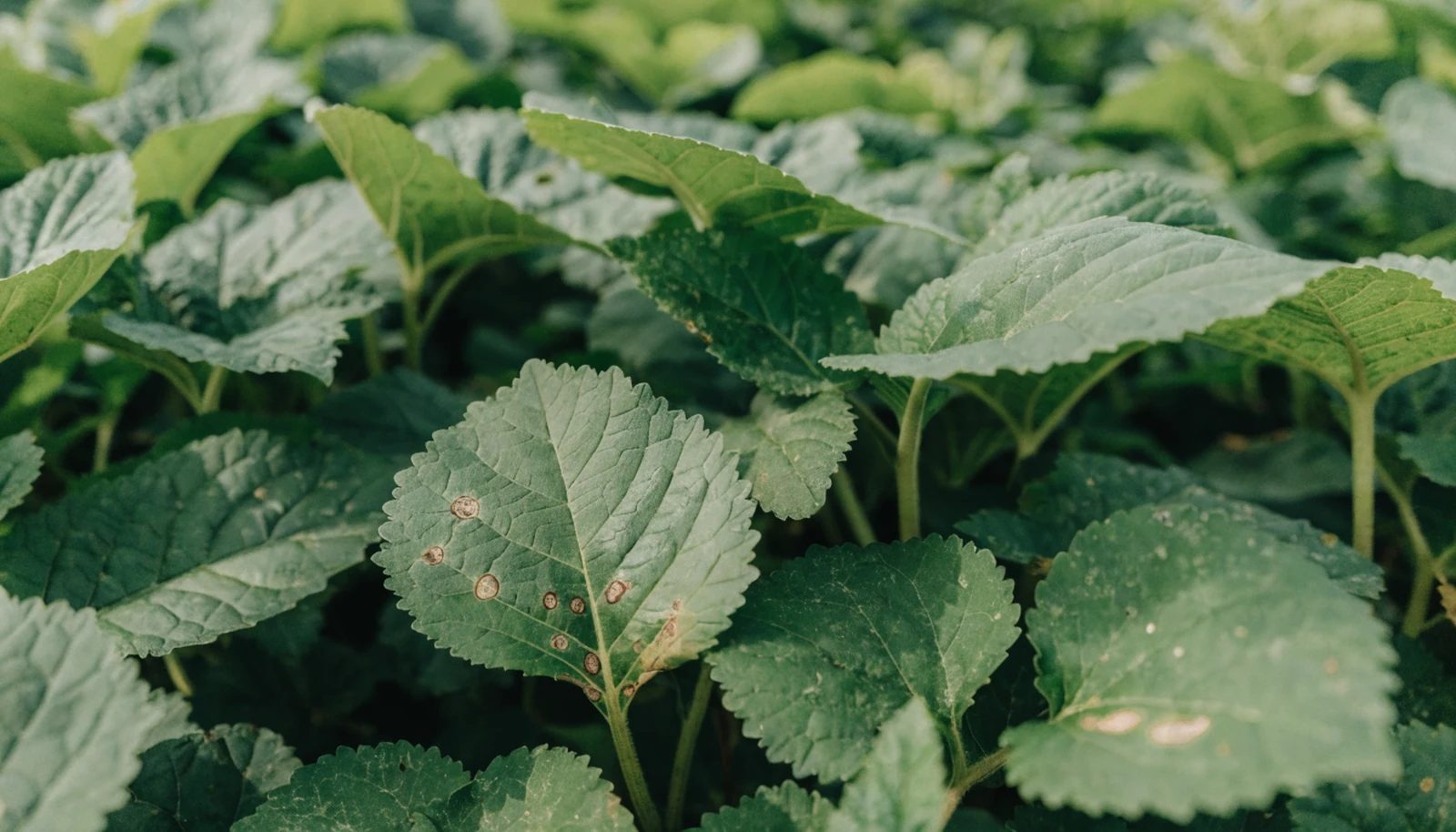
Bacterial blight of rice is caused by Xanthomonas oryzae pv. oryzae, a bacterium that lives inside the xylem, so no chemistry available to growers cures it once inside. Look for leaf lesions with a wavy margin, opaque tissue and milky ooze, or kresek, a seedling wilt in the first three weeks after transplanting. Confirm with the cut-stem streaming test, then manage with clean seed, water, nitrogen and resistance genes.
Crops affected

What is it?
Xanthomonas oryzae pv. oryzae (Xoo) is a rod-shaped, yellow-pigmented bacterium that colonizes the xylem vessels of rice. Infection begins when bacterial cells in a film of water are drawn into hydathodes - the water pores along the leaf margin that exude guttation droplets overnight - or are pushed into the plant through wounds. From the entry point the population moves down the vascular bundles, and the classic lesion is the visible record of that movement.
The same organism produces three clinically different diseases depending on plant age and route of entry. Leaf blight is the familiar one on established plants. Kresek is a systemic seedling wilt that follows root injury at transplanting. Pale yellow leaf is a chronic systemic form in which the visible symptom appears far from where the bacterium actually is. Growers who know only the first form routinely misdiagnose the other two.
Classical bacterial blight is not established in United States rice production. It is a defining constraint of irrigated and rainfed lowland rice across South and Southeast Asia, and it appears in parts of Africa, Australia and Latin America. Yield loss depends entirely on how early infection arrives: late leaf blight trims grain filling, while kresek in the first three weeks after transplanting can take out the stand.
How do you identify bacterial blight of rice?
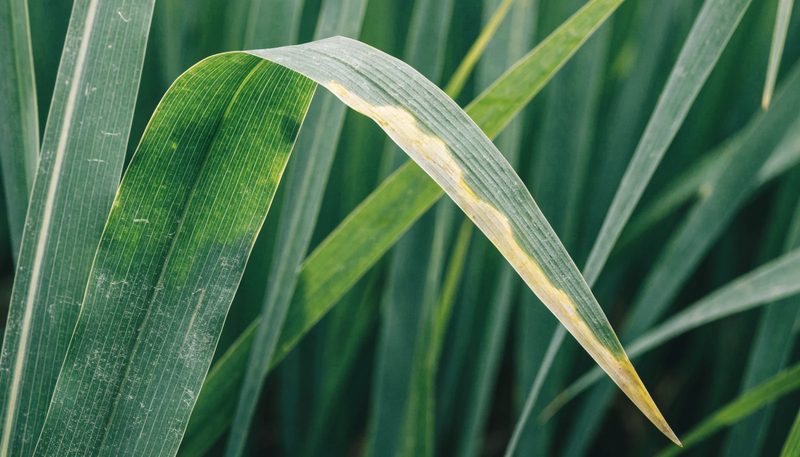
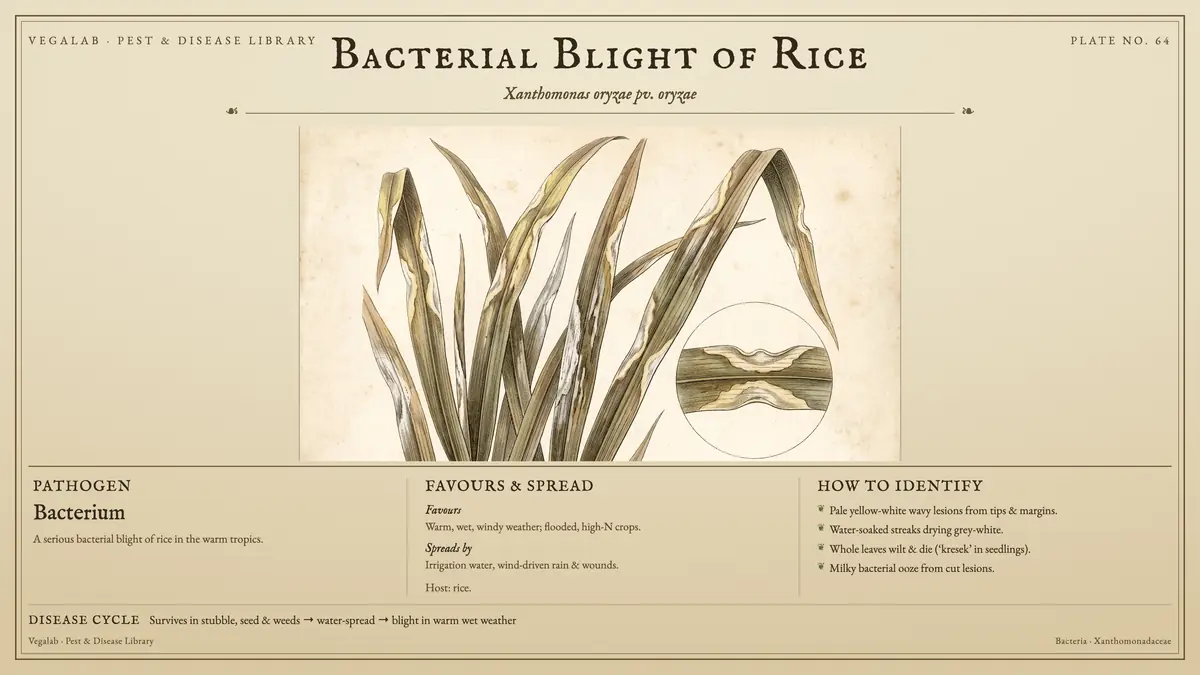
Leaf blight begins at the leaf tip or along a margin as a water-soaked streak, then turns yellow and finally straw-white as tissue dies. The single most useful visual character is the margin of the advancing lesion: it is wavy and undulating, not a straight line. Hold the leaf up to the light and the affected tissue is opaque, not translucent. In humid mornings the lesion exudes a milky bacterial ooze that dries into a thin yellow crust or small amber beads on the leaf surface.
Kresek is the seedling syndrome and it looks nothing like leaf blight. It appears within the first three weeks after transplanting. Leaves roll, turn grayish-green, then straw-colored, and whole hills wilt and die. There is no marginal lesion to find, because the bacterium entered through roots cut during pulling and transplanting and went straight to the vascular system. Kresek is best understood as a transplanting-injury disease, and it is the syndrome that destroys stands rather than trimming yield.
Pale yellow leaf is the trap. The youngest fully expanded leaf turns uniformly pale yellow, or carries a broad pale stripe, while older leaves stay green. The bacterium is in the crown and the internode - it is not in the yellow tissue. Sampling the discolored leaf returns a negative and the grower concludes it is a nutrient deficiency. Sample the crown and the lower internode instead.
The confirmatory field test is the cut-stem streaming test. Cut a tiller or a symptomatic leaf sheath cleanly, suspend the cut end in a glass of clear water, and view it against a dark background in good light. A positive shows dense milky turbid strands pouring from the cut vascular bundles within a minute or two. That stream is a mass of bacterial cells leaving the xylem, and no fungal or abiotic problem reproduces it.
What else looks like bacterial blight of rice?
Bacterial leaf streak, caused by X. oryzae pv. oryzicola, is the closest look-alike and the one most often confused. Streak enters through stomata rather than hydathodes and colonizes parenchyma rather than the vascular system. Its lesions therefore start anywhere on the blade rather than at the margin, run interveinal with straight, narrow, parallel sides, and appear translucent when held to the light. Streak never wilts the plant, because the bacterium is not in the plumbing. Wavy margin plus opaque tissue plus streaming means blight; straight-sided plus translucent plus no wilt means streak.
Leaf-tip drying from salinity or potassium deficiency mimics blight at a distance. It is uniform and symmetrical across the crop, follows a field gradient rather than appearing on scattered hills, has no wavy margin, and gives no streaming test. Mechanical tip damage from clipping seedlings before transplanting produces a straight cut line with browning below it.
Sheath blight produces irregular greenish-gray lesions with brown borders on sheaths near the water line, with visible mycelium and sclerotia; blast collar rot produces a dark constricted band at the leaf collar. Neither streams.
How does bacterial blight of rice spread?
Xoo survives between crops in rice stubble and straw, in ratoons and volunteers, in weedy grass hosts along bunds and channels, on and in seed, and in irrigation water itself. Irrigation water is a genuine vector, not a theoretical one: bacteria released from infected debris upstream are carried onto clean fields, and standing floodwater keeps them in contact with the crop.
Infection of established plants happens through hydathodes when a film of water bridges the leaf margin - overnight guttation, dew, rain, or splash from flooding. Once inside, the bacterium multiplies in xylem vessels and moves systemically. Ooze pushed out of the lesion in the morning is the inoculum for the next round, redistributed by rain, wind-driven rain, and leaves rubbing against each other in a dense canopy.
The kresek route bypasses all of that. Pulling seedlings from a nursery tears roots; transplanting pushes those cut roots into water carrying the bacterium. Every cut root is an open vascular entry point. This is why kresek clusters in the first three weeks and why nursery and transplanting practice matter more than anything sprayed later.
Typhoons and severe storms are the classic epidemic driver. They wound the canopy wholesale, spread inoculum across the field, and leave standing water. A blight epidemic in Asia is very often readable as the record of a storm two to three weeks earlier.
What conditions favor bacterial blight of rice?
The disease runs on warmth, water and nitrogen. The favorable band is roughly 25–34 °C with high humidity. Below that range progress slows sharply; above it the crop is usually past the vulnerable stage.
Deep flooding and continuously standing water increase disease. Water depth raises humidity in the canopy, keeps leaf margins wet, and carries inoculum between hills. Drainage cycles that let the soil surface dry between irrigations reduce it measurably, which is why water management is a control practice rather than an agronomic detail.
High nitrogen, especially a heavy single application, produces soft succulent tissue and a dense canopy that stays wet longer. Splitting nitrogen and reducing the total rate on blight-prone fields is one of the few levers that works during the season.
Anything that wounds the plant is a risk factor: storms, mechanical damage, insect feeding, and above all root injury at transplanting.
What damage does bacterial blight cause in rice?
Leaf blight destroys photosynthetic area during grain filling. Losses scale with how much flag leaf and penultimate leaf is lost and how early the loss occurs; a blight that arrives at heading costs far more than one at late dough.
Kresek kills plants outright. Because it hits within three weeks of transplanting, the crop has no time to compensate, and the loss is a stand loss rather than a yield trim. Replanting gaps into an infested field rarely pays.
Pale yellow leaf reduces vigor and grain fill chronically and is often booked as a nutrient problem, so its cost is systematically under-attributed.
Field-to-field spread runs on water and on human traffic. Irrigation channels move the bacterium between fields on the same system; tools, machinery, hands and boots move it within a field; and seed moves it between seasons and between regions.
How do you scout for bacterial blight of rice?
Start scouting in the nursery, not the field. Nursery symptoms and a history of blight in the source field predict kresek better than anything observed after transplanting.
For the first three weeks after transplanting, walk the field looking for wilting hills rather than for leaf lesions. Rolled grayish-green leaves on young plants warrant an immediate streaming test.
From tillering onward, inspect leaf margins in the early morning when ooze is still visible and guttation droplets have not yet evaporated. Check the upwind edges and any part of the field that stayed flooded longest.
Confirm every suspected case with the cut-stem streaming test before acting, and when the symptom is pale yellow leaf, take the sample from the crown and internode rather than from the discolored blade. A laboratory confirmation is worth having on a first occurrence in a district, because the management response to blight and to leaf streak differs.
Can sprays control bacterial blight of rice?
There is no curative chemistry for bacterial blight. This is the single most important operational fact on this page, and most wasted spend follows from ignoring it.
Fungicides do nothing. Xoo is a bacterium; the fungicide chemistries used against blast and sheath blight have no activity against it, and applying them for blight costs money and delays real action.
Copper is a surface protectant only. It cannot reach a bacterium already inside xylem vessels, and Xoo is diagnostically copper-tolerant - resistance to 0.001% copper nitrate is used as an identification character for the organism. Copper should not be presented to a rice grower as a blight solution.
Antibiotics are not an option and in most jurisdictions are not legal. India imposed a complete ban on streptomycin and tetracycline in agriculture effective 1 January 2024; the EU and UK do not permit antibiotics as pesticide active substances. Check the rules that apply where you farm, and expect them to prohibit this route.
What remains is genetics, sanitation and water. More than forty Xa resistance genes are described, and durable protection comes from pyramiding rather than from any single gene - combinations built around xa5, xa13, Xa21, Xa7 and Xa23 are the ones deployed in practice. One caveat matters enormously in kresek-prone systems: Xa21 confers adult-plant resistance, so a pyramid that leans on it will not protect seedlings against kresek. Match the gene stack to the syndrome you actually get.
How do you manage bacterial blight of rice?
Start with certified clean seed, and use hot-water seed treatment where the facility exists. Seed is the route by which blight arrives in a district that did not have it.
Do not clip seedling leaf tips. Clipping is done for handling convenience, and it opens vascular bundles at exactly the entry tissue, on every seedling, with one blade. If the blade passes through one infected seedling it inoculates the rest of the tray.
Handle seedlings to minimize root tearing, and transplant into fields that have been drained and dried rather than into standing water carrying debris from the previous crop.
Manage water actively. Drain and dry between irrigations where the system allows, avoid unnecessarily deep flooding, and keep field water from the worst-affected blocks out of clean ones.
Reduce total nitrogen on blight-prone fields and split what remains. Avoid heavy nitrogen ahead of a forecast storm period.
Remove the reservoir between crops: incorporate or remove stubble and straw, destroy ratoons and volunteers, and control weedy grasses on bunds and channel banks.
Sanitize tools and equipment between fields, and treat irrigation water as a vector when planning the order in which blocks are worked.
Why does the kresek window decide the season?
Bacterial blight is usually discussed as a leaf disease, but the losses that end seasons are concentrated in a three-week window immediately after transplanting, and that window is created almost entirely by farm practice rather than by weather.
Consider what happens in those three weeks. Seedlings are pulled, which tears roots. They may be tip-clipped, which opens vascular bundles. They are then set into standing water that may carry bacteria from the previous crop's residue or from an upstream field. Each of those steps is a decision, and each one is reversible.
By contrast, the leaf blight phase later in the season is driven by storms, humidity and canopy density - conditions a grower influences only partially, through nitrogen rate and water depth. The lesson is that the highest-leverage blight management happens before the crop looks like a crop, and that a grower who is scouting leaf margins at booting has already spent the part of the season where the decisions mattered most.
This also explains the resistance-gene caveat above. A variety chosen for a strong adult-plant gene stack can carry a field beautifully through the leaf blight phase and still lose hills to kresek, because the protection arrives after the vulnerable window has closed.
How do you tell the three bacterial blight syndromes apart?
| Syndrome | When it appears | What you see | Where to sample |
|---|---|---|---|
| Leaf blight | Tillering to grain fill | Water-soaked streak from leaf tip or margin turning yellow then straw-white; wavy undulating margin; tissue opaque to light; milky ooze drying to a yellow crust | Advancing lesion edge |
| Kresek | First 3 weeks after transplanting | Whole seedlings wilt; leaves roll and turn grayish-green then straw; no marginal lesion; entry was through cut roots | Base of the tiller |
| Pale yellow leaf | Mid-season, chronic | Youngest leaf uniformly pale yellow or with a broad pale stripe; older leaves stay green; often misread as nutrient deficiency | Crown and internode · not the yellow leaf |
| Bacterial leaf streak (different pathogen) | Any stage | Interveinal, narrow, straight-sided lesions anywhere on the blade; translucent to light; plant never wilts | Lesion, for laboratory confirmation |
| Salinity / potassium tip burn (abiotic) | Any stage | Uniform symmetrical tip drying following a field gradient; no wavy margin; no ooze; streaming test negative | Soil and tissue analysis |
Recommended Vegalab solution: Armour Boost
Integrated management. Bacterial blight is a no-cure problem - Vegalab products play a supporting role in an integrated program (plant health, prevention, root-zone support) and are not a control or a cure for this disease. The foundation is clean certified seed, avoiding seedling root and tip injury, draining and drying between irrigations, splitting and reducing nitrogen, removing stubble and ratoons, and choosing an appropriate resistance gene stack. Because the bacterium sits inside xylem vessels, nothing applied to the surface reaches it once infection is established, so everything below is positioned upstream of infection.
| Role | Product | Use |
|---|---|---|
| Plant resilience | Armour Boost | Silica for resilient tissue |
| Roots | Root Boost | Root-zone support through the transplanting establishment window |
| Soil biology | Charge BioBoost | Root-zone support to build suppressive soil biology |
How do you prevent bacterial blight of rice next season?
Next season begins with the residue of this one. Incorporate or remove straw and stubble, destroy ratoons and volunteers, and clear weedy grasses from bunds and channel banks, because those are where Xoo overwinters. Source certified clean seed and use hot-water treatment where it is available. Plan the nursery so that seedlings can be lifted with minimal root tearing and without tip clipping. Set the nitrogen program lower and in more splits on fields with a blight history. Check where your irrigation water comes from and which fields it has passed through, and sequence field operations so that the worst blocks are worked last. Where resistance genes are available, choose a pyramid rather than a single gene, and verify that it covers the seedling stage if kresek is your problem rather than late leaf blight.
Key takeaways
- The bacterium enters through hydathodes at the leaf margin, through wounds and through roots cut at transplanting.
- One pathogen causes three syndromes: leaf blight, kresek and pale yellow leaf.
- Deep flooding and heavy nitrogen increase disease; draining and drying between irrigations reduces it.
- Clipping seedling tips opens vascular bundles on every seedling and is an avoidable risk.
- Xa21 gives adult-plant resistance, so a gene stack relying on it does not protect seedlings against kresek.
Claims and product availability vary by jurisdiction. Always read and follow the product label.