

How does spinosad work?
Last updated:
Spinosad is an insecticide made of two compounds, spinosyn A and spinosyn D, produced by the soil bacterium Saccharopolyspora spinosa1,2. It attacks the nervous system of insects that eat or touch it, making their muscles flex uncontrollably until they are paralyzed and die, typically within 1 to 2 days1. Its main target is the insect nicotinic acetylcholine receptor3.
What is spinosad made from?
Spinosad is a natural substance made by a soil bacterium, Saccharopolyspora spinosa, and it is a mixture of two chemicals called spinosyn A and spinosyn D1,2. The bacterium was found in the 1980s in a soil sample collected at the site of an old rum distillery in the Virgin Islands6. Today the bacterium is grown in large fermentation vats and its active compounds are harvested, concentrated and formulated, so the finished product contains no live bacteria, only the compounds they produce6.
The U.S. Environmental Protection Agency has registered spinosad for use in pesticides since 1997, and it is found in over 80 registered pesticide products1. Many of these are used on crops and ornamental plants, others in and around buildings, in aquatic settings and as seed treatments, and they come as sprays, dusts, granules and pellets1. Some spinosad products are approved for organic agriculture1. The active ingredient itself is organic, but some products contain inert ingredients that keep them from being fully organic, so the label tells you which ones qualify6. Spinosad also appears in some drugs regulated by the U.S. Food and Drug Administration, used for head lice on people and fleas on dogs and cats1.
In North America, interest in spinosad peaks in June, in the main garden pest season, and is lowest in February. In the Southern Hemisphere, the same window falls around December and January.
How does spinosad kill insects?
Spinosad affects the nervous system of insects that eat or touch it. It causes their muscles to flex uncontrollably, which leads to paralysis and death, typically within 1 to 2 days1. University of California IPM classes it as a biological contact insecticide and miticide that disrupts the central nervous system of insects and mites2.
Its mechanism of action appears to be unique. The primary site of attack is the nicotinic acetylcholine receptor in insect nerve cells, and a secondary site is the gamma-aminobutyric acid (GABA) receptor3. For rotation planning, Cornell Vegetable Program guidance lists spinosad products in IRAC mode of action group 57.
Spinosad is not systemic. Some of it is absorbed when applied to leaves, but it does not readily spread from leaves to the rest of the plant1. It does move short distances into sprayed tissue, which is called translaminar activity, and that lets it reach thrips feeding in protected plant parts4.
Which pests does spinosad control, and which does it miss?
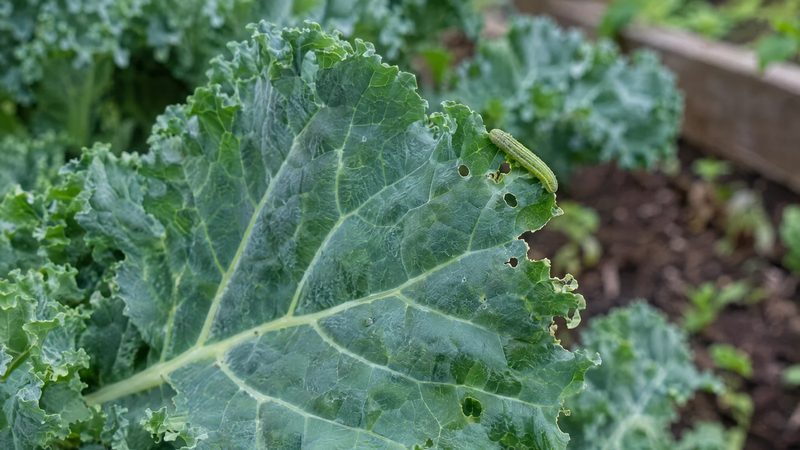
Spinosad works on a wide variety of pests, including thrips, leafminers, spider mites, mosquitoes, ants and fruit flies1. Mississippi State University Extension rates it especially useful for caterpillars, and much more effective than the Bt products gardeners traditionally used for them6. It also controls leaf-feeding beetles whose larvae feed on leaves, such as Colorado potato beetle6. For that beetle, Cornell guidance notes that one spinosad product gives very good control of larvae but no control of adults or eggs7.
It has clear gaps. Spinosad is not effective on true bugs such as stink bugs and leaffooted bugs, and it does not control cucumber beetles or cowpea curculios6. Because it is less toxic to many beneficial insects and mites, it is less likely than most other insecticides to trigger outbreaks of spider mites, whiteflies or aphids6.
| Pest group | What the sources report |
|---|---|
| Caterpillars (armyworms, loopers, cabbageworms, diamondback moth) | Especially useful; more effective than traditional Bt products6 |
| Thrips | Generally more effective than horticultural oils, insecticidal soaps and pyrethrins4 |
| Leafminers | Listed among the pests spinosad controls1,6 |
| Colorado potato beetle | Very good control of larvae; no control of adults or eggs with one product7 |
| Codling moth | Listed option, made more effective by adding horticultural oil5 |
| Fruit flies, ants, mosquitoes | Listed among the pests spinosad controls1 |
| Stink bugs, leaffooted bugs, cucumber beetles | Not effective or not controlled6 |
How do you use a spinosad spray?
Mix and apply it exactly as the product label directs; the label sets the rate, the interval and the crops it may be used on. On plants with a history of thrips damage, University of California guidance is to begin treatment early, when thrips or their damage first appear, and, unless the label says otherwise, to repeat applications as long as pest thrips and susceptible plant parts are both present4. A spinosad spray lasts 1 week or more, and adding horticultural oil to the spray mix can increase its persistence within plant tissue4. Pesticides alone rarely give good thrips control, so spraying works best combined with other methods4.
For codling moth, spinosad applications are timed to egg hatch, and UC IPM notes that 1% horticultural oil in the tank makes spinosad more effective5. Do not apply spinosad to plants that are flowering4.
Protect yourself while spraying. Exposure can happen through breathing spray or dust, or getting it on skin or eyes, for example when applying in windy conditions, and after use if you do not wash your hands before eating or smoking1. Read the label for protective equipment; many consumer labels list none, so basic gloves, long sleeves and goggles are still advised2.
Is spinosad harmful to bees, beneficial insects, people or fish?
Bees are the main concern. Spinosad is very highly toxic to bees, although evidence suggests it has little or no effect on honey bees and other beneficial insects after sprays have dried1. University of California guidance adds that spinosad can be toxic to certain natural enemies, such as predatory mites and syrphid fly larvae, and to bees when sprayed and for about 1 day afterward4. That is why it should not go on flowering plants4.
Spinosad is low in toxicity to people and other mammals, but it can cause irritation and redness if it gets on skin or in eyes1. When eaten it is readily absorbed, broken down, and mostly leaves the body within 1 to 2 days, and it is absorbed poorly through skin1. The EPA has classified it as not likely to cause cancer1.
| Organism | Reported toxicity |
|---|---|
| Bees | Very highly toxic; little or no effect after sprays have dried1 |
| People and other mammals | Low toxicity; skin and eye irritation possible1 |
| Birds | Practically non-toxic to slightly toxic1 |
| Fish | Practically non-toxic to moderately toxic, depending on species1 |
| Aquatic invertebrates | Slightly to moderately toxic; very highly toxic to eastern oysters1 |
| Earthworms | Moderately toxic1 |
How long does spinosad last, and can pests become resistant?
Sunlight breaks spinosad down rapidly. In sunlight, its half-life on leaves is 2 to 16 days and less than one day in water1. In soil, microbes break it down with half-lives of 9 to 17 days, and it binds to soil with a very low potential to move toward groundwater1. Without light it breaks down very slowly in water, but it binds rapidly to sediment1.
Resistance is real. Spinosad resistance has been selected for and characterized in several insect species; it is generally inherited as a single, recessive trait and cannot be overcome by adding insecticide synergists3. Colorado potato beetle can develop resistance to many insecticides, and Cornell guidance calls insecticide rotation within and across seasons vital for long-term control7. For the same beetle, Alberta's agriculture department identifies alternating pesticides from different chemical groups as one of the key methods to prevent resistance8. In practice, that means rotating spinosad with products from other mode of action groups and following any label limit on consecutive applications7.
Key takeaways
- Spinosad is a mixture of spinosyn A and spinosyn D from the soil bacterium Saccharopolyspora spinosa, registered in U.S. pesticides since 1997.
- It acts on insect nicotinic acetylcholine receptors, with GABA receptors as a secondary site, and kills by contact or ingestion within 1 to 2 days.
- It is most useful against caterpillars, thrips, leafminers and leaf-feeding beetle larvae, and weak on stink bugs and cucumber beetles.
- It is very highly toxic to bees while wet, so keep it off flowering plants and follow the product label.
- Resistance has been documented in several insects, so rotate it with other mode of action groups.
References
- Spinosad General Fact Sheet
- Pesticide Active Ingredients Database: spinosad
- Unraveling the mystery of spinosad resistance in insects
- Pest Notes: Thrips (UC ANR Publication 7429)
- Pest Notes: Codling Moth (UC ANR Publication 7412)
- Spinosad Insecticide (Bug's Eye View, Vol. 7, No. 25)
- Potato Seed Treatments and In-Furrow Insecticide Applications for Colorado Potato Beetle Resistance Management (VegEdge, Volume 18, Issue 3)
- Colorado Potato Beetle: Effective Chemical Control (Agdex 625-4)