

Are natural crop actives safe for fish and aquatic life?
Last updated:
The short answer
Several are not, and plant origin is no guide. Monoterpenes are generally harmful to fish at low concentrations, and saponins are among the more aquatically toxic natural actives in use. Keep applications, spills and rinsate out of ponds, ditches, drains and watercourses.
Why plant origin is not a guide here
Many plant secondary metabolites are defensive compounds, and several act by disrupting membranes. Saponins are surface-active and lyse gill and cell membranes, which is precisely why some have been used traditionally as fish poisons. A compound being plant-derived and breaking down quickly in soil says nothing about its acute toxicity to an organism living in water.
A multi-species aquatic toxicity study with species-sensitivity distribution modelling found tea-seed saponin the most aquatically toxic of three saponins tested, with an HC5 of 0.22 mg/L against 2.91 mg/L for quillaja and 22.9 mg/L for quinoa saponin - a hundredfold spread within one compound class.
What exposure looks like
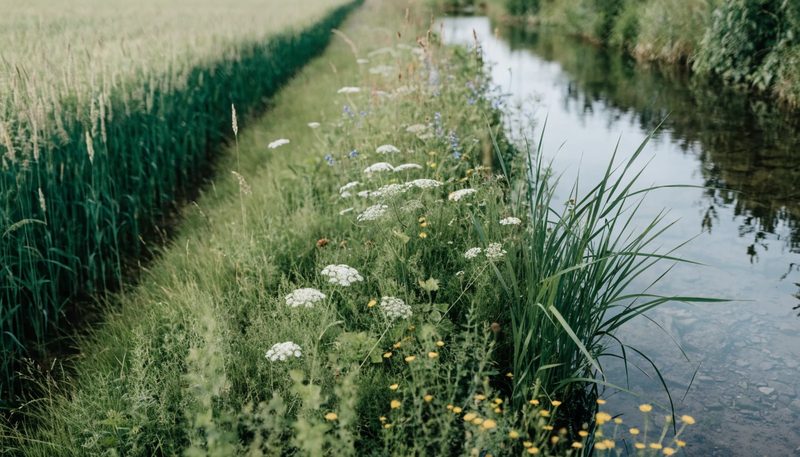
Direct overspray onto standing or running water. Drift onto a watercourse from an adjacent pass. Runoff from a treated surface after irrigation or heavy rain. Rinsate from tank washout, and spilled concentrate reaching a drain - which in most settings discharges to surface water.
What to do
Observe the no-spray buffer on the label beside any watercourse, pond, ditch or drain. Do not apply before heavy rain. Wash out tanks where the rinsate cannot reach a drain or watercourse, and dispose of it as the label directs. Bund and absorb spilled concentrate rather than hosing it away.
Treat drains as watercourses. In most sites they are.
When to get advice
Contact your environmental regulator immediately if product reaches a watercourse. For applications near sensitive water, check the buffer requirement on the applicable label and with your local authority before spraying.
Which compounds are rated, and how
Ratings come from the compound records, so the same vocabulary appears here and on each compound page.
| Compound | Rating | Why |
|---|---|---|
| Chlorine dioxide | avoid | Oxidant; do not discharge treated water containing residual to surface water without neutralisation. |
| Geraniol | avoid | Monoterpenes are generally harmful to fish at low concentrations. Keep applications and rinsate out of ponds, ditches and drains. |
Do not expose · Fish and aquatic life. Contact your environmental regulator immediately if product reaches a watercourse.
Do not expose · Fish and aquatic life. Contact your environmental regulator immediately if product reaches a watercourse.
References
Related reading
More in safety & stewardship
Products
No direct product mapping. This page examines a claim rather than a single ingredient, so no product maps to it directly.