


Does foliar feeding work?
Last updated:
Partly. Leaves absorb some nutrients, but foliar sprays cannot supply the large amounts of nitrogen, phosphorus, potassium, calcium and magnesium plants need, so those belong in the soil2,3. Foliar feeding works best for micronutrients such as iron and zinc, needed in small amounts and sprayed in chelated forms, where it gives a quick but often temporary fix2,4.
How do leaves absorb nutrients?
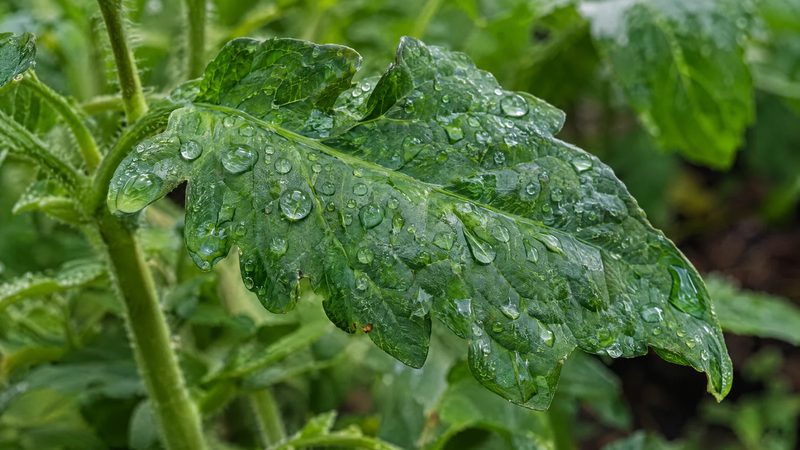
Leaves are built to capture light and limit water loss, not to take up nutrient solutions1,2,3. Most leaf surfaces are covered by the cuticle, a lipid-rich layer of cutin and waxes that protects the leaf and minimizes water loss1. A sprayed nutrient has to cross that cuticle or enter through the stomata, the leaf pores, and how much the stomata contribute is still unclear, though it can be significant and varies with species, leaf age and conditions1.
Alabama Cooperative Extension estimates that only about 15 to 20 percent of the material sprayed onto a leaf is actually taken in2. The cuticle thickens as a leaf ages and is heavier in hot climates2. A foliar fertilizer also has to be absorbed before it dries on the leaf or volatilizes, which is harder in hot, humid summer weather3.
Even researchers who study foliar fertilizers describe the understanding of what makes them work as incomplete1. Results depend on the spray formulation, the weather during application and the plant itself1.
In North America, interest in foliar feeding peaks in June as vegetable gardens grow fastest, and foliar sprays are best applied early in the morning and skipped on days above 85°F. In the Southern Hemisphere, the same window falls around December and January.
Is foliar feeding better than soil feeding?
For the major nutrients, no. Roots are the primary route by which nutrients enter plants, and a foliar spray supplies only a small amount of material with each application3. For nitrogen and potassium, foliar application cannot supply enough to meet crop needs, and spray solutions must be diluted to avoid burning the leaves, which shrinks the dose further3. Alabama Cooperative Extension advises applying nitrogen, phosphorus, potassium, calcium, magnesium and sulfur to the soil because plant requirements are higher than the foliage can supply2.
Cost follows from the dose. A Mississippi State University Extension worked example for hay found that supplying nitrogen from a foliar product would cost about 15 times more than supplying it from urea, and a University of Georgia trial it reports found bermudagrass yields reduced by almost 50 percent with a foliar nitrogen fertilizer compared with conventional nitrogen3.
Foliar sprays earn their place in specific situations: when soil conditions limit the availability of soil-applied nutrients, when losses from soil application are high, or when growth stage, demand and weather limit delivery of a nutrient to critical organs1.
| Question | Foliar feeding | Soil feeding |
|---|---|---|
| Main route into the plant | Through the cuticle and stomata1 | Through the roots, the primary route3 |
| Amount per application | Small, because sprays must be dilute3 | The primary supply route for nitrogen, phosphorus and potassium2,3 |
| Best suited to | Micronutrients such as iron, zinc and boron2 | Macronutrients: nitrogen, phosphorus, potassium, calcium, magnesium, sulfur2 |
| Speed | Iron sprays can green leaves within days4 | Iron chelates in soil can respond quickly if the right chelate is used4 |
| Main risk | Leaf burn from strong solutions or heat2,3 | Nutrients tied up by soil conditions such as high pH4 |
Which nutrients work as foliar sprays?
Micronutrients are the best fit. Zinc, boron, copper, iron, manganese and molybdenum are needed in small amounts and can be applied through the foliage, but only in a formulation made for foliar use, such as iron or zinc chelate2. A Mississippi State University Extension article on foliar products makes the same distinction: foliar sprays can quickly correct a micronutrient imbalance but are not a replacement for nitrogen and potassium3.
How far a nutrient travels after it enters the leaf matters too. Nutrients differ in how easily they move through the phloem, the plant's sugar-carrying tissue, so sprays of the more mobile nutrients are more likely to benefit the whole plant1. In many species, zinc, manganese, calcium and iron sprays act mostly where they land, with very limited transport out of the sprayed leaves, although that local benefit can still matter1.
Leaf age changes the picture as well. Immature leaves cannot export nutrients until they mature, while mature leaves export to young leaves and roots but do not import, as radioactive phosphorus tracing in bean seedlings showed1.
| Mobility class | Nutrients | What it means for a foliar spray |
|---|---|---|
| Highly mobile | Nitrogen, phosphorus, potassium, magnesium, sulfur, chlorine, nickel1 | More likely to move beyond the sprayed leaf1 |
| Intermediate or conditionally mobile | Iron, zinc, copper, boron, molybdenum1 | Movement varies; iron and zinc often stay local1 |
| Rather immobile | Calcium, manganese1 | Effect mostly limited to the sprayed tissue1 |
Does foliar feeding work on tomatoes?
The most common reason gardeners spray tomatoes is blossom end rot, and for that, foliar calcium does not work. Blossom end rot is a localized calcium deficiency in the fruit, and it can occur even when soil calcium is adequate5,6. Calcium travels with water in the xylem from the roots, calcium already in the leaves cannot move through the phloem into the fruit, and the fruit skin cannot absorb sprayed calcium5. Nebraska Extension adds that tomato fruit have no openings in the skin through which surface-applied calcium could enter6.
Alabama Cooperative Extension describes foliar calcium as at most a stop-gap that may slow the condition, never a cure, and recommends proper liming or calcium-containing fertilizers such as calcium nitrate instead2. The most effective prevention is uniform soil moisture, helped by mulch, drip irrigation and a soil test before planting5,6. Excess nitrogen also makes blossom end rot worse, because extra leaf growth draws calcium-carrying water away from the fruit6.
When does foliar feeding make sense?
Iron chlorosis is the classic case2,4. In alkaline soils above pH 7.0, iron is fixed into insoluble forms that roots cannot absorb, so soil applications of plain iron are ineffective4. Symptoms are yellow leaves with green veins, appearing first on new growth, while nitrogen deficiency yellows the whole leaf, veins included, starting on older leaves4.
Foliar sprays of iron sulfate or iron chelates can green leaves within days, but the response is often spotty and temporary, several applications per season may be needed, and the effect does not carry over to the next year4. Complete coverage is essential, because untreated leaves stay yellow, which makes foliar treatment of large trees impractical4. For iron-loving shrubs such as dogwoods, hollies and azaleas, two to three iron chelate applications can relieve the deficiency2.
Diagnose before you spray. A soil test and leaf tissue analysis show whether a spray addresses the actual problem2. Tissue analysis is a diagnostic tool for a nutrient imbalance, not a basis for a season-long fertilizer program3.
How do you foliar feed without burning leaves?
Follow the product label and never exceed the labeled rate, because stronger solutions burn leaf tissue2. Too much nitrogen in a foliar mix is a common cause of that burn3. With iron, the margin between a concentration that greens leaves and one that burns them is small, and iron burn can turn leaf tissue black4.
Timing matters as much as rate. Apply foliar nutrients early in the morning, and avoid spraying on days above 85°F, when the risk of burn is greatest2. For iron sprays, Colorado State University Extension suggests evenings or cloudy days, when slower drying helps, and notes that chelated iron sprays are inactivated by sunlight4.
Key takeaways
- Leaves absorb only a small share of what is sprayed on them, so foliar feeding supplements soil fertility rather than replacing it.
- Nitrogen, phosphorus, potassium, calcium, magnesium and sulfur belong in the soil.
- Micronutrients such as iron and zinc, in chelated forms, are where foliar sprays work best, though the effect is often temporary.
- Foliar calcium sprays do not fix blossom end rot on tomatoes; steady soil moisture does more.
- Spray early in the morning, skip days above 85°F and follow the product label to avoid leaf burn.
References
- From plant surface to plant metabolism: the uncertain fate of foliar-applied nutrients
- Foliar Feeding Vegetables
- Foliar Fertilizers: How They Might Fit in Your Hay Operation? (Forage News, Volume 8, Issue 6)
- Iron Chlorosis of Woody Plants
- Gardening Myths: Fix Blossom End Rot with Calcium Sprays
- Blossom End Rot in Tomatoes (G1752)
Frequently asked questions
Should you spray the tops or undersides of leaves?
Alabama Cooperative Extension notes that the stomata are found mainly on the undersides of leaves, while the upper surfaces are usually coated with waxy substances2. Researchers report that the stomatal route can be significant, though its overall contribution is still unclear1. Covering both surfaces as the product label directs is the practical answer.
How fast does foliar feeding work?
Why do leaves look greener after a foliar spray if yields do not rise?
Do Epsom salt sprays work?
Epsom salts (magnesium sulfate) are commonly applied to the foliage or the soil to correct magnesium deficiency, which in cole crops often traces to improper pH or lime without magnesium2. Magnesium is one of the more phloem-mobile nutrients1. A soil test before planting is the better guide to what the soil needs2.