


What order should you apply skincare products?
Last updated:
Apply skincare from the thinnest, most watery product to the thickest: cleanser, then toner or essence, then serum or ampoule, then moisturizer, with sunscreen as the last step every morning. Serum goes before moisturizer, because creams and oils form a film that holds water in. At night, retinoids and acids go on clean, dry skin before moisturizer.
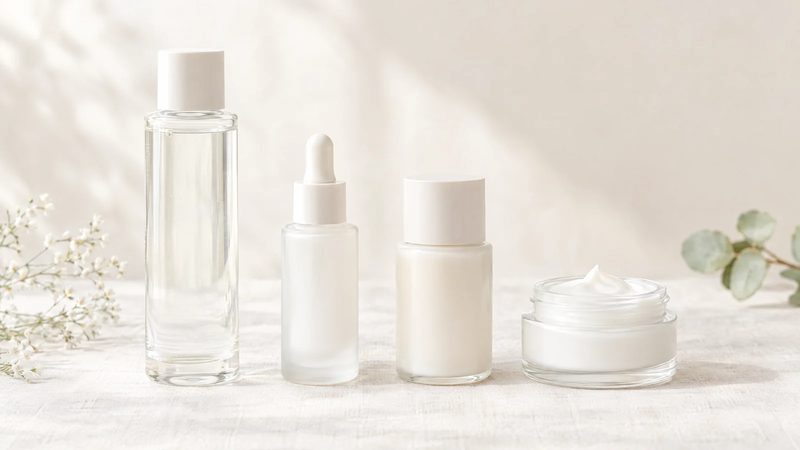
What is the right skincare order, morning and night?
Each step has a job, and the order lets each one reach the skin. Retinoid labeling gives the starting point: clean the skin gently, pat it dry, and apply a thin layer5,6. Moisturizers built with occlusive ingredients form a water-repelling film that limits water loss, so they belong near the end2. In the morning, sunscreen goes on last, 15 minutes before you go out1.
The table below shows a complete sequence. Most people do not need every step.
| Step | Morning | Evening |
|---|---|---|
| 1 | Cleanser, or a water rinse | Cleanser; remove makeup and sunscreen first |
| 2 | Toner or essence (optional) | Toner or essence (optional) |
| 3 | Serum or ampoule, for example vitamin C | Active step on clean, dry skin: a retinoid, or an acid on a different evening |
| 4 | Moisturizer | Hydrating serum or ampoule (optional) |
| 5 | Broad spectrum sunscreen, SPF 15 or higher | Moisturizer or night cream, last |
Why do thinner, water-based products go before creams and oils?
Moisturizing ingredients fall into three groups that work in different ways2. Humectants such as glycerin, hyaluronic acid, panthenol and urea attract water into the outer layer of skin2. Emollients, such as fatty acids and fatty alcohols, influence barrier function and skin repair2. Occlusives, mostly oil based, create a hydrophobic barrier that blocks water from evaporating2.
Those roles set the order. Humectants can increase water loss on their own, because they pull water from deeper skin into the surface where it evaporates, so they are frequently combined with occlusives2. A watery serum or essence full of humectants goes on first, and a cream or oil with occlusive ingredients goes on top to hold that water in2.
Petrolatum is the most effective classic occlusive: at 5% or more it can reduce transepidermal water loss by more than 98%2. That film is the reason the heaviest, most occlusive product goes last.
Do you apply serum before or after moisturizer?
Before. Most moisturizers combine humectants, emollients and occlusives, and the occlusive part forms a film that holds water in2. Apply the serum first so it reaches clean skin, then the moisturizer over it.
The order matters less than many routines suggest. In a laboratory study on human skin, a 15% azelaic acid gel was applied either 15 minutes before or 15 minutes after three common moisturizing lotions, and total absorption, absorption rate and the amounts found in the epidermis and dermis did not differ significantly between the two orders3. For two of the three lotions, applying the lotion first showed a trend toward greater early absorption of the active3.
That study tested one active and three lotions on skin from three donors, so it does not settle every combination3. It does suggest that a sensible order and steady daily use matter more than precise timing between layers.
Ampoule or serum first?
Put the thinner, more watery of the two first. Judge by texture rather than by name, and follow the same logic as humectants under occlusives: water-based layers first, anything creamy or oily after2.
If both products are equally light, apply first the one holding the ingredient you most want in contact with clean skin, then wait until it has absorbed before the next layer. If one of the two is an active such as a retinoid or an acid, it goes onto dry skin, with hydrating layers after it5,6.
Where do vitamin C, retinol and exfoliating acids go in the order?
- Vitamin C, in the morning, after cleansing and before moisturizer and sunscreen. It is one of the most potent antioxidants in skin, and sunscreens only partly block the free radicals that ultraviolet light generates4. L-ascorbic acid needs a pH below 3.5 to stay stable and penetrate4, so apply it to clean skin as the first leave-on step.
- Retinoids, at night, on clean dry skin, in a thin layer5,6. Tretinoin information directs use at bedtime and says a doctor may recommend a moisturizer for dryness5.
- Exfoliating acids, at night and on a different evening from a retinoid. FDA studies found that four weeks of alpha hydroxy acid use raised sensitivity to UV-induced reddening by 18%7.
- One active at a time while you start. Over-the-counter adapalene labeling warns that irritation is more likely when more than one topical acne product is used at once6.
Where does sunscreen go, and how many steps do you need?
Sunscreen is the last skincare step in the morning. FDA advises applying it 15 minutes before sun exposure, using a broad spectrum product of SPF 15 or higher, and reapplying at least every two hours, more often when swimming or sweating1. An average adult needs at least one ounce, about a shot glass, to cover the whole body1.
Fewer steps are often enough. In a 2026 survey of 168 Dutch dermatologists and residents, 91.6% expressed concern about the popularity of multi-step routines, 88.1% regularly saw skincare-related skin problems, and only 12.5% actively recommended multi-step routines8. Nearly all of them named daily sunscreen as essential8.
A three-step base of cleanser, moisturizer and morning sunscreen covers the essentials. Add a serum when you have a specific goal, and add one active at a time.
Key takeaways
- Go from thinnest to thickest: cleanser, toner or essence, serum or ampoule, moisturizer, then sunscreen in the morning.
- Serum goes before moisturizer, because occlusive ingredients in creams and oils seal water in.
- Retinoids and acids go on clean, dry skin at night, on separate evenings.
- Sunscreen is the last morning step: SPF 15 or higher, 15 minutes before sun, reapplied every two hours.
- Dermatologists favor simple routines plus daily sunscreen over long multi-step ones.
References
- Sunscreen: How to Help Protect Your Skin from the Sun
- The Role of Moisturizers in Addressing Various Kinds of Dermatitis: A Review
- Impact of Order of Application of Moisturizers on Percutaneous Absorption Kinetics: Evaluation of Sequential Application of Moisturizer Lotions and Azelaic Acid Gel 15% Using a Human Skin Model
- Topical Vitamin C and the Skin: Mechanisms of Action and Clinical Applications
- Tretinoin Topical: MedlinePlus Drug Information
- DIFFERIN (adapalene) gel 0.1%: Drug Facts (over-the-counter label)
- Alpha Hydroxy Acids
- Dermatologists' Perspectives on Skincare Routine Trends
Frequently asked questions
How long should you wait between skincare steps?
Should you apply moisturizer to damp skin?
Where does facial oil go in a routine?
Near the end, after water-based serums and before sunscreen in the morning. Most occlusives are oil based, form a hydrophobic film over the skin and have their greatest effect on dampened skin2.
Do you need a 10-step skincare routine?
No. Only 12.5% of dermatologists in a 2026 survey actively recommended multi-step routines, and the authors reported that professional recommendations emphasize simplicity and daily sun protection8.