

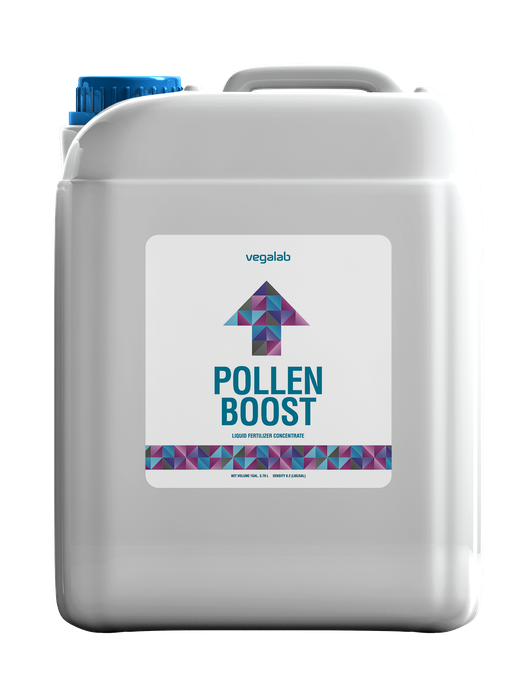
Pollen Boost
Pollen Boost improves pollination rate, fruit-set and new-shoot development. Propolis and seaweed with balanced N-P-K and micronutrients support flowering and the critical pollination window for better fruit numbers.
Biological bloom enhancer · Bloom enhancer, Propolis + seaweed.
- Zero REINo re-entry wait
- Zero PHIHarvest the same day
Biological bloom enhancer from Vegalab Crop Science, powered by Propolis · seaweed · N, P, K + micronutrients. Pollen Boost targets Pollination rate, fruit-set, new-shoot development.
Shipping $20 + $5 per gallon, calculated at checkout. Online orders up to 50 gallons; contact us for larger loads. Not available for delivery to Canada.
Secure checkout on Shopify. Each store keeps its own bag.
Supplies the macro- and micronutrients needed at pollination. Propolis attracts bees to the flowers while brown-seaweed bio-stimulants encourage new flower buds and shoots - maximizing fruit production and reducing deformation.
| Active | Propolis · seaweed · N, P, K + micronutrients |
|---|---|
| Targets | Pollination rate, fruit-set, new-shoot development |
| Dilution rate | 1:500 · 2 mL/L (7.6 mL/gal) · 1.0–1.5 L/ha (13.8–20.8 fl oz/acre) |
| Application | Foliar spray at flower-bud differentiation |
| Line · Category | Boost · Biological bloom fertilizer |
- Improves pollen viability
- Increases fruit-set percentage
- Reduces bloom-stage flower drop
- Supports embryo development
| Nutrient | Content |
|---|---|
| N | 3% |
| P | 3% |
| K | 5% |
| Mg | 0.03% |
| S | 0.8% |
Derived from: Urea · Mono-potassium phosphate · Potassium chloride · Magnesium sulfate
Contains: Protein hydrolysate · Seaweed extract (Sargassum) · Propolis · Citric acid · Sucrose · Glutamine
Why is the pollination window so critical?
The number of flowers that successfully set fruit largely determines yield, and that is decided in a narrow window around bloom. Poor pollination or weak fruit-set - from stress, weather or nutrition - can cap yield no matter how well the rest of the season goes. Supporting the crop through flowering protects that potential.
How does Pollen Boost improve fruit-set?
Pollen Boost (3-3-5) combines propolis and seaweed extract with nitrogen, phosphorus, potassium and micronutrients (Mg, S). The blend supports flower quality and the energy demands of pollination and early fruit-set, helping more flowers convert to fruit while also supporting new-shoot development through the reproductive phase.
When and how should it be applied?
- Establishment
- Vegetative
- Pollination windowPre-flower
- Flowering
- Fruit set
- Fruit development
- Ripening
- Harvest
Apply during Pre-flower and Flowering.
- Method
- Foliar spray
- Rate
- 1:500 · 2 mL/L · 1.0–1.5 L/ha1:500 · 7.6 mL/gal · 13.8–20.8 fl oz/acre · Work out your rate
- Pack sizes
- 3.8 L, 9.5 L1 gal, 2.5 gal
- Area treated
- 3.8 L treats 2.5-3.8 ha; 9.5 L treats 6.3-9.5 ha1 gal treats 6.2-9.4 acres; 2.5 gal treats 15.6-23.4 acres
- Pre-harvest interval
- Zero - harvest the same day
- Re-entry interval
- Zero - no re-entry wait
Treat just before and into bloom.
Always read and follow the applicable product label.
Apply as a foliar spray ahead of and during flowering - timing it to the pollination window is what drives the fruit-set response. Treating just before and into bloom supports flower quality and the early set, when the crop is most sensitive to nutritional shortfalls.
Which crops is it for?
Pollen Boost has been tested on apples, stone fruit, tomatoes, vines and almonds - crops where fruit-set and pollination directly govern yield, and where a poor set window is costly. It is especially relevant for tree fruit and nuts that flower in variable early-season conditions.
What roles do propolis and seaweed play?
Propolis and seaweed extract bring bioactive compounds that support flower vitality and the plant's stress response during the demanding bloom period, alongside the balanced N-P-K and micronutrients that fuel pollination and set. Together they help the crop hold and develop more of the flowers it produces.
Need a recommendation for your crop or pest?
Contact usFrequently asked questions
What is the application rate for Pollen Boost?
1:500 · 2 mL/L (7.6 mL/gal) · 1.0–1.5 L/ha (13.8–20.8 fl oz/acre) Application: Foliar spray at flower-bud differentiation.
Is Pollen Boost suitable for natural or organic programs?
Pollen Boost supplies Propolis · seaweed · N, P, K + micronutrients in a formulation designed to fit low-residue and IPM programs.
What does Pollen Boost do?
Improves pollination rate, fruit-set and new-shoot development.
What is the analysis?
N 3%, P 3%, K 5% (NPK 3-3-5), with propolis, seaweed and micronutrients.
When should I apply it?
Ahead of and during flowering, in the pollination window.
Which crops is it for?
Apples, stone fruit, tomatoes, vines and almonds.
What do propolis and seaweed add?
Bioactive compounds that support flower vitality and stress response during bloom.
The evidence behind these actives
Reference pages on the actives this product declares - mode of action, limits and the published sources, written independently of the product listing.
Problems addressed
Supports the root zone where these problems establish. Reference links only - see the label for approved uses.
Pest & disease library
See all plant pests & diseases →
Reference links to identification and management guides. Claims and product availability vary by jurisdiction - always read and follow the product label.
Last updated: