

Last updated:
Springtails (Collembola) are tiny, wingless soil arthropods about 1/16 inch long that jump with a forked tail and feed on fungi, algae and decaying plant matter.1 In houseplants and garden soil they signal excess moisture; they do not bite people or pets and rarely injure established plants.1,6 Let the soil dry between waterings, empty saucers and fix damp spots to reduce them.1
What are springtails?
Springtails (order Collembola) are tiny, wingless arthropods now usually classified as entognathous hexapods, a sister group to the insects rather than true insects.2 Most are about 1/16 inch long and whitish, bluish or dark gray to black, and the immatures look like small, paler adults.1 Species range from 0.2 to 10 mm, but those that invade homes are mostly 1 to 2 mm.3
Their name comes from the furcula, a forked structure folded under the abdomen that snaps down to launch them several inches into the air, which is why they are sometimes called jumping dirt and often mistaken for fleas.1,2 Unlike fleas, they do not bite or spread disease.1
Springtails are among the most abundant soil animals on Earth. A global dataset from 2,470 sites estimated their total biomass at 27.5 megatons of carbon, three times that of wild terrestrial vertebrates, with peak densities of up to 2 million per square meter in tundra.7 In moist, organic garden soils, populations can reach thousands per square foot.2
| Feature | Springtails | Fungus gnats |
|---|---|---|
| Wings | None | Adults have light gray to clear wings |
| Size | About 1/16 inch | Adults 1/16 to 1/8 inch |
| How they move | Jump with a forked tail (furcula) | Adults fly; larvae stay in the soil |
| Young stage | Looks like a small, paler adult | Legless, whitish larva with a shiny black head |
| What they eat | Fungi, molds, algae, decaying plant matter | Organic matter and fungi; larvae also feed on roots |
| Risk to houseplants | Very little, if any | Root damage in large numbers, worst on seedlings |
In North America springtails are most noticeable in spring and early summer, and house invasions peak in summer after a wet spring turns hot and dry1,2. In the Southern Hemisphere the same pattern runs about six months later, with spring and early summer falling from September to December.
Why are there springtails in my houseplant soil?
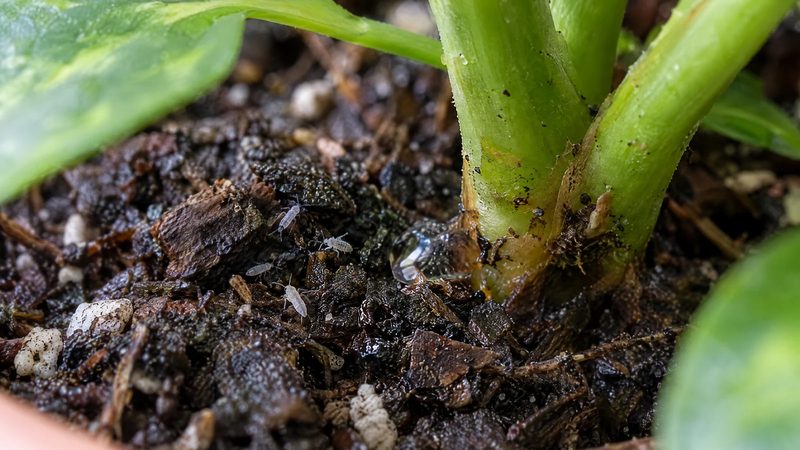
Springtails occasionally develop in houseplant soil and are most often noticed just after watering, when they move from the saturated soil to the surface.2 They can be abundant in overwatered pots and in growing media high in organic matter or compost.5,6 They arrive in unpasteurized potting soil, through contact between plants, or by moving in from nearby outdoor habitat.5
Seeing them is a moisture signal rather than an emergency. In potting soil they do very little, if any, damage to the plant, and they do not harm established plants.2,6 In greenhouses they also turn up on yellow sticky cards or drop onto white paper when plants are tapped to check for thrips, and they are sometimes confused with thrips larvae.5
Are springtails in soil good or bad for plants?
Mostly good. Springtails feed on fungi, molds, algae, bacteria and decaying plant material, and some prey on nematodes, so they are generally considered beneficial nutrient recyclers.1,5 Through that feeding they influence the growth of bacteria, fungi and plants and support nutrient cycling, and they are an important food source for soil and surface predators.7
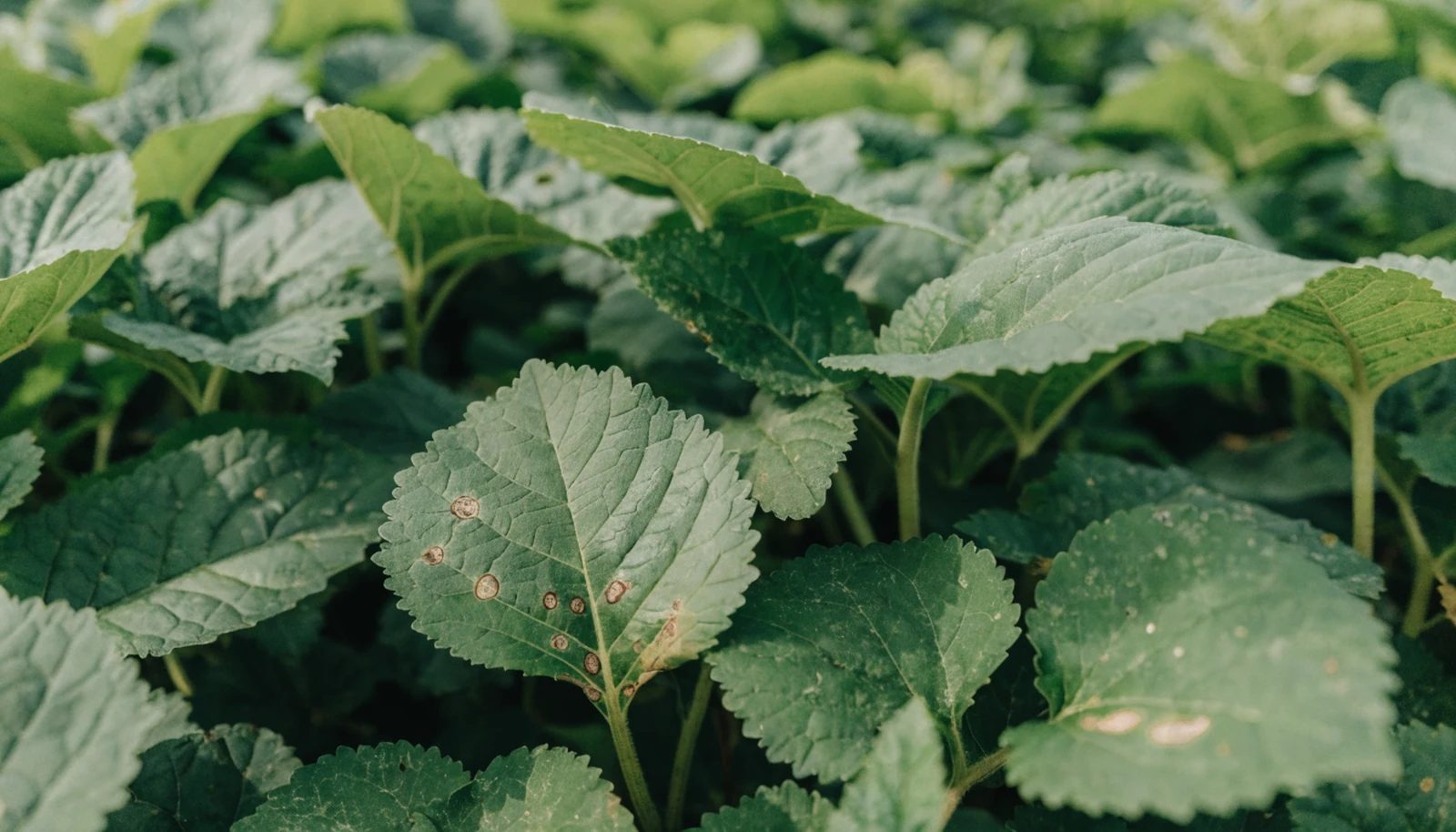
A few species cause damage. Some springtails chew the roots and leaves of seedlings, leaving small rounded pits or irregular holes, and damaged young seedlings can wilt or die, while mature plants are not significantly injured.1 High populations of the garden springtail can pit the leaves of tender seedlings in a way that resembles flea beetle feeding, and reported hosts include beans, beets, cabbage, cucumber, lettuce, onion, spinach, squash and tomato.5 Damage has also been noted in gardens, fields, greenhouses and cultivated mushrooms.3 Even so, springtail damage rarely warrants control.1
How do you get rid of springtails in houseplants?
Dry the soil out. Springtails need moisture, and reducing it often brings populations down within a few days.1,4
Insecticides are rarely needed. Springtails are fairly resistant to most insecticides, and indoor treatment is generally unnecessary and of questionable effectiveness.2 If you do treat a houseplant, use a product labeled for houseplants on the soil surface and follow the product label.6
- Water thoroughly, then let the soil dry before watering again; Iowa State University Extension recommends letting potted plant soil nearly dry out between waterings.3,6
- Do not leave drain water standing in saucers.1
- Use pasteurized potting mix, since springtails can be carried in unpasteurized soil.5
- Improve air circulation around plants.4
- In greenhouses, keep up sanitation, avoid overwatering and let media dry between irrigations; the predatory mite Stratiolaelaps scimitus feeds on springtails.5
Why do springtails come into the house, and how do you keep them out?
Springtails move toward moisture when their outdoor habitat dries out. Indoor migrations usually follow a wet spring and a hot, dry early to mid summer, and they typically last less than a week.2 They come in around doors, sill plates, siding, windows and screens during droughts or saturating rains.3 Inside they gather in bathrooms, sinks, floor drains, damp basements, crawl spaces and wall voids, and most die soon after entering unless they find moisture.1 They do not bite, harm people or pets, or damage furnishings.1
Insecticide sprays are generally no more effective than vacuuming, and perimeter sprays break down quickly in moist conditions, giving only temporary control unless moisture is reduced.1,4
- Fix leaks and dry out damp areas near the house and in crawl spaces; fans speed drying.1
- Lower indoor humidity with air conditioning or a dehumidifier, especially in bathrooms.3,4
- Remove excess mulch and moist leaves next to the foundation.1
- Seal gaps with caulk, weatherstripping or fine mesh, and vacuum springtails that get in.1
- Never pour or spray insecticides down drains.1
When are springtails most active?
Springtails usually appear in spring and early summer, though they can be found year round wherever conditions stay moist.1 House invasions are most likely in summer, after dry conditions push them out of lawns and leaf litter.2 Springtails known as snow fleas mass on the surface of thawing snow, often after climbing tree trunks, plant stems or rocks; overcrowding and lack of food are suggested causes, and many die on the snow.2
Key takeaways
- Springtails (Collembola) are tiny jumping soil arthropods that feed on fungi, algae and decaying plant matter.
- In houseplants and soil they point to excess moisture and rarely harm established plants.
- Drying the soil, emptying saucers and fixing leaks reduces them, often within a few days.
- Indoor insecticides are rarely needed and are generally no more effective than vacuuming.
- Seedlings are the plants at risk, from a few species such as the garden springtail.
References
- Pest Notes: Springtails (UC ANR Publication 74136)
- Springtails (Fact Sheet 5.602)
- Springtails
- Springtails (Collembola) in South Carolina: Identification and Management (HGIC 2445)
- Springtails in the Greenhouse
- Springtail
- Globally invariant metabolism but density-diversity mismatch in springtails
- Pest Notes: Fungus Gnats (UC ANR Publication 7448)