

Crops affected
Jumping Worms at a glance
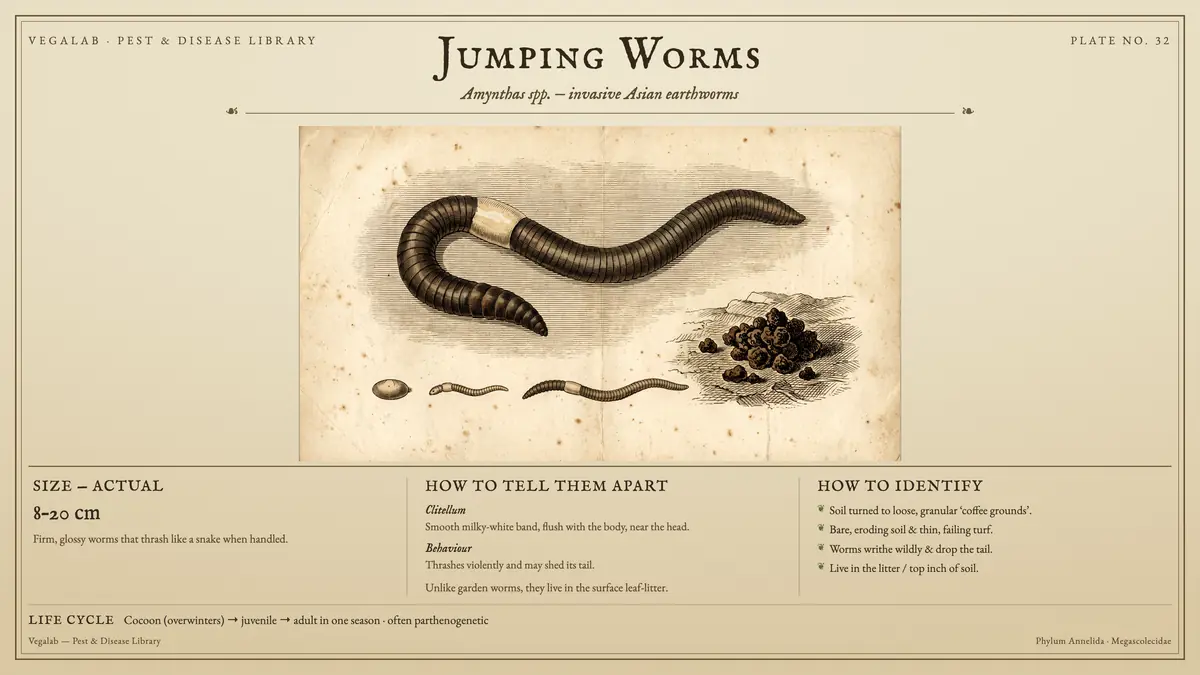
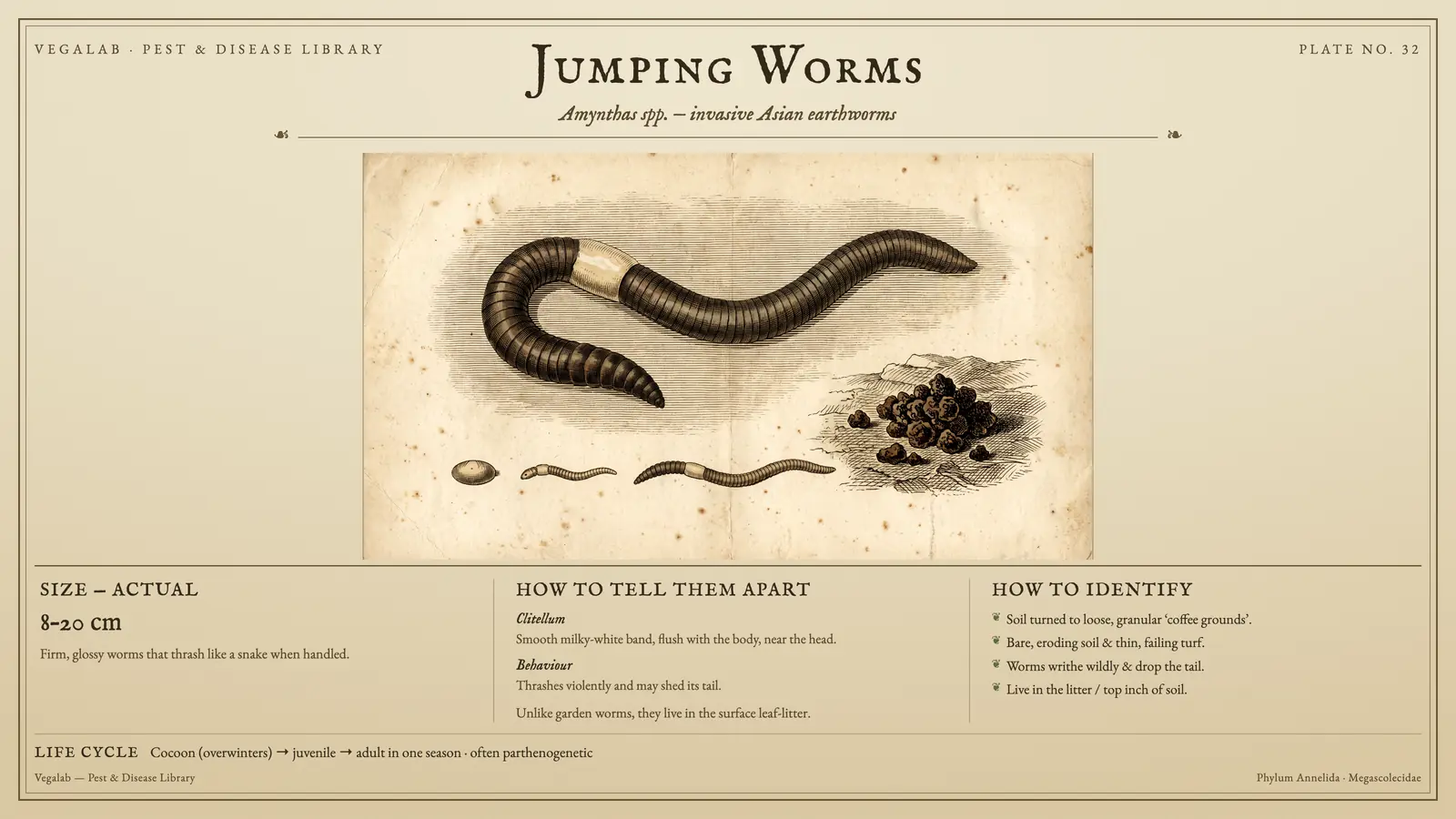
Size. 8 - 20 cm Firm, glossy worms that thrash like a snake when handled.
- Bare, eroding soil & thin, failing turf.
- Worms writhe wildly & drop the tail.
Life cycle. Cocoon (overwinters) → juvenile → adult in one season · often parthenogenetic
What are jumping worms?
Jumping worms (Amynthas spp.) are invasive earthworms originally from East Asia. Unlike familiar burrowing earthworms, they live in the top layer of soil and leaf litter and feed voraciously on organic matter. A single season's feeding can convert rich topsoil into a loose, grainy castings layer that erodes easily, holds nutrients poorly, and undermines lawns, ornamentals and seedlings.
How to identify jumping worms
- Violent movement: they thrash, wriggle and "jump" when disturbed - far more active than common earthworms
- A smooth, pale clitellum (band) flush with the body, milky-white to grey, located close to the head
- Coffee-ground soil: a signature granular, uniform castings layer at the surface
- Surface living: found in the top few centimetres and in leaf litter, not deep burrows
Why they are a serious problem
By stripping organic matter and destroying soil structure, jumping worms reduce the soil's ability to hold water and nutrients, harm plant roots, and disrupt the wider soil ecosystem. They spread easily in mulch, potted plants, compost and soil, and their cocoons are tiny and hard to detect - so nurseries, landscapers and gardeners can move them unknowingly. Prevention and early control are critical.
Why jumping worms are a problem when other earthworms are not
Earthworms have a reputation as unambiguously beneficial, which makes the invasive Amynthas species genuinely counter-intuitive. The difference is not that they are worms; it is where and how fast they feed.
Jumping worms live and feed in the litter layer and the top few centimetres of soil, and they consume organic matter extremely rapidly and in enormous numbers. Rather than creating deep burrows that improve infiltration and mix organic matter down the profile - the classic beneficial earthworm function - they strip the surface organic layer and convert it into loose, granular castings with a distinctive appearance often compared to coffee grounds.
The consequences are physical. The surface loses its structure and its organic layer; the granular castings do not hold water or nutrients well and are prone to erosion; fine root systems and mycorrhizal networks in the surface layer are disrupted; and nutrient cycling accelerates in a way that releases nutrients faster than plants take them up, so they are lost. In forests this has measurable effects on regeneration; in horticulture, nurseries and gardens it degrades the surface soil that shallow-rooted plants depend on.
So the concern is specific and ecological rather than a matter of direct crop attack - but for nursery stock, established perennials and any system relying on a surface organic layer or mulch, it is real.
Deep-burrowing earthworms remain beneficial. The problem is a surface-dwelling, fast-feeding invasive with a different functional role.
Identification
- Movement: the definitive character · when disturbed they thrash violently, snake-like, and can flip themselves off the ground, quite unlike the slow contraction of a common earthworm. This alone identifies them in the field.
- Clitellum: the band around the body is smooth, pale or milky-white, and flush with the body, and it encircles the worm completely. Common earthworms have a raised, swollen, pinkish clitellum.
- Body: firm, smooth and glossy, grey-brown; they may shed the tail when handled.
- Castings: loose, uniform, granular surface castings resembling coffee grounds, with the litter layer visibly depleted.
- Cocoons: tiny, about the size of a mustard seed, dark and hard to see - this is how they spread, and it is why soil, mulch and potted plants move them.
The thrashing snake-like movement plus a smooth flush white clitellum is conclusive. If in doubt, photograph and report to a local extension or invasive species programme.
How to limit their spread
- Inspect and be careful with incoming material. Soil, compost, mulch, potted plants and divided perennials are the main vectors, and the cocoons are nearly invisible. Sourcing matters.
- Use heat-treated compost and mulch where available; cocoons do not survive appropriate composting temperatures.
- Clean equipment, boots and tools when moving between sites, particularly nursery and landscape operations.
- Do not move plants, soil or mulch from an infested site, and be cautious about plant swaps and shared divisions, which is a well-documented spread route.
- Report new occurrences to local extension or invasive species programmes - distribution data is what makes containment possible.
- Maintain mulch and organic matter inputs on affected ground, since the surface layer is being consumed faster than it accumulates; this manages the symptom rather than the worm.
- Avoid dumping fishing bait, which has been a route of introduction.
There is no established method for eradicating jumping worms from an area, so the practical emphasis is entirely on containment and on not moving them - which is achievable, because they disperse slowly on their own and travel mainly in material people move.
Containment is the realistic objective. The single most effective action any grower or nursery can take is not moving infested soil and mulch off site.
Recommended Vegalab solution: Jumping Worm Control
Vegalab Jumping Worm Control is an all-natural bioinsecticide developed specifically for invasive jumping worms (Amynthas spp.). In controlled and independent university testing, it achieved 100% efficacy within 24 hours; independent university evaluation is ongoing and results have not yet been peer-reviewed, so field results may vary by site and conditions. It is designed to fit turf, ornamental and nursery settings. Claims, registrations and availability vary by jurisdiction - always read and follow the applicable product label.
| Role | Product | Use |
|---|---|---|
| Primary control | Jumping Worm Control | Targeted bioinsecticide for soil |
| Companion / broader pressure | Charge Bioboost | Soil biology / suppressive soil |
Claims and product availability vary by jurisdiction. Always read and follow the product label.