

Crops affected
How to identify reniform nematode
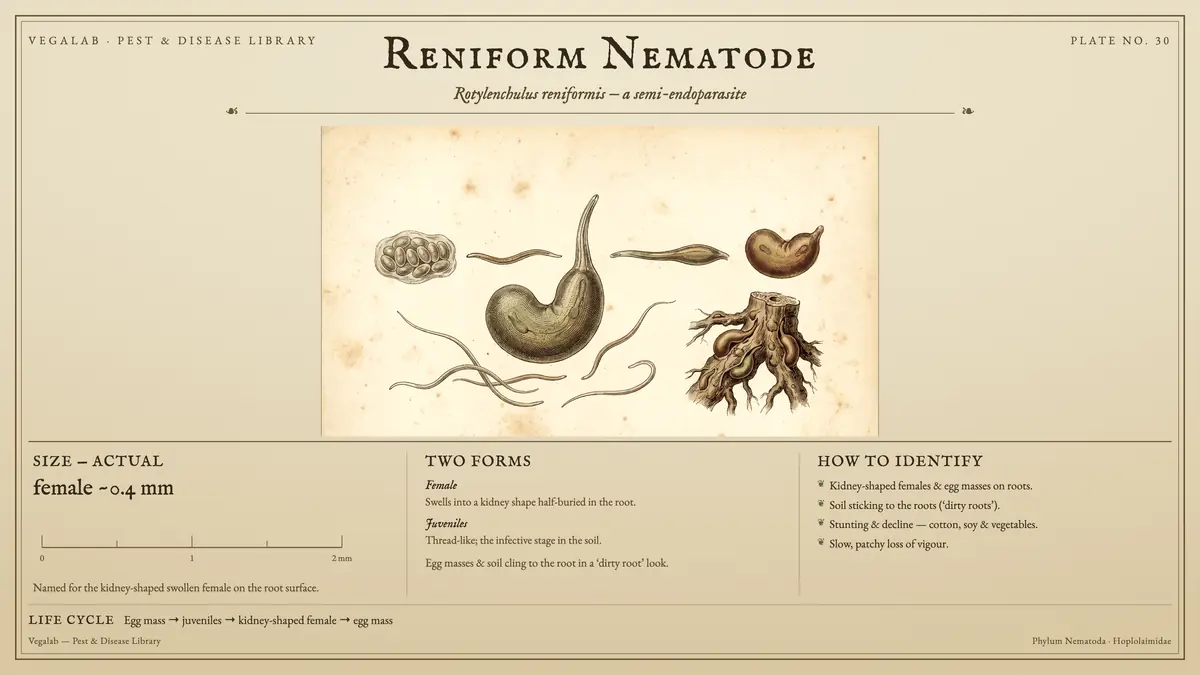
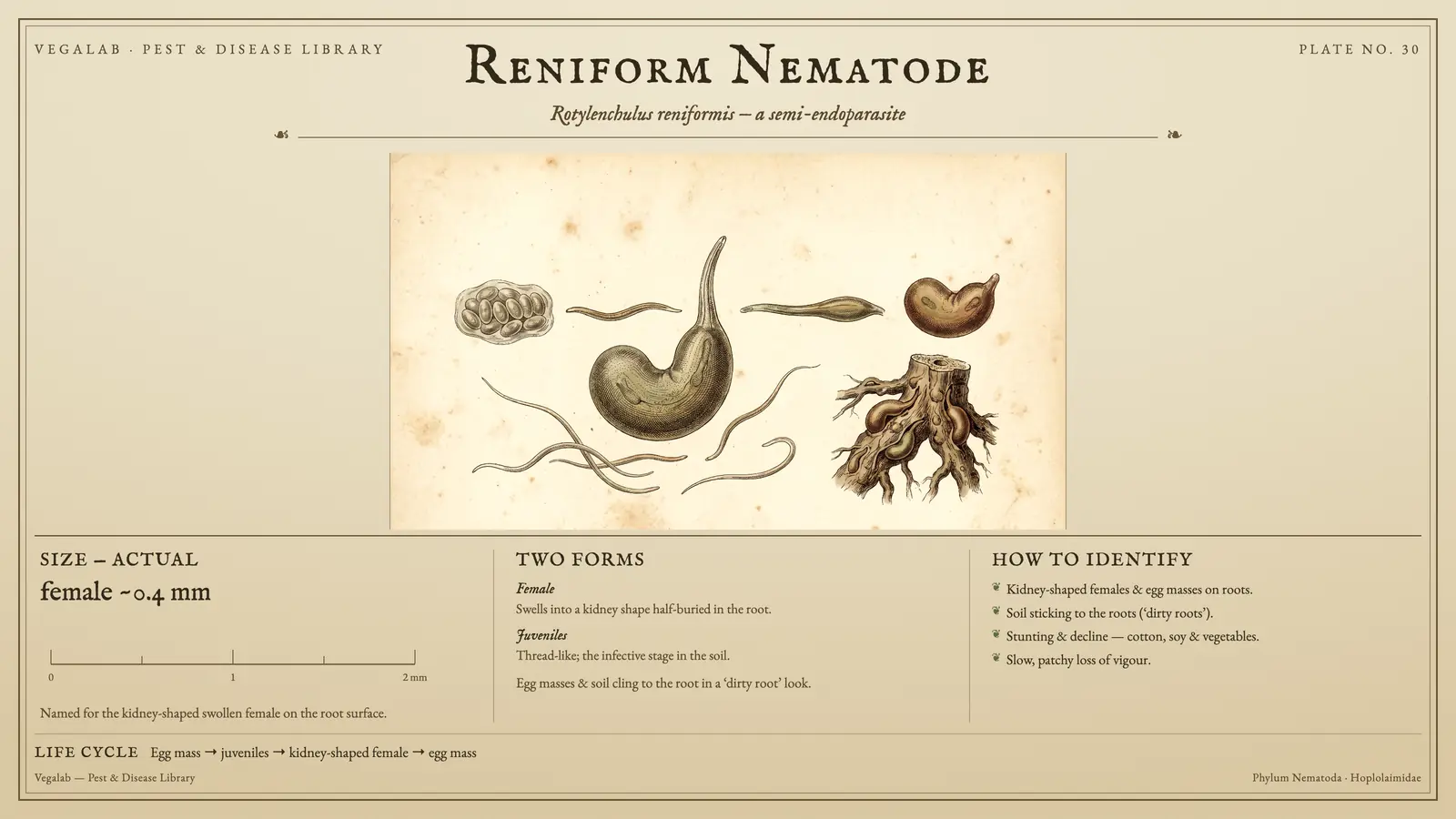
Size. female ~0.4 mm Named for the kidney-shaped swollen female on the root surface.
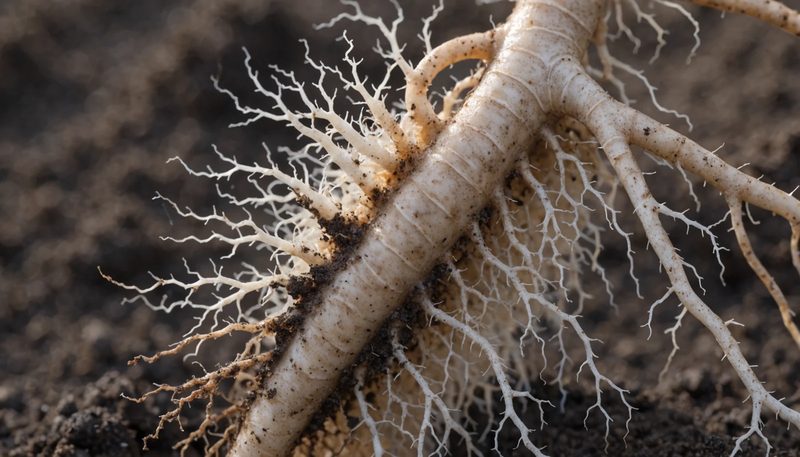
- Soil sticking to the roots (‘dirty roots’).
What is it?
Reniform nematode is a semi-endoparasite: the female embeds her head in the root while her kidney-shaped body remains outside, feeding continuously. It is one of the most damaging nematodes of cotton in the southern US and also attacks vegetables, soybean and pineapple.
How to identify it
- No distinctive above-ground galls (unlike root-knot) - symptoms are easy to miss.
- Patchy, stunted, uneven stands and reduced vigour, often worse in lighter or sandy-loam soils.
- Wilting under heat/drought despite adequate moisture; nutrient-deficiency-like symptoms.
- Confirmation requires a soil assay (egg/juvenile counts); reniform builds high populations quickly.
Life cycle & spread
Young females penetrate roots and feed; populations build rapidly across the season and survive between crops in soil and on roots. Warm soils accelerate reproduction.
Conditions that favour it
Warm soils, continuous susceptible cropping (especially cotton-on-cotton), and lighter-textured soils favour build-up.
Damage and how it spreads
Impairs water and nutrient uptake, reducing yield - often without obvious above-ground signs until losses are significant. In cotton, effective nematode control can recover meaningful lint yield in infested fields.
Monitoring & scouting
Soil-sample problem areas (counts before planting guide decisions); map field history; act at planting where assays or history show pressure.
How to control it
- Treat at planting before populations damage establishing roots;
- rotate to non-host or resistant crops;
- support root-zone health.
- Because nematodes can't be 'cured' mid-season once roots are damaged, prevention and at-plant timing matter.
How to manage reniform nematode
- Assay before planting. Like lesion nematode, reniform produces no galls, so field symptoms are non-specific stunting and patchy vigour. A soil assay is the basis for any decision.
- Rotate with genuine non-hosts. Maize, sorghum and most grasses are poor hosts and are the effective break crops; the difficulty is that soybean, cotton and many vegetables are all good hosts, so a rotation among them achieves nothing.
- Use resistant varieties where available · resistance has been developed in soybean and is progressing in cotton.
- Note the depth distribution. Reniform populations extend deeper in the profile than root-knot, which affects both sampling depth and the effectiveness of surface-directed measures. Sample to 30 cm or more.
- Manage root health. Because the damage is to the fine root system, supporting root regeneration and avoiding compaction reduces the yield penalty.
- Control weed hosts and volunteers through the break.
- Sanitise equipment moving between infested and clean fields, since this nematode spreads in soil on machinery.
- Consider the disease complex · reniform feeding predisposes cotton to Fusarium wilt, and the combination is more damaging than either alone.
Rotylenchulus reniformis is a semi-endoparasitic nematode of warm regions and a major constraint in cotton, soybean and vegetables. It differs from root-knot nematode in ways that matter for both diagnosis and rotation.
The single most common failure with reniform nematode is a rotation that looks diverse but consists entirely of good hosts. Cotton to soybean is not a break.
Why reniform displaced root-knot in cotton
Across large areas of the US cotton belt, reniform nematode has progressively replaced root-knot nematode as the dominant nematode problem, and the reasons are instructive about how management choices reshape pest populations.
Reniform is favoured by the cotton–soybean rotation that became standard in much of the region: both crops are excellent hosts, so a rotation intended to break disease and nematode cycles provided continuous support for this species. Root-knot management focused on resistant varieties and rotations selected against root-knot specifically, leaving reniform unaffected and reducing its competition.
Reniform also survives well in dry soil and extends deeper in the profile, which makes it less vulnerable to surface conditions and to shallow sampling - so populations built up while being under-detected.
The general lesson applies well beyond cotton: a management programme targeted at one soil organism changes the competitive balance among the others, and the species that benefits is the one whose hosts remain in the rotation. It is a reason to assay periodically for the full nematode community rather than only for the species that was a problem last time.
Sampling depth matters here. A shallow sample designed for root-knot can substantially understate a reniform population.
Recognising reniform in the field
- No galls · roots look normal to the naked eye, which is the main reason it goes undiagnosed
- Sand grains adhering to roots in a distinctive way, caused by the gelatinous egg masses of the females attached to the root surface - a useful field clue
- Patchy stunting and uneven vigour, often worse in lighter soil zones and along historical machinery paths
- Poor response to fertiliser and irrigation, because a damaged fine-root system cannot take up what is applied
- Interaction with wilt diseases, with Fusarium wilt incidence in cotton rising sharply in the presence of reniform
See Root-Knot Nematodes and Lesion Nematode. Adhering soil on apparently healthy roots plus unexplained patchy stunting in a warm-region cotton or soybean field is worth an assay.
Sampling for reniform: depth and timing
- Sample to 30 cm or deeper, not the 15–20 cm typical for root-knot
- Sample at the end of a susceptible crop for a planting decision
- Zone the field rather than taking one composite across it
- Keep samples cool and process promptly · nematodes die in hot cars and results understate
- Request species identification, not just a total count, since rotation depends on it
Reniform nematode is under-detected more often than it is misidentified, and the reason is almost always sampling method. A protocol designed for root-knot nematode will systematically understate a reniform population, which leads growers to conclude they do not have a problem when they do.
Depth is the main issue. Root-knot populations concentrate in the upper 15–20 cm and standard sampling reflects that. Reniform extends considerably deeper, commonly to 30 cm and beyond, with a substantial share of the population below the depth a routine sample reaches. Sampling to at least 30 cm, and deeper where the crop roots deeper, is what gives a representative count.
Timing matters too. Populations are highest late in the season on a susceptible crop and lowest after a fallow or a non-host, so a sample taken at the wrong point in the rotation can be misleading in either direction. For a planting decision, sampling at the end of the previous susceptible crop gives the most useful picture of what the next crop will face.
Distribution is the third factor. Nematode populations are patchy, so a single composite sample from a large field averages away the hot spots that will actually cause the yield loss. Sampling by management zone - soil type, historical yield pattern, previously affected areas - gives information you can act on.
This is not academic. Because the management response is a multi-year rotation or a varietal decision, the assay is the basis of a commitment that is expensive to get wrong.
A reniform result from a shallow root-knot protocol is not a low population; it is an incomplete measurement.
Recommended Vegalab solution: Nematode Control
Nematode Control · natural nematicide (geraniol) applied at planting in-furrow or through drip irrigation to reduce reniform populations on contact in the root zone; a second mid-season application is an option under high pressure. - Charge Bioboost · soil inoculant applied at planting to support a healthy, biologically active root zone and help roots withstand nematode pressure.
| Role | Product | Use |
|---|---|---|
| Primary control | Nematode Control | |
| Also apply | Charge Bioboost |
By crop
Preventing it next season
Rotation to non-host/resistant crops, soil sampling to guide decisions, at-plant treatment, and root-zone health support.
Claims and product availability vary by jurisdiction. Always read and follow the product label.