

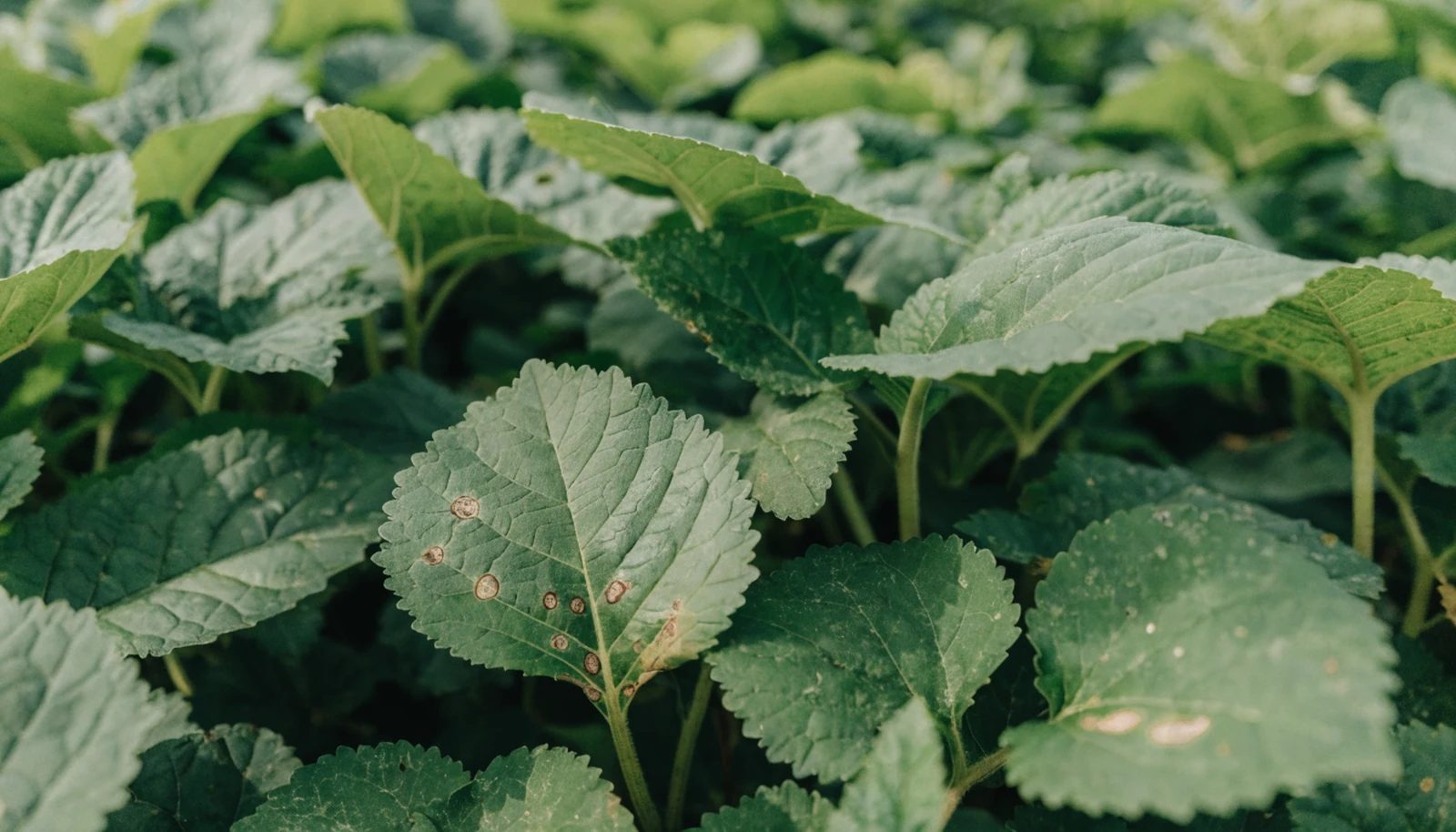
Last updated:
Crops affected

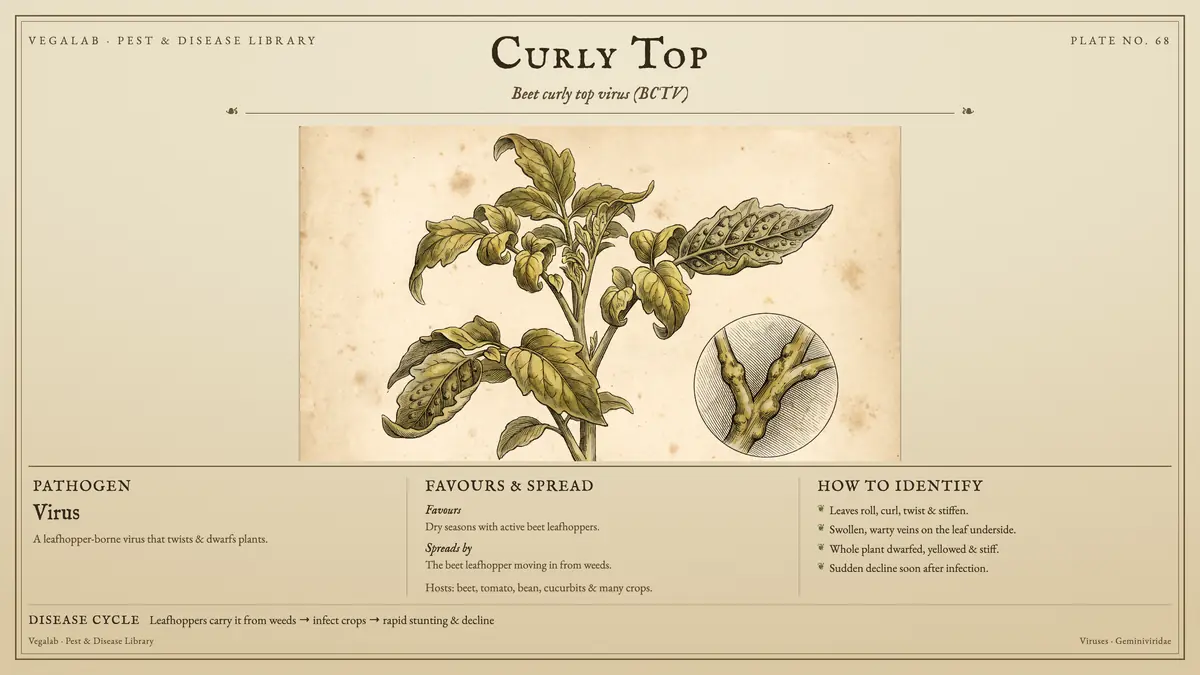

How to identify curly top
- Leaves roll, curl, twist & stiffen.
- Whole plant dwarfed, yellowed & stiff.
- Sudden decline soon after infection.
Disease cycle. Leafhoppers carry it from weeds → infect crops → rapid stunting & decline
What is it?
Beet curly top virus (BCTV) has a monopartite circular single-stranded DNA genome of roughly 2.9 to 3.0 kb in a geminate (twinned) particle. A 2014 taxonomic revision applying 77% and 94% identity thresholds collapsed what had been seven species into three: BCTV, spinach severe curly top virus, and horseradish curly top virus.
The old species names survive in the literature as strain names, and the mapping is worth knowing because papers written either side of 2014 read differently. Beet mild curly top virus became BCTV-Worland. Beet severe curly top virus became BCTV-CFH, also called Severe. What was BCTV in the strict sense became the Cal/Logan strains. Other named strains include Mild, Colorado, PeCT, PeYD and SpCT. Worland was the only strain recovered from Arizona field hemp.
The host range exceeds 300 species across more than 44 plant families, which is why it appears in vegetable, field and speciality crops that share nothing agronomically.
Two negatives define management. BCTV is not mechanically transmissible, and seed transmission is rare: a 2026 grow-out study found low-frequency infected seedlings in some hemp genotypes - you cannot spread it on hands, tools or machinery. The leafhopper is the only route into a plant, so vector avoidance is the entire disease management strategy.
The vector
The beet leafhopper is Circulifer tenellus, also published as Neoaliturus tenellus - the same insect under two names. In the Mediterranean the vector is a different species, C. opacipennis. The insect is about 3 mm long, pale green to grey, and females lay 300 to 400 eggs at around 30 °C, passing through five instars. There are about three generations per year in the Pacific Northwest and up to five in California and Arizona.
The overwintering biology is the key to the whole disease. Adults overwinter on uncultivated foothill and desert rangeland, feeding on filaree, peppergrass and mustards. That is where the virus is acquired - before any crop exists, on land the grower may not own. The autumn generation builds on Russian thistle and kochia. When spring dry-down removes the rangeland hosts, viruliferous adults move downslope into irrigated cropland en masse.
The vector does not colonise tomato, pepper or hemp. Only transient adults visit those crops; eggs laid on chile largely fail to hatch. It does settle and reproduce on beet and spinach. This distinction determines which control tactics can work in which crop, and it is the reason sugar beet is the one crop where an insecticide approach succeeds.
Transmission is persistent, circulative and non-propagative. The acquisition access period is as short as one minute, though acquisition is optimal over two to three days and best after about 48 hours of feeding. The latent period is a minimum of about four hours, typically 21 to 24 hours, and as short as four to six hours at high temperature. The inoculation access period is about one minute. Once viruliferous the insect retains the virus for life - detectable beyond three months. Transmission is transstadial but not transovarial, so nymphs do not inherit it. The virus persists about four months in dried beet tissue.
How to identify it
The most reliable single sign across hosts is vein enations - warty, swollen veins on the underside of the leaf. On sugar beet these accompany an upward and inward leaf curl, thickened brittle crisp leaves, dark vascular rings visible in a cut root, and hairy root.
On tomato, lead with vein enations: swollen and often purple on the lower leaf surface. Leaves roll upward and become thick and leathery with a dull yellow cast. Growth stops abruptly and the plant becomes rigid and dies - describe it that way rather than as a "sudden wilt", because a wilt implies loss of turgor and this plant is stiff, which is the opposite. Green fruit reddens prematurely.
On bean the leaves curl downward - the opposite direction from tomato - which regularly causes misdiagnosis when a grower applies tomato experience to a bean field. Cucurbits show cupping, shortened internodes and a bunched habit. Spinach suffers total loss even at low apparent severity.
Plant age at infection is the dominant determinant of how severe the symptoms are. Very young plants die; plants infected late may show symptoms confined to a single branch, which growers often dismiss as physical damage.
The field pattern is itself diagnostic and is the fastest check available. Curly top appears as randomly scattered single plants with completely healthy immediate neighbours. There are no expanding patches, because there is no secondary spread - UC IPM states plainly that the disease does not spread from one plant to another. Overlaid on that random scatter is a field-edge gradient facing the direction the leafhoppers migrated from; SARE reports approximately 75% of infections on field perimeters.
What to rule out first
Tomato spotted wilt virus produces bronzing and necrotic ringspots on both leaves and fruit; curly top produces neither necrotic ringspots nor fruit spotting. Tomato yellow leaf curl virus is transmitted by whiteflies, so whiteflies are present, it spreads in expanding patches, and it produces bright yellow leaf margins.
Herbicide drift is the closest mimic and has the cleanest check. Drift produces a contiguous gradient rather than random singles, with epinasty and strap-shaped new leaves - and, decisively, the broadleaf weeds in and around the field are affected too. Curly top leaves the weeds alone.
Fusarium wilt is a true wilt with one-sided yellow flagging and dark vascular streaking. Verticillium shows tan vascular discolouration near the stem base and V-shaped leaf lesions. Psyllid yellows is accompanied by visible psyllid nymphs and white "psyllid sugar" granules. Physiological leaf roll affects older leaves first, leaves texture normal, and costs no yield. BLTVA phytoplasma produces virescence, phyllody and witches' broom. Broad mite damage produces distorted, bronzed new growth with a hand-lens-visible mite population.
In bean, distinguish curly top from bean common mosaic virus: BCMV produces mosaic patterning, is aphid- and seed-transmitted, and spreads in expanding patches. In beet, distinguish it from aphid-borne yellows - which progresses from the outside of the leaf inward and has aphids present · and from rhizomania, which appears in soil-associated patches.
Life cycle & spread
The season begins outside the field. Viruliferous adults overwinter on rangeland weeds, acquire or retain the virus there, and migrate into cropland when spring dry-down removes their hosts. They probe crop plants - in tomato, pepper and hemp only transiently, since they cannot colonise these crops - and each probe of about a minute is sufficient to inoculate.
There is no secondary cycle within the crop for the non-host crops, because the insect does not settle and breed there. In beet and spinach the insect does colonise, so populations build in-field and the exposure is prolonged.
Symptoms lag infection by seven to fourteen days. Combined with the absence of secondary spread, this means that the disease you can see today was inoculated a fortnight ago by insects that have already moved on. Reacting to visible symptoms is reacting to a completed event.
A widespread belief that wet years are bad years is wrong, and the 2021 San Joaquin Valley season demonstrated the opposite: drought made it worse, because early foothill dry-down pushed the migration earlier, into a younger and more vulnerable crop. Migration timing relative to crop stage is what matters, not rainfall.
Conditions that favour it
Proximity to uncultivated foothill and desert rangeland carrying filaree, peppergrass and mustards, since that is the overwintering and acquisition site.
Early rangeland dry-down, which advances the migration into a younger crop. This is why drought years can be severe and why "wet year equals bad year" is misleading.
A crop at a young, vulnerable growth stage coinciding with the migration window. Plant age at infection dominates symptom severity and yield outcome.
Warm conditions, which shorten the latent period in the insect to as little as four to six hours and accelerate leafhopper generations - up to five per year in California and Arizona.
Sparse stands with plants standing individually in exposed soil, which beet leafhoppers prefer over dense continuous canopy.
Field margins facing the migration direction. Roughly 75% of infections occur on perimeters, so exposed edges carry a disproportionate share.
Damage and how it spreads
Losses swing enormously between years, and the range is worth quoting because it shapes how much a grower should invest in prevention. In California, 2013 saw 30 to 50% incidence and losses exceeding $100 million on roughly one million short tons, while 2014 came in under 1%. A 2021 San Joaquin Valley survey found eight fields at 0 to 5%, fourteen at 5 to 10%, and five above 10%. In 2024, six San Joaquin Valley counties declared agricultural emergencies.
In hemp the impact has been severe where it has appeared: Colorado in 2019 recorded over 90% loss in some fields with more than 150 positives across nine counties, and Arizona in 2020 recorded up to 100%.
Spinach is the crop where low apparent severity still means total loss. In sugar beet the historical record is stark - in 1934, 85% of the acreage was abandoned.
Spread is entirely by the leafhopper. There is no plant-to-plant or mechanical transmission, and seed transmission is rare (reported at low frequency in some hemp genotypes). This is not a caveat; it is the central management fact.
Monitoring & scouting
The most valuable correction on this page concerns thresholds. Figures of 40 to 100 leafhoppers per sticky card, or 1 to 2 per plant, circulate as curly top thresholds. They are not. Those are Oregon State EM 9282 thresholds for potato purple top, caused by the BLTVA phytoplasma - a different disease with a different epidemiology. Applying them to curly top produces spray decisions with no basis.
The accurate statement is that there is no validated economic or action threshold for beet curly top virus in any crop. Anyone offering one should be asked for the trial.
Sticky cards still have a use, but as a timing indicator rather than a spray trigger. Place them 5 to 10 feet (1.5 to 3.0 m) from the field edge and read them weekly to detect when migration is happening. Because a single one-minute probe transmits, card counts cannot be converted into a risk level.
Sweep the source vegetation, not the crop. Rangeland and margin weeds are where the population and the virus are, and sweeping there tells you what is about to arrive.
Confirm by PCR, which can also type the strain within about 24 hours. Confirmation matters here because the differentials - particularly herbicide drift and the other viruses - carry completely different responses.
How to control it
There is no cure and no antiviral. Once a plant is infected, nothing recovers it.
Roguing does not work. Because there is no secondary plant-to-plant spread, removing symptomatic plants removes no inoculum from the field. Utah State University describes roguing for curly top as ineffective and thus futile. The labour is better spent elsewhere.
Insecticides structurally fail in the non-host crops, and the reason is arithmetic rather than product quality. Inoculation takes about one minute; a systemic material takes roughly thirty minutes to act. The insect has transmitted and moved on long before the chemistry engages. Adding the seven-to-fourteen-day symptom lag means a spray triggered by visible disease is responding to an event two weeks past. Pyrethroids do kill beet leafhoppers, but they also remove natural enemies and commonly trigger aphid outbreaks.
There is one real exception, and it is instructive. Neonicotinoid seed treatment in sugar beet genuinely works: Poncho Beta has produced curly top ratings down 41% with root yield up 39%; a second study recorded reductions of 37% and 31% with sucrose up 8.5% and 5% after 124 and 131 days of storage; Asana (esfenvalerate at 55.48 g a.i./ha) gave a 24% reduction with a 32% yield increase, with effectiveness lasting eleven weeks or more.
It works there because three conditions hold at once: sugar beet is direct-seeded so the systemic is in place from emergence, the vulnerable crop window coincides with peak systemic concentration in the plant, and the beet leafhopper actually settles and feeds on beet rather than probing and leaving. Remove any one of those and the approach collapses - which is exactly what happens in tomato, pepper and hemp. At-plant neonicotinoids in processing tomato give an 11 to 17% yield benefit (WERA1007), which is meaningful risk reduction but is not control. Note also that a California DPR restriction effective 1 January 2024 limits neonicotinoid use in processing tomato to the preplant-through-bloom period; confirm the current position before planning around it.
How to manage curly top
Shift the planting date so the vulnerable crop stage does not coincide with the migration window. California and Idaho advice appears contradictory - one recommends earlier, the other later - but both express the same principle applied to different migration timings. Work out when migration reaches your area and plan away from it.
Plant at higher density with narrower rows. Beet leafhoppers prefer plants standing individually in exposed soil, and a continuous canopy is a less attractive landing surface.
Use row covers where the crop value supports them. The trial result is decisive: 0 of 80 plants infected under cover against 5 of 80 (6.2%) uncovered, with roughly six times more beet leafhoppers outside the cover.
Manage margin weeds, but not during the migration window. Destroying weedy hosts while leafhoppers are moving pushes them directly into the crop. Do this work outside the migration period.
Two tactics frequently recommended online should be treated as unverified. Trap crops for beet leafhopper have no supporting trial data that could be retrieved, so this page does not recommend them. Reflective and UV mulch is likewise unverified for this pest - every source traces back to whitefly and begomovirus literature, with no beet leafhopper or BCTV trial data behind it.
Where an area-wide program exists, it is the most effective intervention available, because it works on the rangeland source rather than on the crop. The one standing program is the California Department of Food and Agriculture Beet Curly Top Virus Control Program, established in 1943 under California Food and Agricultural Code sections 6031 to 6043, governed by a nine-member board across four districts. Its annual cycle runs hillside surveys from January to May, spring control from late February to mid-May, ground-rig spot treatments from April to August, Russian thistle mapping from August, and fall operations from around October. The protected crop list now includes hemp.
Resistance: one success story and a lot of honest gaps
Sugar beet is one of the great achievements of plant pathology, and the numbers deserve repeating. US 1 was released in 1933 and added 5.5 tons per acre. In 1934, before it was widely deployed, 85% of the acreage was abandoned at yields around 4.9 tons per acre. By 1941, 97% of the acreage was harvested at around 13.5 tons per acre. The resistance is tolerance-type and polygenic rather than a single immunity gene, which is part of why it has been durable.
Tomato has nothing comparable. UC IPM states there is no genetic resistance in tomatoes to beet curly top virus. A 2009 New Mexico trial recorded varietal differences - Columbian 5.5%, Jet Star 5.5%, Rowpac 11.1%, Mountain Fresh 16.6%, Celebrity 22.2% - but these are best read as escape rather than resistance, and should not be presented to a grower as protection.
Pepper has no resistance. Hemp has none.
Bean is genuinely disputed and this page does not resolve it. UC IPM states that no resistant varieties currently exist. The University of Arizona (publication az1931) and USDA-ARS describe successful breeding for curly top resistance in bean. Both positions are reported here with their sources; a grower should check what is actually available in their seed market rather than relying on either statement in the abstract.
Why the standard responses fail, and what the timing actually is
| Event | Time required | Consequence for management |
|---|---|---|
| Inoculation access period | About 1 minute | A single brief probe transmits the virus; there is no exposure duration low enough to be safe |
| Systemic insecticide to act on the insect | About 30 minutes | The insect has already transmitted and moved on - this gap is why sprays fail in non-host crops |
| Latent period in the insect | 4 h min, typically 21–24 h, 4–6 h when hot | Heat shortens the delay between acquisition and infectivity |
| Symptom expression in the plant | 7–14 days | Visible disease reports an event a fortnight old; reacting to it is reacting late |
| Retention by the insect | For life (>3 months detectable) | Transstadial but not transovarial · nymphs do not inherit it |
| Plant-to-plant spread | Does not occur | Roguing removes no inoculum and is described by Utah State as ineffective and futile |
Recommended Vegalab solution: Armour Boost
Integrated management. Curly top is a viral, no-cure problem - Vegalab products play a supporting role in an integrated program (plant health, root-zone support) and are not a control or a cure for this disease, and nothing applied to a plant reverses a virus infection. The foundation is avoiding coincidence between the vulnerable crop stage and the beet leafhopper migration window, higher planting density, row covers where crop value supports them, weed management on margins outside the migration window, and area-wide source control where a program exists. The items below support crop condition alongside that program.
| Role | Product | Use |
|---|---|---|
| Plant resilience | Armour Boost | Silica for resilient tissue |
| Roots | Root Boost | Root-zone support for strong early establishment |
| Soil biology | Charge BioBoost | Root-zone support to build soil biology |
Preventing it next season
Because the virus arrives from outside the field on an insect that has already acquired it, prevention is about position and timing rather than about anything applied to the crop. Find out when beet leafhopper migration reaches your area and set the planting date so that the most vulnerable crop stage falls outside that window - this is the same principle behind the apparently opposite California and Idaho recommendations. Plant denser and in narrower rows so plants are not standing individually in exposed soil. Plan row covers for high-value blocks, where a trial recorded 0 of 80 infected under cover against 5 of 80 uncovered. Schedule margin and rangeland weed control outside the migration window, since clearing hosts while leafhoppers are moving drives them into the crop. Pay particular attention to field edges facing the migration direction, which carry roughly 75% of infections. In sugar beet, plan seed treatment, which is the one crop where it genuinely works. And drop the assumption that a wet year is a bad year - the 2021 San Joaquin Valley drought produced a worse outcome by advancing dry-down and pushing migration into a younger crop.
Claims and product availability vary by jurisdiction. Always read and follow the product label.