


How do you tell jumping worms from earthworms?
Last updated:
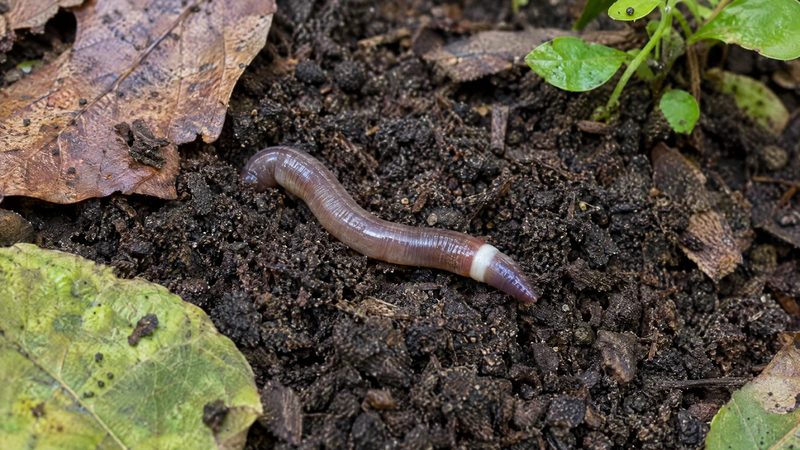
Check the band near the head, called the clitellum. On jumping worms it is cloudy white to gray, smooth, flush with the body, close to the head and fully encircling it; on European nightcrawlers it is pink or reddish, slightly raised and saddle shaped.1 Jumping worms also thrash like snakes when handled, can drop their tails, and leave soil like coffee grounds.1,3
What is the clearest difference between jumping worms and earthworms?
Jumping worms are a small group of Asian earthworm species, mainly Amynthas agrestis, Amynthas tokioensis and Metaphire hilgendorfi, while the familiar garden earthworms and nightcrawlers in states such as Wisconsin came from Europe.1,2,6 The most reliable field mark on an adult is the clitellum, the band of glandular tissue where cocoons are produced.1
On a jumping worm the clitellum is cloudy white to gray, completely encircles the body, sits relatively close to the head, and is flush with the rest of the body.1 On other adult earthworms it is reddish pink or orange, often does not fully encircle the body, may look ridged, and bulges out from the body.3 The University of New Hampshire checklist summarizes it as annular and close to the head on jumping worms, and saddle-like and farther from the head on other worms.4
Juveniles have no visible clitellum yet, so they are identified by their active, snake-like squirming and their ability to drop their tails.2
| Feature | Jumping worm (Amynthas and Metaphire) | European earthworm or nightcrawler |
|---|---|---|
| Clitellum color | Cloudy white to gray, lighter than the body | Pink, reddish or orange |
| Clitellum shape | Smooth, flush, fully encircles the body | Slightly raised, saddle-like, partly encircles the body |
| Clitellum position | Close to the head | Farther from the head, more central |
| Body | Glossy dark gray or brown, sleek, firm, less slimy | Pink or reddish, thick, slimy, floppy |
| When disturbed | Thrashes like a snake, may drop tail segments | Wiggles and stretches, does not drop its tail |
| Castings | Uniform layer like coffee grounds on the surface | Dispersed piles of casts |
| Peak adult season | August to September | Early spring and fall |
In North America, jumping worms hatch in April and May, adults are most noticeable from late summer into early fall, peaking in August and September, and adults die at the first freeze1,4; spring is the time to solarize soil before cocoons hatch3. In the Southern Hemisphere the same pattern shifts by about six months, placing the adult peak around February and March.
How do jumping worms move and feel compared with earthworms?
The common names, including jumping worms, crazy worms, snake worms, Alabama jumpers and Jersey wrigglers, all describe the escape behavior: when handled they thrash rapidly from side to side and may shed the tail end of the body.3 European nightcrawlers wiggle and stretch when disturbed and do not drop tail segments.1
Jumping worms have a smooth, metallic sheen and are often darkly pigmented, glossy gray or brown and uniformly colored; the body is sleek, dry and firm, and less slimy to the touch than a nightcrawler.2 Virginia Cooperative Extension describes them as reddish to brownish purple, sometimes with an iridescent sheen, typically 3 to 6 inches long and occasionally up to 8 inches.3 European earthworms are reddish pink, thick, slimy and floppy, usually with a darker front end, and can live up to 8 years.2
Numbers are another clue. Jumping worms tend to occur in large numbers, and where there is one there are more.1 Identifying the exact Amynthas species requires dissection of the internal organs, which is a laboratory task.3
What do jumping worm castings and soil look like?
Jumping worms live on the soil surface in debris and leaf litter or within an inch or two of the topsoil, rather than burrowing deep.1 They turn the surface into dry, granular pellets with a texture like discarded coffee grounds, deposited as a uniform layer, while European nightcrawlers leave dispersed piles of casts.1 UConn Extension describes the castings as resembling coffee grounds or ground beef, often in a deep, uniform layer at the surface.2
That texture matters for plants. Jumping worm castings sit on the surface, where their nutrients are unavailable to plants, and the coarse, granular structure with large air pockets can limit how well plants anchor roots and take up water and nutrients.2 The altered soil is often unaccommodating to ornamental, garden and native plants, and can be depleted of nutrients.1 By eating leaf litter and mulch, jumping worms can leave soil bare, expose tree roots and increase erosion, and gardeners may find infested flower beds less productive than in previous years.3 In nursery containers, jumping worms change substrate water holding capacity and nutrient availability, which lowers plant quality.7
When is the best time to check for jumping worms?
Late summer and early fall.1 Unlike other earthworms in Wisconsin, jumping worms have an annual life cycle, so they are most noticeable when most are mature in late summer and early autumn.1 UConn Extension reports high densities of very active adults near the soil surface from late June to mid-October.2 Each worm can reproduce without a mate, and it takes about 90 to 120 days from hatching to reproduction, so two generations a year are possible in Wisconsin.1
Cocoons are about the size of a mustard seed, 2 to 4 mm across, and they carry the population through winter.2,3 They hatch through spring and summer once soil temperatures rise above 50°F.2
| Period | What is happening |
|---|---|
| April to May | Tiny worms hatch from overwintered cocoons |
| Summer | Worms feed and grow; adults visible from late June |
| August to September | Mature worms deposit cocoons; peak of visible adults |
| First freeze | Adult worms die |
| Winter | Embryos survive in cocoons in the soil |
What are Asian jumping worms and where did they come from?
Jumping worms are native to Japan and the Korean peninsula and probably reached North America through the horticultural trade in imported plants and plant materials.3 They first arrived sometime in the late 19th century and are now widespread across much of the Midwest, Southeast and Northeast of the United States, and have recently appeared along the West Coast and in parts of southeastern Canada.1 Wisconsin confirmed its first population in 2013, at the University of Wisconsin-Madison Arboretum.1
People move them.2 Worms and cocoons travel in potted plants, mulch, bagged leaves, compost and other landscape materials.2 They have also been sold as fish bait and online as live worms, and can turn up in batches sold for vermicomposting.3 A 2021 review in Biological Invasions identified their annual life cycle, reproductive and cocoon survival strategies, and casting behavior as key reasons for their successful spread and distinct ecological impact.6
What should you do if you find jumping worms?
No product is listed for controlling jumping worms in the United States, and UConn Extension reports no documented effective treatment to eradicate an existing population.2,7 Management therefore centers on removing the worms you find, killing cocoons with heat, and not moving them.1,3
- Remove and destroy worms when you see them: seal them in a bag and put it in the trash, or leave the bag in direct sun for at least 10 minutes first.1,3
- Use heat. Neither worms nor cocoons survive 104°F or higher for over three days, a temperature well-managed compost piles can reach.1
- Solarize small areas: cover moistened soil with plastic for 2 to 3 weeks, or until the soil exceeds 104°F for at least three days, ideally in early spring before eggs hatch; this also kills plants under the sheet.3
- Buy compost and mulch that has been heat treated, and inspect the root ball, soil and mulch of new plants, or plant bare-root stock.2,3
- Do not move soil, plants or mulch from infested areas, and clean soil and debris from tools and vehicles.1,5
- Never buy jumping worms for bait, gardening or vermicomposting, and never release bait worms.3
Key takeaways
- The clitellum is the giveaway: cloudy white, smooth, flush and fully encircling on jumping worms, pink, raised and saddle shaped on European earthworms.
- Jumping worms thrash like snakes, can drop their tails, and feel firm and less slimy than nightcrawlers.
- Soil that looks like a uniform layer of coffee grounds is the strongest sign of an established population.
- Adults are easiest to find from late summer into fall; cocoons overwinter and hatch in spring.
- No product is listed to control them in the United States, so removal, heat and not moving soil or mulch are the tools.
References
- Jumping worms (Amynthas spp.)
- Jumping Worms (Crazy Worms, Snake Worms, Asian Jumping Worms) fact sheet
- Jumping Worms (Amynthas spp.) (ENTO-559NP)
- Earthworm Identification: Not All Worms are "Crazy"!
- Invasive Species Alert: Jumping Worms (Technical Forestry Bulletin NRES-1603)
- The second wave of earthworm invasions in North America: biology, environmental impacts, management and control of invasive jumping worms
- The Potential of Chemical and Biological Management Options for Controlling Jumping Worms (Amynthas spp.) in Container Nursery Production