

Last updated:
Stink bugs (family Pentatomidae) are shield-shaped sucking insects that release an unpleasant odor when disturbed.1 The invasive brown marmorated stink bug (Halyomorpha halys) is the one most people meet, feeding on fruit and vegetables and moving into homes in fall.2 Control rests on sealing buildings, handpicking bugs and egg masses, row covers and natural enemies, because garden insecticides do little against adults.2
How do you identify stink bugs?
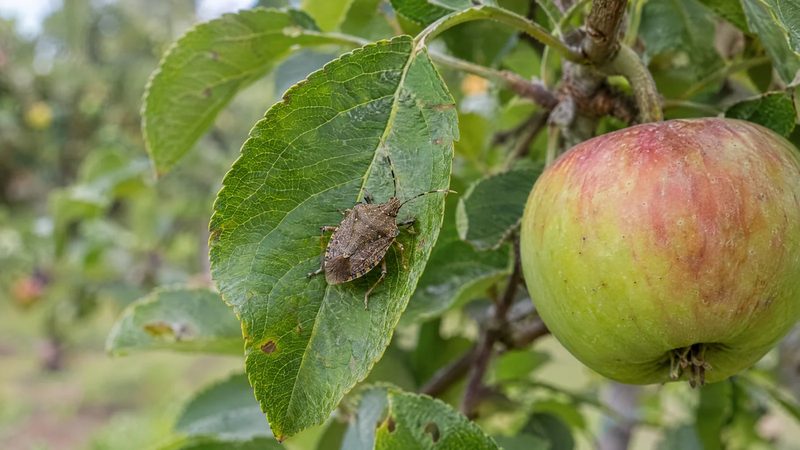
Stink bugs (family Pentatomidae) are sucking insects named for the fluid with an unpleasant odor that they can release when disturbed.1 Adults are wider relative to their length than most insects and carry a large triangular plate with a rounded rear end, the scutellum, on the back.1 More than 50 species occur in California alone.1 Most feed on plants as sporadic pests, but some are beneficial predators of pest insects, including the spined soldier bug (Podisus maculiventris) and the twospotted stink bug (Perillus bioculatus).1
Eggs are barrel shaped with circular caps and are usually laid in groups, commonly on leaves.1 Nymphs develop through five instars, gradually growing wing pads, and their color often differs from the adults and changes between instars.1 Infestations often begin when adults fly in from weedy areas.1
| Species | Adult size | Key features | Pest or beneficial |
|---|---|---|---|
| Brown marmorated stink bug (Halyomorpha halys) | About 5/8 inch | Mottled brown or gray; white bands on dark antennae; one white band on hind legs; banded abdominal edge | Pest of tree fruit and fruiting vegetables |
| Rough stink bug (Brochymena sulcata) | Similar to brown marmorated | Rough shoulder margin; head extended into two points; no white bands on antennae; two white bands on hind legs | Beneficial predator |
| Consperse stink bug (Euschistus conspersus) | About 1/2 inch | Grayish brown to green; grayish legs with black speckles; no white leg bands | Pest |
| Southern green stink bug (Nezara viridula) | About 1/2 inch | Bright green adults; pale yellow early nymphs | Pest |
| Harlequin bug (Murgantia histrionica) | 1/3 inch or longer | Mostly black with orange, red and yellow; no white markings | Pest |
| Bagrada bug (Bagrada hilaris) | About 1/4 inch or shorter | Black and orange with white markings; damages crucifer seedlings and mustard greens | Pest |
In North America, brown marmorated stink bug adults emerge from late April to mid-May and move onto buildings to overwinter from September through October3, which is why fall brings most sightings in and around homes2. In the Southern Hemisphere, the equivalent autumn period falls from about March to May.
How do you recognize the brown marmorated stink bug?
The brown marmorated stink bug is native to East Asia and was first collected in North America in Allentown, Pennsylvania, in 1998, although it probably arrived several years earlier.3 Adults are about 17 mm (0.66 inch) long, shield shaped and brown on both the upper and lower surfaces, with lighter bands on the antennae, darker bands on the membranous tip of the front wings, and coppery or bluish metallic punctures on the head and pronotum.3 Compared with the rough stink bug, it has a blunt front edge to the head and a smooth shoulder margin.2
Eggs are light yellow to yellow-red and are laid side by side on the underside of leaves in masses of 20 to 30.3 A female lays clusters of 20 to 28 eggs and 212 to 486 eggs in her lifetime.2 The five nymphal instars range from 2.4 mm to 12 mm long and have deep red eyes.3
In Pennsylvania there is probably one generation a year, with two possible in warm seasons: adults emerge from late April to mid-May, lay eggs from May through August, and start searching for overwintering sites from September through October.3
What damage do stink bugs cause to fruit and vegetables?
Stink bugs feed with strawlike mouthparts on fruits, nuts and vegetables, from beans and tomatoes to apples and stone fruit.1 Feeding leaves blemishes, dark pinpricks and discoloration, and the tissue underneath becomes pithy and white and stays firm instead of ripening normally.1 On green tomatoes the injury shows as dark pinpricks ringed by a light area that stays green or turns yellow as the fruit ripens, peaches turn brown and corky, and fruit fed on early can grow distorted.1
The brown marmorated stink bug injects tissue-destroying enzymes and sucks juices from fruit and seeds, leaving pockmarks and distortions that make produce unmarketable.2 In the mid-Atlantic, the crops most affected include apple, pear, peach, nectarine, lima bean, snap pea, pepper, sweet corn, tomato, field corn and soybean.2 On apples the feeding causes a distortion called cat facing, while beans and okra show scarred, sunken areas and deformed pods, and tomatoes and peppers develop spongy areas inside.3 The pest feeds on more than 170 host plants.5
Lygus bugs and other true bugs can cause virtually the same damage, so the cause is reliable only if the bugs were seen feeding.1 In a home garden a small amount of damage is tolerable: a spot or pithy area can be cut out and does not affect eating quality.2
How do you keep stink bugs out of your house?
In late summer and early fall, brown marmorated stink bugs gather on the sides of buildings and on trees, then move into protected places to spend the winter as adults.2 Once indoors they hide in cracks behind baseboards, around window and door trim and around ceiling fans and lights, and they do not reproduce or cause damage inside.2 Exclusion is the best way to keep them out.2,3
- Seal cracks around windows, doors, siding, utility pipes, vents and under fascia boards with silicone, silicone-latex caulk or foam sealant.2,3
- Repair damaged screens, add weather stripping and door sweeps, and put window screening inside gable vents to keep bugs out of attics.2
- Turn off unnecessary outdoor lights, because stink bugs are attracted to light.2
- Indoors, a foil roasting pan with water and a few drops of dish soap under a light in a dark room traps bugs, and a vacuum removes them, though it will smell of stink bugs for a time.2,3
- Exterior insecticide sprays break down in sunlight within days to about a week, and indoor sprays are not recommended because they are generally ineffective.2,3
How do you control brown marmorated stink bugs in the garden?
Large populations usually need several methods together, including row covers, handpicking, traps, trap crops and natural enemies.2 Row covers prevent feeding on vegetables, but they also keep pollinators away from flowers and are hard to use on large fruit trees.2 Bugs can be handpicked or brushed into soapy water, and egg masses on the underside of leaves should be destroyed.2 For stink bugs in general, UC IPM recommends removing weeds and groundcovers in early spring, before stink bugs build up there and move to other hosts.1
Pheromone traps are useful for monitoring when bugs emerge in spring and when numbers are high, but they probably have little value in preventing crop damage.2 In a 2013 study in Maryland home gardens, single traps placed about a meter from garden rows led to more stink bugs and more damage on nearby plants.2
Most garden insecticides are not very effective against stink bugs, especially adults, and new bugs move in to replace those killed.2 Oils and botanicals such as pyrethrin or azadirachtin may suppress young nymphs; check that the product is labeled for the crop and follow the product label.2 UC IPM generally does not recommend insecticides for stink bugs in gardens, partly because the damage often shows after the bugs have left.1 In laboratory tests, azadirachtin, orange oil, potassium salts of fatty acids, kaolin and diatomaceous earth all increased mortality of brown marmorated stink bug nymphs compared with untreated controls.6 In two seasons of trials in Italian pear orchards, diatomaceous earth alone or alternated with sulfur or calcium polysulfide limited fruit injury about as well as grower programs based mainly on acetamiprid in some orchards, though not in every orchard.6
Does the samurai wasp control brown marmorated stink bugs?
The samurai wasp (Trissolcus japonicus) is a tiny parasitoid, about 1.5 mm long and black, that lays its eggs inside brown marmorated stink bug eggs.4 The developing wasps kill the stink bug before it hatches, and the wasp does not sting people or attack adult stink bugs.5 It shares the stink bug's native range in China, Japan and Korea and was first recorded in the western United States in 2015.4 Oregon State University Extension describes it as the superior parasitoid of the stink bug because it restricts its egg laying to brown marmorated stink bug eggs.4 Parasitized egg masses darken and show irregular, circular emergence holes.4
Oregon State University researchers redistributed the wasp to 69 sites and recovered it at 36 of them between 2016 and 2021, and egg parasitism stayed between 22.4% and 26.8% from 2018 to 2020.5 The researchers stress that establishment does not mean the stink bug is controlled statewide; the wasp is one part of a program that includes monitoring and careful pesticide choices.5 In laboratory tests, azadirachtin and kaolin did not harm the samurai wasp, while most other products tested, including sulfur and calcium polysulfide, did.6
Native natural enemies also feed on brown marmorated stink bug eggs and nymphs, including assassin bugs, earwigs and green lacewing larvae, and egg mortality as high as 50% to 60% has been observed in some situations.2 Persistent, broad-spectrum insecticides destroy these parasites and predators, which also control other pests.1,2
Key takeaways
- Stink bugs (Pentatomidae) are shield-shaped sucking insects; some species, such as the spined soldier bug, are beneficial predators.
- The brown marmorated stink bug (Halyomorpha halys) has white-banded antennae, a banded abdominal edge and feeds on more than 170 host plants.
- Feeding leaves dark pinpricks, pithy tissue and cat facing on fruit, injury that lygus bugs can mimic.
- Sealing cracks and openings before bugs gather on buildings in fall is the most effective way to keep stink bugs out of homes.
- Garden insecticides do little against adults, so row covers, handpicking, egg mass removal and natural enemies such as the samurai wasp carry most of the load.
References
- Stink Bugs
- Pest Notes: Brown Marmorated Stink Bug (UC ANR Publication 74169)
- Brown Marmorated Stink Bug
- Samurai Wasp: Promising Egg Parasitoid for Management of Brown Marmorated Stink Bug (EM 9164)
- OSU research advances wasp that attacks stink bug eggs
- Laboratory and field efficacy of natural products against the invasive pest Halyomorpha halys and side effects on the biocontrol agent Trissolcus japonicus