

Titanium dioxide
Last updated:
What is titanium dioxide?
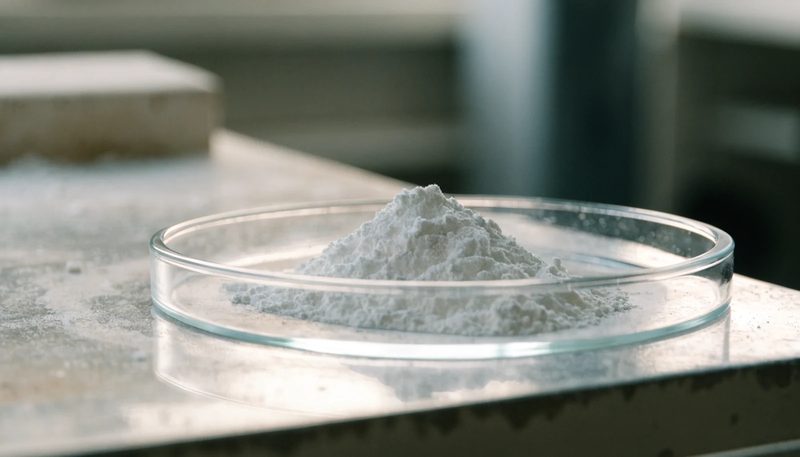
Titanium dioxide is a white, chemically inert, highly refractive mineral oxide - the most widely used white pigment in the world, and a physical UV filter in sunscreens. In Sun Boost it appears at 8% as the active, positioned around photosynthesis, fruit size and leaf development.
The plausible mechanisms, stated carefully
Two rationales exist for TiO2 in crop use, and they should not be blurred.
The first is optical. A reflective particle film on leaf surfaces scatters light, which can reduce leaf surface temperature and heat stress, reduce photoinhibition in high light, and redistribute light into the canopy. This is the same principle as kaolin clay particle films, which have a reasonable evidence base for sunburn and heat-stress reduction in fruit crops. It is a credible mechanism.
The second is photocatalytic. TiO2 is a photocatalyst, generating reactive oxygen species under UV. Some literature proposes benefits from this in terms of photosynthetic efficiency or antimicrobial action. This is considerably more speculative for whole-plant field use, and reactive oxygen generation on a leaf surface is not self-evidently beneficial.
An honest page rests the claim on the optical mechanism, notes the photocatalytic literature as unsettled, and does not conflate them.
What does titanium dioxide not do?
It is not a nutrient - titanium has no established essential role in plant nutrition. It is not a registered pesticide, so disease and pest claims are not available. It does not increase photosynthetic capacity directly; any benefit is a consequence of managing light and temperature stress. And a particle film reduces light interception as well as scattering it, so in low-light conditions the effect can be negative.
Is titanium dioxide safe?
Titanium dioxide is inert and poorly absorbed, with very low oral toxicity. The significant hazard is inhalation of respirable powder: TiO2 in inhalable form has been classified as possibly carcinogenic to humans by IARC on the basis of inhalation studies, and the EU has introduced classification and labelling requirements for certain powder forms. The EU has also restricted its use as a food additive.
None of that bears on a liquid agricultural formulation applied as a spray, but it does mean handling of any powder form requires respiratory protection, and it means the safety section of this page must be specific rather than reassuring in general terms.
A note for the product page
Sun Boost served a legacy template on the non-www host during this review, with older long-form active-ingredient text. Worth confirming the canonical and redirect behaviour so the legacy version is not indexed.
References
Related reading
Products containing titanium dioxide
Listed because this ingredient appears in each product's declared composition. This is a commercial link from a reference page; it is not a recommendation, and approved uses and availability vary by market.