

Sun Boost
Sun Boost uses titanium dioxide to enhance photosynthesis, fruit size and leaf development. The TiO2 foliar coating helps optimise light use on the leaf surface, supporting stronger growth and larger fruit, particularly in protected and high-value crops.
Photosynthesis enhancer · Photosynthesis stimulant, Foliar-active.
- Zero REINo re-entry wait
- Zero PHIHarvest the same day
Photosynthesis enhancer from Vegalab Crop Science, powered by Titanium dioxide (TiO₂). Sun Boost targets Photosynthesis, fruit size, leaf development.
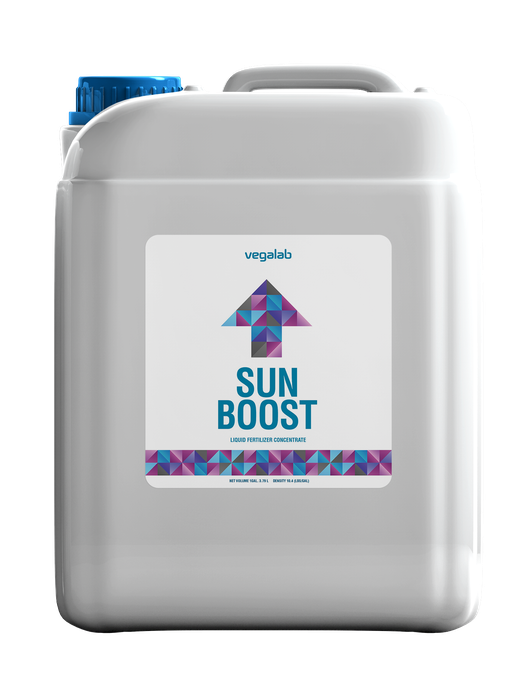
Foliar titanium dioxide delivers a photosynthesis-boosting effect by reflecting and re-emitting light to leaf chloroplasts. Plants capture more usable light under low-sun conditions.
| Active | Titanium dioxide (TiO₂) |
|---|---|
| Targets | Photosynthesis, fruit size, leaf development |
| Dilution rate | 1:650 · 1.54 mL/L (5.8 mL/gal) · 0.5–0.75 L/ha (6.9–10.4 fl oz/acre) |
| Application | Foliar spray 3–4 times during peak growth |
| Line · Category | Boost · Photosynthesis enhancer |
- Maintains photosynthesis in wet seasons
- Improves fruit taste and size under low light
- Reduces stress from cloud cover
| Nutrient | Content |
|---|---|
| TiO2 | 8% |
Derived from: Titanium dioxide
How can a leaf coating improve photosynthesis?
Light is the raw material of photosynthesis, and how efficiently a leaf captures and uses it sets the ceiling on growth. Sun Boost applies a titanium dioxide (TiO2 8%) coating that helps optimise the way leaves interact with incoming light, supporting more efficient photosynthesis - particularly valuable where maximising light use directly affects yield.
How does Sun Boost work?
Applied as a foliar spray, the TiO2 forms a fine coating on the leaf that helps the plant make better use of available light for photosynthesis. The downstream effect is support for fruit size and leaf development, as more photosynthetic output is available to build canopy and fill fruit.
When and how should it be applied?
- Establishment
- Active growthVegetative
- Pre-flower
- Flowering
- Fruit set
- Fruit fillFruit development
- Ripening
- Harvest
Apply during Vegetative and Fruit development.
- Method
- Foliar spray
- Rate
- 1:650 · 1.54 mL/L · 0.5–0.75 L/ha1:650 · 5.8 mL/gal · 6.9–10.4 fl oz/acre · Work out your rate
- Frequency
- Repeat through the growth and fruit-fill period
- Pre-harvest interval
- Zero - harvest the same day
- Re-entry interval
- Zero - no re-entry wait
Even leaf coverage matters - the effect depends on the coating interacting uniformly with incoming light.
Always read and follow the applicable product label.
Apply as a foliar spray during active growth and fruit development, ensuring even leaf coverage - the effect depends on the coating interacting uniformly with incoming light. Repeat through the growth and fruit-fill period to maintain the benefit as new leaves expand.
Which crops benefit most?
Sun Boost has been tested on greenhouse crops, berries and vines - protected and high-value crops where squeezing more yield and size out of available light has a direct payback. Greenhouse production especially benefits, since light is often the limiting factor under cover.
What outcomes does it support?
By improving how efficiently leaves use light, Sun Boost supports stronger leaf development and larger fruit. In settings where light is a constraint - greenhouses, dense canopies or lower-light periods - that improved efficiency can translate into measurable gains in size and yield.
Need a recommendation for your crop or pest?
Contact usFrequently asked questions
What is the application rate for Sun Boost?
1:650 · 1.54 mL/L (5.8 mL/gal) · 0.5–0.75 L/ha (6.9–10.4 fl oz/acre) Application: Foliar spray 3–4 times during peak growth.
Is Sun Boost suitable for natural or organic programs?
Sun Boost supplies Titanium dioxide (TiO₂) in a formulation designed to fit low-residue and IPM programs.
What does Sun Boost do?
Enhances photosynthesis, fruit size and leaf development via a titanium dioxide foliar coating.
What is the active?
Titanium dioxide (TiO2) at 8%.
Which crops benefit most?
Greenhouse crops, berries and vines, where maximising light use drives yield.
When should I apply it?
During active growth and fruit development, with even leaf coverage.
How does it raise yield?
By improving how efficiently leaves use light, supporting larger fruit and stronger leaf development.
The evidence behind these actives
Reference pages on the actives this product declares - mode of action, limits and the published sources, written independently of the product listing.
Problems addressed
Supports the root zone where these problems establish. Reference links only - see the label for approved uses.
Pest & disease library
See all plant pests & diseases →
Reference links to identification and management guides. Claims and product availability vary by jurisdiction - always read and follow the product label.
Last updated: