


Scaly leg mites in chickens
Last updated:
Scaly leg mites (Knemidokoptes mutans) are tiny burrowing mites that live under the scales of a chicken's legs and feet, making the legs thick, crusty and raised1,2. They spread by direct contact and complete their whole life cycle on the bird2. Treatment softens and removes the crusts with an oil such as petroleum jelly, repeated for at least two weeks, plus treatment of the coop1,2.
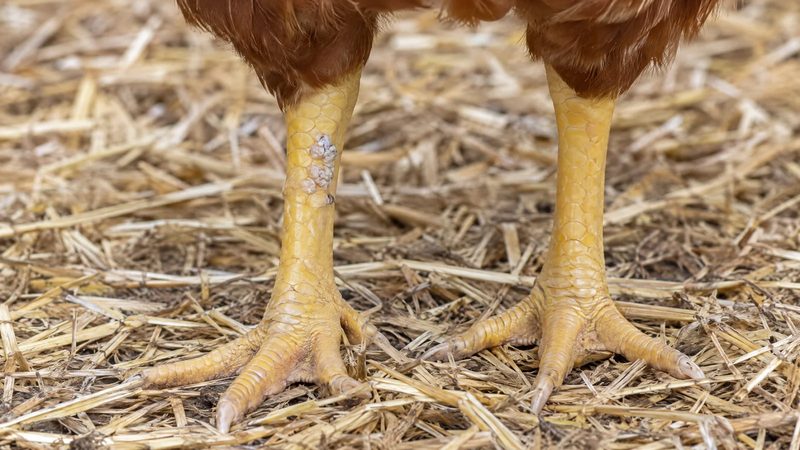
What are scaly leg mites?
The scaly leg mite (Knemidokoptes mutans) is smaller than the northern fowl mite, about 1/100 inch, pale gray, with a flat, circular body1. It lives under the scales of the legs and feet and tunnels into the upper layers of the skin, where it lays its eggs3. The mite infects both wild birds and domestic poultry and lives on areas of unfeathered skin2.
Knemidokoptes mutans is a burrowing mite that completes its entire life cycle on the host6. It burrows into the deeper layers of the skin of the unfeathered legs, feeds on fluids that ooze from the area, and adult females lay eggs in the tunnel, where the young pass through larval and two nymphal stages before becoming adults6. Under the microscope the mite is round, 0.2 to 0.4 mm across, with four pairs of short, stumpy legs6.
Its close relative, the depluming mite (Knemidokoptes gallinae), also burrows under the skin and lays its eggs there, but it targets the skin at the base of the feathers, mostly on the wings and abdomen, rather than the legs4,7. Birds infested with depluming mites pull out their own feathers4.
What are the signs of scaly leg mites?
The mites burrow into the skin of the shanks and feet, causing irritation, swelling, enlarged scales and a thickening of the outer skin, so the lesions carry white, powdery, flaking crusts2. The skin of the shanks looks thickened and the scales visibly protrude2. The normal shiny, smooth shank turns ash-colored or dark with a heavily scaled look, and the intense itching leads birds to peck at their own legs6.
Scaly leg mites are diagnosed from the signs plus a skin scraping in which the small round mites are found under a microscope5,6. A veterinarian or diagnostic laboratory can confirm the mite if the crusts look unusual.
| Stage | What you see on the legs and feet |
|---|---|
| Early | Irritation, swelling and enlarged scales with white, powdery crusts2 |
| Established | Thick, crusty legs and feet with raised, protruding scales1,2 |
| Severe | Crusts that slough off and leave raw, weeping skin; distorted feet6 |
| Untreated | Deformed legs and claws and crippled birds2; blood supply to the toes cut off and toes lost1 |
How do chickens get scaly leg mites?
Transmission is by direct contact, and all life stages occur on the bird2. Spread through a flock is slow2, and for Knemidokoptes mites in general, prolonged contact appears necessary for transmission5. Although scaly leg mites prefer to live on birds, they can also survive in the poultry house1.
Scaly leg mites are occasionally found on poultry in Mississippi, particularly in private farm flocks4. They are reported to be highly prevalent in adult poultry and frequently seen in free-range and backyard systems6. They thrive on wet ground, attaching first to the toes and gradually moving up to cover the leg6.
How do you treat scaly leg mites on chickens?
Each affected bird needs treatment2. Daily application of an oil-based product such as petroleum jelly, paraffin or mineral oil softens the crusts, and the legs can then be washed with mild soap to loosen and remove them; continue for at least 2 weeks or until the legs look normal2. Coating the entire leg with petroleum jelly or dipping the legs in linseed oil suffocates the mites and moisturizes the scales at the same time1.
Insecticide treatment is an option, but it must be given on the advice of a veterinarian2. Ivermectin is not approved for use in poultry1. It is against the law to use pest control products off-label in food animals without a veterinarian's supervision, so any product used must be labeled for poultry8. Follow the product label, including withdrawal times for eggs and meat8.
In long-standing cases, response to treatment may be slow or incomplete because the legs have already changed in ways that are close to permanent5.
- Soften: work petroleum jelly, paraffin or mineral oil into the scales daily2.
- Lift: wash the legs with mild soap to loosen and remove softened crusts2.
- Smother: keep the whole leg coated with petroleum jelly, or dip it in linseed oil1.
- Persist: keep going for at least 2 weeks, or until the legs return to normal2.
Do you need to treat the coop for scaly leg mites?
Yes. Because scaly leg mites can survive off the bird, the entire poultry house must be treated to clear an infestation3. Treat the inside of the house, making sure the nesting area, roosts and any cracks and crevices are covered1.
Use only a product whose label lists poultry and the pest, and read the label before you buy; the label is the law8. For the wider coop cleaning sequence used against all poultry mites, see the coop cleaning guide linked below.
How do you prevent scaly leg mites in a flock?
Inspect the flock regularly, monthly or every two months, for mites and lice8, and include the legs and toes of each bird in the check6. Because the mite passes by direct contact2, check the legs of any new or returning bird before it joins the flock, and treat it first if the scales look raised or crusty.
Treat the house along with the birds, since the mites survive in the poultry house1. Raised, crusty scales on one bird are a reason to examine every bird, because the mite spreads slowly through a flock by direct contact2.
Key takeaways
- Scaly leg mites (Knemidokoptes mutans) burrow under the leg scales and live their whole life on the bird.
- Raised scales with white, powdery crusts and thick shanks are the main signs; untreated birds can lose toes.
- Soften and lift the crusts with petroleum jelly or another oil and mild soap daily for at least 2 weeks.
- Treat the coop, including nests, roosts and crevices, because the mites can survive off the bird.
- Any insecticide or drug needs a poultry label or a veterinarian's direction; ivermectin is not approved for poultry.
References
- External Parasites of Poultry
- Knemidocoptes mutans (scaly leg mite) in backyard flocks
- Common External Parasites in Backyard Poultry (EPS-011)
- Control External Parasites of Poultry (Publication 3800)
- Knemidokoptic Mange in Pet Birds: Scaly Face and Scaly Leg Disease (VM022)
- Research note: Mite infestations in non-descriptive indigenous chickens in Bangladesh: Present status and pathology
- Parasitic Mite Fauna in Asian Poultry Farming Systems
- Protecting Your Flocks from External Parasites: Mites and Lice (AZ1858)
Frequently asked questions
Can scaly leg mites spread to people, dogs or other animals?
Scaly leg mites infect wild birds and domestic poultry2. Extension guidance contrasts them with sticktight fleas, which can thrive on dogs, cats, horses and humans, while scaly leg mites live under the scales of birds' legs and feet1. Related Knemidokoptes species cause scaly face and scaly leg in pet birds such as budgerigars and some parrots5.
Will a chicken's legs go back to normal after scaly leg mites?
Are some chickens more likely to get scaly leg mites?
The mite is reported to be highly prevalent in adult poultry and is frequently seen in free-range and backyard flocks6. In a study of 390 village chickens, adults and males had higher mite infestation rates than young birds and females, which the authors linked to more roaming and more contact with the ground6.
Can you eat eggs from hens treated for scaly leg mites?
If a pesticide is used, follow all label instructions, including withdrawal times; withdrawal times begin after the last treatment8. Insecticide labels for poultry also state any withholding time for meat and eggs from treated birds1. Off-label use in food animals requires a veterinarian's supervision8.