


Chicken mites: types, signs and treatment
Last updated:
Chicken mites are tiny eight-legged poultry parasites. Three species matter most: the northern fowl mite (Ornithonyssus sylviarum) lives on the bird around the vent, the poultry red mite (Dermanyssus gallinae) hides in the coop by day and feeds at night, and the scaly leg mite (Knemidokoptes mutans) burrows under leg scales1,3. Control pairs a poultry-labeled product with coop treatment, repeated to catch newly hatched mites3.
What kinds of mites live on chickens?
The northern fowl mite is the most common external parasite of poultry and the most serious ectoparasite of poultry in North America1,4. It spends its entire life cycle on the bird, feeding on blood, and lays its eggs in masses at the base of feathers, usually around the vent4.
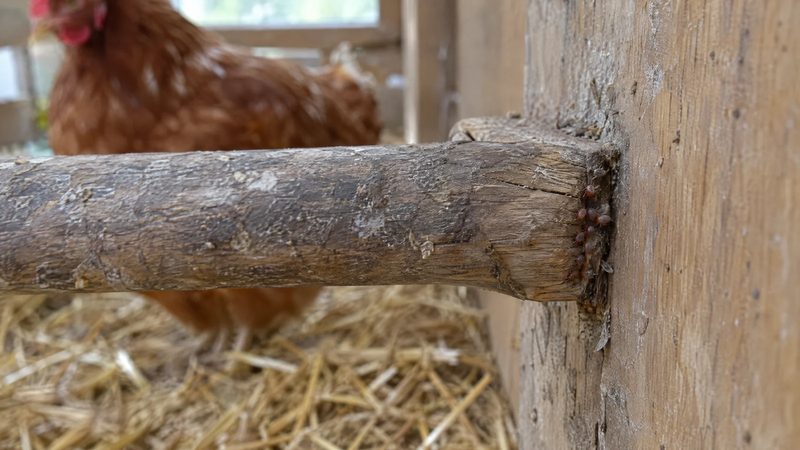
The poultry red mite is the species extension guides formally call the chicken mite, also known as the roost mite or red mite1,3. Unlike the northern fowl mite, it does not live on the bird: it hides by day in cracks and crevices in roosts, walls, ceilings and floors, and comes out at night to feed3. It is probably a greater problem in floor nests and on floor-housed birds1.
The scaly leg mite is smaller than the northern fowl mite and lives under the scales of the legs and feet, tunneling into the upper layers of skin to lay its eggs1. Its relative, the depluming mite, burrows into the skin at the base of the feathers, and infested birds pull out their own feathers5,7. The tropical fowl mite (Ornithonyssus bursa) behaves much like the northern fowl mite and is often confused with it4.
| Mite | Where it lives | How to find it |
|---|---|---|
| Northern fowl mite (Ornithonyssus sylviarum) | On the bird its entire life, mostly around the vent4 | Part the vent feathers and look for moving specks and black droppings3 |
| Poultry red mite, or chicken mite (Dermanyssus gallinae) | Cracks in roosts, walls, ceilings and floors by day; on the bird at night3 | Examine birds at night, or check cracks and crevices5 |
| Scaly leg mite (Knemidokoptes mutans) | Under the scales of the legs and feet1 | Legs that turn thick and crusty1 |
In North America, northern fowl mites and poultry lice build up in cool weather, so infestations typically rise in fall and ease in spring, while poultry red mites are mainly a warm-weather pest2,4,5. In the Southern Hemisphere the seasons are reversed, so expect the cool-weather build-up from late fall through winter and red mite pressure in the warm months.
What do chicken mites look like?
Mites are about 1 mm across, roughly the size of a grain of ground pepper, so a magnifying glass helps2. Each species looks different and sits in a different place on the bird or in the coop3.
- Northern fowl mite: about 1/25 inch, eight legs, black or brown, seen as tiny specks moving quickly on the skin near the vent3. Eggs and black specks of mite droppings at the vent are sometimes the most obvious sign3.
- Heavy northern fowl mite infestations: a dark gray discoloration and matting of the vent feathers, made of mites, eggs, droppings and shed skins4.
- Poultry red mite: gray, brown or red, turning red after a blood meal3. In the coop, look for the mites plus black and white deposits of droppings and cast skins in crevices3.
- Scaly leg mite: about 1/100 inch, pale gray, flat and circular, living under the leg scales; infested birds' legs become thick and crusty3.
What is the difference between chicken mites and lice?
The two common body mites of chickens, the red mite and the northern fowl mite, are blood feeders2. Poultry lice are wingless, flat-bodied insects with chewing mouthparts2, and they feed on dry skin scales, feathers and scabs rather than sucking blood3. The chicken body louse (Menacanthus stramineus) and the shaft louse (Menopon gallinae) are the species most often found on poultry3.
Lice are larger, about 1/8 inch, yellow and fast-moving, and do not cluster around the vent the way northern fowl mites do5. The white egg masses glued to the base of the feathers are the best sign of lice5. Lice survive only about a week off the bird, so they spread mainly bird to bird3.
| Feature | Mites | Lice |
|---|---|---|
| Size | About 1 mm, ground pepper2 | 2 to 3 mm, sesame seed2 |
| Movement | Slow2 | Fast2 |
| Food | Blood2 | Skin scales, feathers and scabs3 |
| Where they live | On the bird and in the coop2 | Only on the bird2 |
| Best time to check | Night or day2 | Day2 |
| Problem for people | Northern fowl mites bite, causing itching and irritation3 | Species-specific; cannot survive on humans3 |
What are the signs of mites in a chicken flock?
Flocks with mites or lice show similar signs: weight loss, fewer eggs, lower activity, bald spots, red and irritated skin, small scabs and dull, ragged feathers2. Heavy red mite infestations cause pale combs and wattles and listless birds3. Red mites can take a heavy toll: a laying hen can lose more than 3% of its blood volume in a night, and heavy burdens can kill hens6. Red mite infestations also drive feather pecking6.
Mites are often noticed first on eggs or on the people who collect them5. For northern fowl mites, part the feathers around the vent in daylight3. For red mites, examine the birds at night or check cracks and crevices, because the mites scatter evenly over a bird's body and are hard to count there5. Inspect the flock every month or two, and pay particular attention to brooding hens, which dust-bathe less and are prone to parasites2. For scaly leg mites, look at the legs: severe cases can cut off blood supply to the toes, and the bird may lose toes1.
How do you get rid of chicken mites?
Use only a product whose label lists poultry or chickens and the pest you are treating, and follow the product label, including any withholding time for eggs and meat2,3. Using these products off-label in food animals is against the law without veterinary supervision2.
Northern fowl mites: the materials used against them do not kill the eggs, so the flock is re-treated every 4 to 7 days, and the nest area, roosts, cracks and crevices are treated too because mites survive off the birds for a couple of weeks3. A house left empty for less than 3 weeks may still hold mites that will infest new birds5.
Poultry red mites: treat the whole coop, every crack and crevice, roost, wall and ceiling, and re-treat every 4 to 7 days, because adults survive up to six months without feeding3. Treat vacant houses thoroughly before new birds arrive5. Resistance to multiple acaricides has developed in red mites, driven partly by improper application such as uneven spraying of cracks that exposes mites to sublethal doses6.
Scaly leg mites: coating the whole leg with petroleum jelly or dipping it in linseed oil suffocates the mites and moisturizes the scales1,3. Treat the coop as well, since these mites can survive off the bird1. Mild cases return to normal; severe cases may leave the feet swollen and deformed3. For the plant-oil actives used on premises, see essential-oil miticides.
How do you prevent chicken mites, and when are they worst?
Wild birds and rodents carry northern fowl mites into poultry houses, so seal entry points, clean up spilled feed that attracts them, and keep up rodent control4. Mites also travel on people, egg flats, racks and equipment moved between flocks4. Clean and disinfect housing and equipment between flocks, and limit contact between your birds and wild birds2.
Season matters. Northern fowl mites prefer about 65 to 68 degrees F and are more of a problem in cool weather, so infestations typically increase in fall and decrease in spring4,5. Lice also build up in cooler weather5. Poultry red mites are mainly a warm-weather pest2. Mite populations build faster on young birds than on older ones5.
Key takeaways
- Three mites cause most chicken mite problems: the northern fowl mite on the bird, the poultry red mite in the coop, and the scaly leg mite under the leg scales.
- Check the vent for northern fowl mites, and the birds at night or the roosts and cracks for red mites.
- Lice are larger, yellow, fast-moving chewers that leave white egg clusters at feather bases; mites are tiny blood feeders.
- Use only products labeled for poultry, follow the product label, and repeat treatment because common treatments do not kill mite eggs.
- Red mites survive up to six months without feeding, so the empty coop needs treating before new birds go in.
References
- Common External Parasites in Backyard Poultry (EPS-011)
- Protecting Your Flocks from External Parasites: Mites and Lice (AZ1858)
- External Parasites of Poultry
- Northern Fowl Mite Management (Publication 2800)
- Control External Parasites of Poultry (Publication 3800)
- Poultry red mite (Dermanyssus gallinae) infestation: a broad impact parasitological disease that still remains a significant challenge for the egg-laying industry in Europe
- Parasitic Mite Fauna in Asian Poultry Farming Systems
Frequently asked questions
Can chicken mites live on humans?
How long can chicken mites live without a host?
Adult poultry red mites can survive up to six months without feeding, so a coop can stay infested long after the birds are gone3. A well-fed northern fowl mite may survive two to three weeks off the host at room temperature4. That is why a house emptied for less than three weeks may still infest new birds5.
Does diatomaceous earth kill chicken mites?
Food-grade diatomaceous earth in dust baths removes the waxy outer layer of a mite's cuticle, so the mite loses water and dies3. It may help control mites but will not clear an infestation on its own, because it has no effect on eggs3. If you use a diatomaceous earth product, follow the product label.