


Essential-Oil Miticide Actives
Last updated:

Nano-emulsified plant oils are used on animal premises against mites and lice in housing, bedding and structures. Monoterpene actives act on contact, but they evaporate quickly and some are toxic to cats. This page explains the mechanism, the limits, and the species-sensitivity rules that apply to Vetpure Miticide and related products.
What they are and how they work
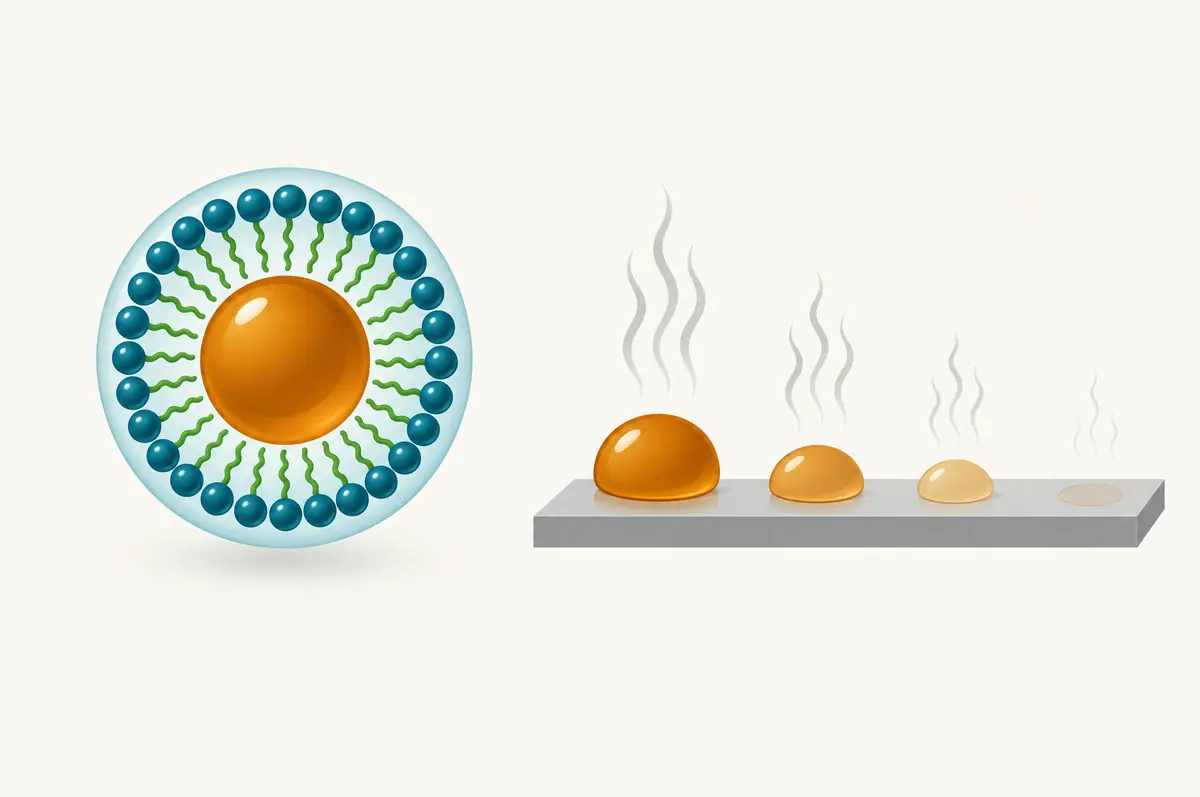
The main actives are monoterpenes and monoterpenoid alcohols such as geraniol and menthol, delivered as nano-emulsions so they disperse in water. They disrupt arthropod cuticle and membranes on contact, with additional proposed action at octopamine receptors in the nervous system. Vetpure Miticide is built on a geraniol and peppermint oil system. Carrier oils such as cottonseed or canola help actives spread and penetrate the waxy cuticle of mites. The goal is a fine, stable droplet that coats mite refuges.
What they do not do
Essential-oil actives have short persistence and do not provide extended residual on their own; unencapsulated oils typically hold a few days. They are not systemic and do not treat an infestation on an animal. They do not reach mites deep in structures unless the deposit remains active when mites emerge. Doses effective against small, soft mites are far lower than those needed for ticks, whose cuticle is thicker. They also do not replace cleandown and monitoring.
Species sensitivity
Geraniol and peppermint oil are toxic to cats, which lack adequate glucuronyl transferase activity. Exposure occurs through skin, airways and mucous membranes. Cats must be excluded from treated areas until surfaces are dry and the space ventilated, and these products are not for catteries. No essential-oil product in this range is applied to animals. Premise, housing, bedding and perimeter uses only, within the label. Keep birds and other animals out of rooms during application.
Key facts
- Geraniol and peppermint oil are permitted minimum-risk pesticide actives in the US (40 CFR 152.25(f)(1)).
- Monoterpenoids have been shown to act on insect octopamine receptors (Enan 2001, Comp Biochem Physiol C 130:325).
- Cats are deficient in UDP-glucuronosyltransferase isoforms that clear phenolic compounds (Court 2013, Vet Clin North Am Small Anim Pract 43:1039).
- Poultry red mite spends most of its life in structural refuges rather than on the bird (Sparagano et al. 2014, Annu Rev Entomol 59:447).
How our delivery technology applies
The limit on essential-oil miticides is not contact activity but how long the deposit lasts. Multi-layer nano-encapsulation wraps geraniol and peppermint oil in biopolymer shells that slow evaporation and protect against oxidation, so active remains on surfaces when mites re-emerge from refuges. Smaller, uniform droplets also improve spreading on the mite cuticle.
Request Vetpure Miticide technical data for your housing system.