


Is diatomaceous earth safe for chickens?
Last updated:
Eaten, diatomaceous earth passes through the body largely unabsorbed, and FDA rules allow it in animal feed at up to 2% of the ration as an anticaking agent1,2. The real risk is the dust: it irritates the eyes and airways of birds and keepers, and any crystalline silica it contains can scar lungs over years of exposure1,7,8.
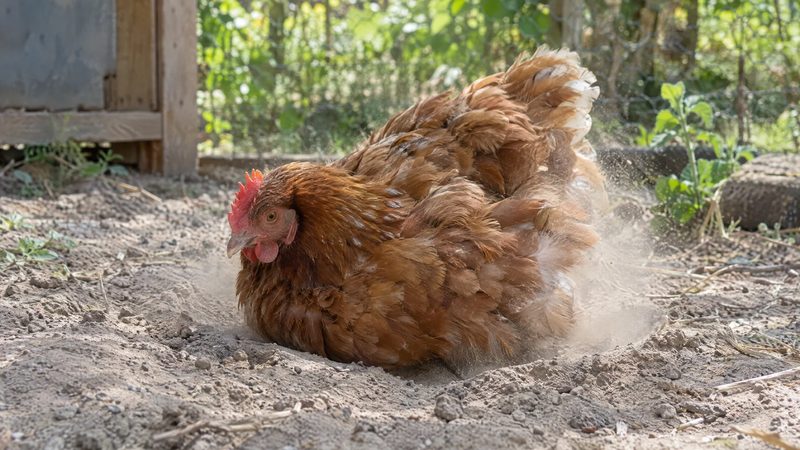
What is diatomaceous earth, and how does it act on mites?
Diatomaceous earth (DE) is made from the fossilized skeletons of diatoms, tiny aquatic organisms whose shells are silica (silicon dioxide)1. Most DE is amorphous silicon dioxide, but it can contain very low levels of crystalline silicon dioxide1. The first pesticide products containing DE were registered in 1960 to kill insects and mites1.
DE works physically rather than as a poison: it does not have to be eaten, and it kills insects and mites by absorbing the oils and fats from the outer cuticle so they dry out, while its sharp edges speed the process1. On a mite such as the northern fowl mite (Ornithonyssus sylviarum), the dust strips the thin waterproof wax layer, so the mite loses water and dies6. It stays effective only while it is kept dry and undisturbed1.
What are the risks of diatomaceous earth for chickens and keepers?
Breathing the dust is the main concern. Inhaled DE can irritate the nose and nasal passages, and a very large amount can cause coughing and shortness of breath; it can also irritate the eyes and dry the skin1. A review of physical mite controls notes that DE dusts carry inhalation risks and that fine dusts can affect the human respiratory tract, which is one reason liquid silica formulations were developed8.
The form of silica matters. Inhaled amorphous DE is rapidly cleared from lung tissue, while crystalline particles are smaller and may accumulate in the lungs and lymph nodes1. The amorphous form is associated only with mild, reversible lung inflammation, whereas long-term inhalation of crystalline silica is associated with silicosis and chronic bronchitis1. Respirable crystalline silica causes silicosis, an incurable lung disease, as well as lung cancer, chronic obstructive pulmonary disease and kidney disease, typically after years of occupational exposure7. Amorphous silica is regarded as far less hazardous to animals and people than the crystalline form8.
For birds, the evidence on swallowed DE is reassuring: when DE is eaten, very little is absorbed and the rest is rapidly excreted1. DE is commonly encountered by birds and wildlife and is not known to cause them problems, although no formal wildlife toxicity evaluations were found1.
| Feature | Amorphous silica | Crystalline silica |
|---|---|---|
| Share of typical DE | Most of the product1 | Very low levels in pesticide products1 |
| What happens in the lung | Rapidly eliminated1 | May accumulate in lung tissue and lymph nodes1 |
| Long-term inhalation | Mild, reversible inflammation1 | Silicosis, lung cancer, COPD, kidney disease7 |
| Relative hazard | Considered far less hazardous8 | More harmful to animal and human health8 |
Does diatomaceous earth control chicken mites and lice?
It helps, but it does not clear an infestation on its own. Food-grade DE in dust baths may help control mites but will not eliminate them, because it has no effect on mite eggs6. In a study of free-range organic layers, hens dusted with DE carried fewer northern fowl mites than undusted hens3.
Against the poultry red mite (Dermanyssus gallinae), which hides in coop cracks, results depend on coverage and humidity. In laboratory tests every inert dust killed red mites, but efficacy was significantly lower at 85% relative humidity than at 75%4. Brief contact with lightly treated surfaces killed mites as fast as heavy dusting, so the authors stressed thorough treatment of all surfaces in the house4. DE suppresses red mites when it is applied thoroughly to their hiding places in cracks and crevices8.
Field results are more modest than laboratory ones. Two DE-based products killed all adult red mites within 48 hours in the laboratory, more slowly than synthetic amorphous silica products5. In commercial layer houses treated with DE, the first mite colonies reappeared 12 weeks after stocking and kept growing, and follow-up spot treatments slowed but did not reverse the build-up5.
| Setting | Finding |
|---|---|
| Dust baths, northern fowl mite | Helps control mites but has no effect on eggs6 |
| Dusted free-range hens, northern fowl mite | Fewer mites than undusted hens3 |
| Laboratory, poultry red mite | All inert dusts killed mites; less effective at 85% humidity4 |
| Laboratory, poultry red mite | DE products killed all adults within 48 hours5 |
| Commercial layer houses, poultry red mite | Colonies returned 12 weeks after stocking5 |
Can chickens eat diatomaceous earth in their feed?
Yes, within a set limit. Federal feed rules allow DE as an inert carrier or anticaking agent in animal feeds at no more than 2% by weight of the total ration, with limits on lead, arsenic and fluorine2. Food-grade DE products are purified and may be used as anticaking materials in feed1.
Claims that feed-grade DE works as a dewormer rest on limited evidence. In one study of organic free-range layers fed a 2% DE diet, one breed had significantly lower Capillaria egg counts and Heterakis worm burdens, while the more parasite-resistant breed showed no significant change3. Hens of both breeds on the DE diet were heavier, laid more eggs and ate more feed, with no difference in feed efficiency3.
How do you use diatomaceous earth around a flock with the least risk?
Choose a product made and labeled for the use you intend, and follow the product label, including any first aid directions1. Exposure happens when people breathe the dust, swallow it or get it on skin or in eyes, for example while applying it or entering a treated area before the dust has settled, so reading and following the label limits it1.
Keep the dust where it does its job and out of the air. Mites are killed by contact with treated surfaces, so a thorough, even treatment of cracks, roosts and nest areas does more than heavy dusting4,8. Because DE only works while dry, it suits dry housing better than damp litter or humid coops1,4. Where respiratory exposure is a concern, liquid silica formulations reduce airborne dust8.
Treat DE as one tool. Mite eggs survive it, so mite programs still rely on repeated, labeled treatment of birds and coop on a schedule that catches newly hatched mites6.
- Apply when dust can settle before birds and people return1.
- Work it into cracks and crevices rather than broadcasting clouds of powder8.
- Keep treated areas dry, since moisture stops DE from working1.
- Store products where children and pets cannot reach them1.
Key takeaways
- Swallowed DE is largely unabsorbed and excreted, and federal rules allow up to 2% of the feed ration as an anticaking agent.
- The dust is the hazard: it irritates eyes and airways, and crystalline silica can cause silicosis over long exposure.
- DE reduces mites on dusted hens and on thoroughly treated surfaces, but it does not kill mite eggs and loses power in humid conditions.
- In commercial houses, DE alone let red mite colonies rebuild within about 12 weeks of stocking.
- Use a product labeled for the purpose, follow the product label, and apply it so the dust settles before birds and people return.
References
- Diatomaceous Earth General Fact Sheet
- 21 CFR 573.340 Diatomaceous earth
- Effect of diatomaceous earth on parasite load, egg production, and egg quality of free-range organic laying hens
- Inert dusts and their effects on the poultry red mite (Dermanyssus gallinae)
- Management of the poultry red mite, Dermanyssus gallinae, using silica-based acaricides
- External Parasites of Poultry
- Silica, Crystalline: Health Effects
- Management of the poultry red mite Dermanyssus gallinae with physical control methods by inorganic material and future perspectives
Frequently asked questions
Does diatomaceous earth kill mite eggs?
Does diatomaceous earth work in a damp coop?
Is diatomaceous earth a dewormer for chickens?
The evidence is limited to small studies. In one trial of hens fed 2% DE, one breed had lower Capillaria egg counts and Heterakis worm burdens, but a more parasite-resistant breed showed no significant change3. That falls short of a reliable deworming result, so a poultry veterinarian is the right source for a worm diagnosis and treatment.