


The Pill That Has to Survive the Trip
An oral vaccine is a delivery problem before it is anything else. It has to sit on a shelf, pass through the stomach, open at the right place in the small intestine and reach the immune tissue there. Licensed oral vaccines show the route works. Tablet vaccines now in clinical trials show how far formulation can push it.
Oral vaccines already in use
The route is older than most people assume. Oral polio vaccine drove polio to the edge of eradication. Rotavirus vaccines are given as drops to infants worldwide. In the United States the FDA licenses an oral cholera vaccine and a live oral typhoid vaccine supplied as enteric-coated capsules, an early example of a coating doing the work of protecting a payload from acid. Most of these still require refrigeration.
Where doses are lost
Four points account for most of the loss. Heat and moisture degrade proteins and viral vectors during storage. Low stomach pH unfolds many proteins. Bile salts and pancreatic enzymes attack what the acid missed. Finally, release has to happen near the lymphoid follicles of the ileum rather than scattered along the whole tract. A formulation that solves only one of the four does not get a usable dose to the target.
Tablet vaccines in the clinic
Tablet vaccines have moved from concept into clinical trials. Published work includes a randomized, placebo-controlled phase 1 trial of an oral norovirus tablet that reported both systemic and mucosal antibody responses, and a phase 2 human challenge study of an oral influenza tablet. Both used a non-replicating adenovirus vector in a tablet with a coating designed to release in the small intestine. Larger trials are under way. All of these candidates are investigational and none is FDA approved.
What layers could add
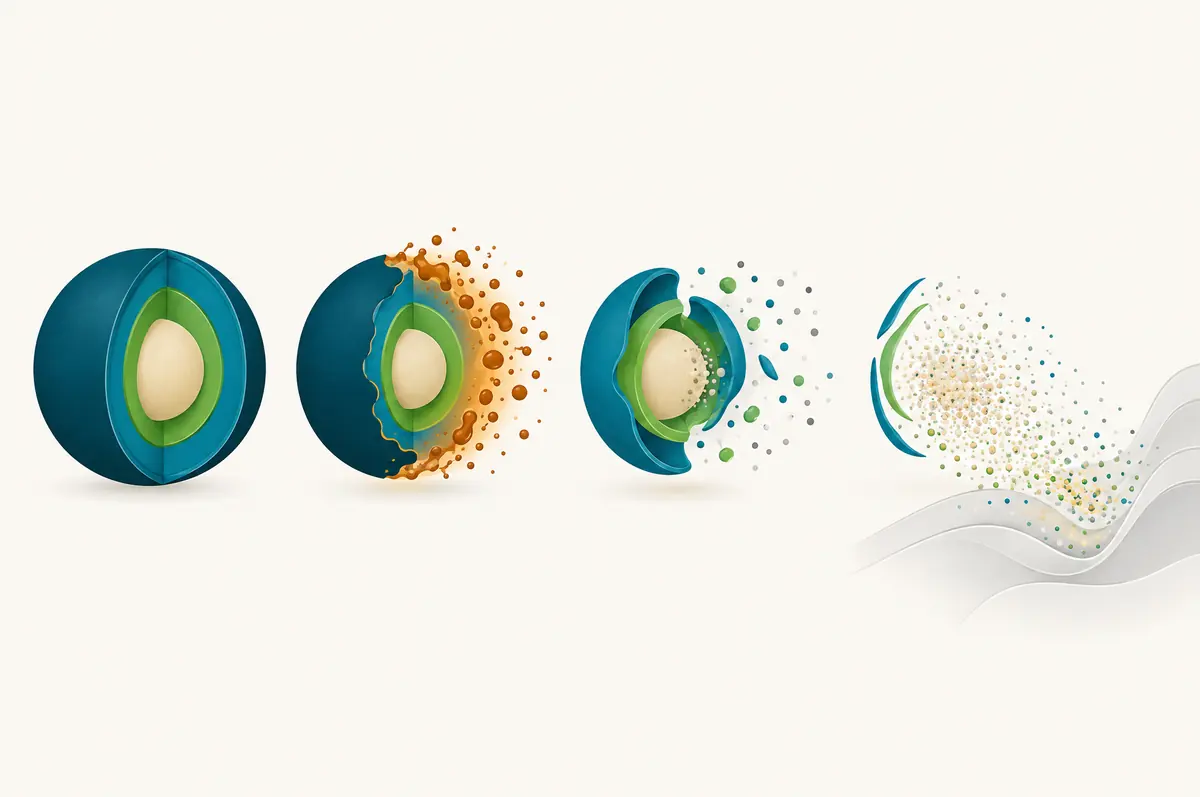
A single enteric coat is one decision, made by pH. A layered shell can stack several. An outer barrier slows moisture uptake in storage. An enteric layer keeps the core closed until it leaves the stomach. A second, slower layer can shift release further along the intestine. A mucoadhesive layer can hold released particles near the gut wall for longer. The core itself can sit in a trehalose or sucrose glass that immobilizes sensitive molecules while dry. Together, the layers get a working immunogen to its target intact.
What we would measure
A credible feasibility study stays in the formulation lab and uses the partner's own assays for the payload. We would measure moisture uptake and payload stability at 25 and 40 degrees Celsius over time, release profiles in simulated gastric and intestinal fluids, payload integrity after release, and particle size and layer uniformity across a batch. The partner owns the payload readouts, and we deliver a complete shell specification.
Key facts
- A live oral typhoid vaccine is licensed in the United States as enteric-coated capsules for adults and children over 6 years (FDA, Vivotif)
- An oral influenza tablet vaccine reduced illness compared with placebo in a phase 2 human challenge study (Liebowitz et al. 2020, Lancet Infect Dis 20:435)
- A single dose of an oral tablet norovirus vaccine candidate generated systemic and mucosal antibody responses in a phase 1 randomized, placebo-controlled trial (Kim et al. 2018, JCI Insight 3:e121077)
How our delivery technology applies
Our oral peptide work already deals with the same four obstacles: heat, acid, enzymes and the timing of release. The chemistry of the payload changes; the shell design questions do not. We run feasibility on a surrogate payload first, then on the developer's payload under a confidentiality agreement, alongside the developer's immunological testing.
Questions
Can Vegalab formulate an oral vaccine tablet?
Yes, as the formulation partner to the vaccine developer. We design the layered shell for storage stability, passage through the stomach and release in the small intestine, and manufacture under GMP in Korea.
Ask us for the oral stability protocol we use for sensitive payloads.
Related reading
Last updated: