


The Refrigerator Is Part of the Product
A vaccine that needs two to eight degrees from factory to arm carries a refrigerator with it everywhere it goes. That chain is expensive, it breaks, and it breaks in both directions: freezing damages adjuvanted vaccines as surely as heat damages live ones. Thermostable formulation is the quiet lever that would change the economics of immunization, and it is a formulation problem end to end.
How often the chain fails
Reviews of cold chain monitoring studies have repeatedly found vaccines exposed to temperatures below the recommended range. A literature review by Hanson and colleagues reported exposure to freezing during storage in roughly a third of studies from higher income countries and a similar share from lower income countries. Freezing is the less obvious failure: a frozen aluminum-adjuvanted vaccine can look normal in the vial and no longer perform as intended.
What cold costs
Refrigerators, cold boxes, ice packs, monitoring devices, backup power and the staff time to run all of it sit on top of the vaccine price. In remote delivery the chain often decides the schedule: how far a team can travel in a day, and how long a session can run. A product that tolerates ambient temperature for a defined period changes those constraints directly. WHO's controlled temperature chain already allows certain licensed vaccines to be kept at up to 40 degrees Celsius for a few days before use, which shows the value regulators place on it.
The physics of a dry, still payload
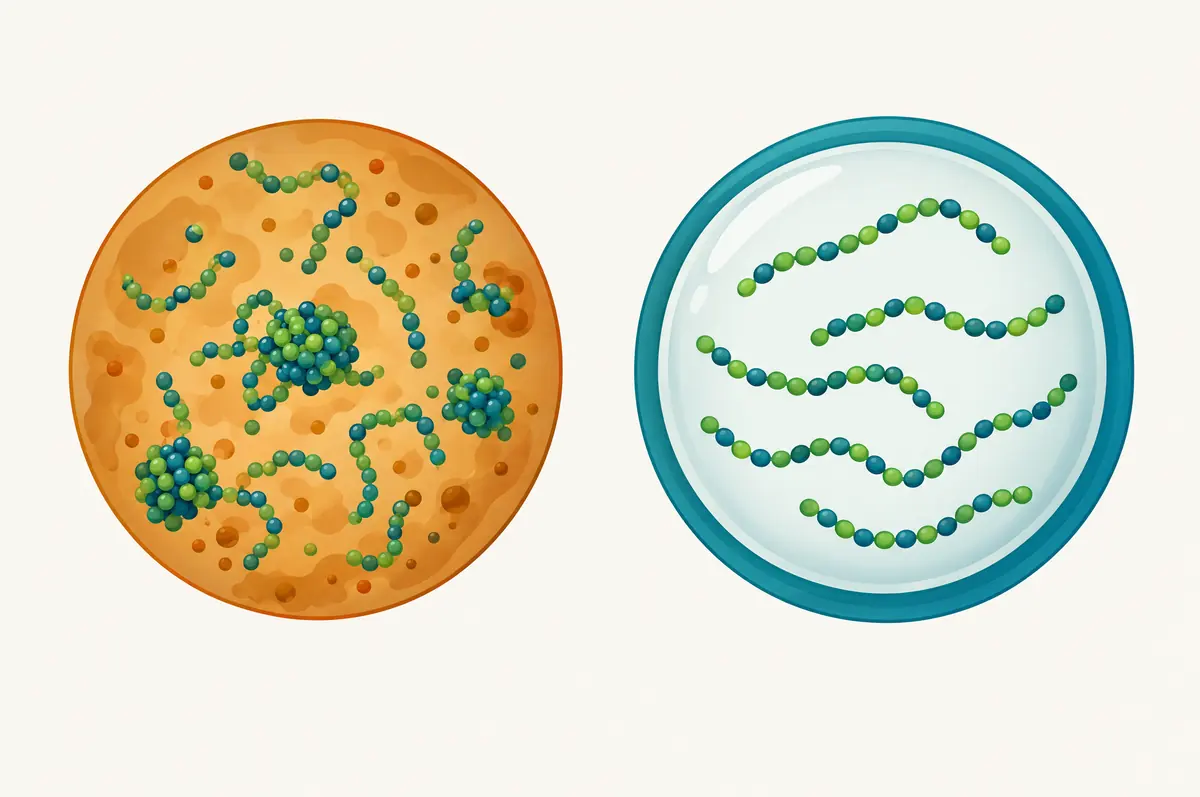
Most thermal damage to biological payloads happens when molecules can move: unfold, aggregate, oxidize, or lose structure as water shifts. Drying into a sugar glass, typically trehalose or sucrose, immobilizes them. Freeze-drying is the standard route and it works, but the drying process itself is a stress, and the reconstitution step reintroduces the vial, the diluent and the syringe. A dry particle inside a protective shell, formulated as a tablet or a powder, avoids that last step.
What our layers contribute
In our platform the outer layers can act as a moisture and oxygen barrier while the inner matrix does the immobilizing. That combination is what we already use for oxidation-sensitive and hygroscopic actives. For a vaccine developer the questions are the same ones we answer for any payload: how much water gets in over how long, at what temperature the glass softens, and how much payload activity remains after accelerated storage. We deliver those data, matched to the developer's potency assay.
Who buys a vaccine without a refrigerator
The buyers for whom temperature matters most are not pharmacies. They are health ministries and the global procurement system: UNICEF and other UN agencies buy vaccines that have passed WHO prequalification, largely for countries where heat and distance make the cold chain hardest to hold. A product that tolerates heat, needs no needle and ships as a tablet or a dry powder is close to the ideal product for exactly those buyers. That is why thermostability and a route to prequalification belong in the same plan from the start, not as an afterthought once a US launch is secured.
Key facts
- A literature review of cold chain studies found vaccine exposure to temperatures below the recommended range during storage in 33 percent of studies from wealthier countries and 37.1 percent from lower income countries (Hanson et al. 2017, Vaccine 35:2127)
- WHO's controlled temperature chain allows licensed, labeled vaccines to be kept above 2 to 8 degrees Celsius, up to at least 40 degrees for at least three days, once before administration (WHO)
- WHO vaccines prequalification is provided to UNICEF and other UN agencies that procure vaccines (WHO)
- A measles and rubella microneedle patch produced immune responses in infants comparable to subcutaneous injection in a phase 1/2 trial in The Gambia, a needle-free format aimed at hard-to-reach settings (Adigweme et al. 2024, Lancet 403:1879)
How our delivery technology applies
Barrier layers plus a glassy core is the same architecture we use for oxidation-prone actives in Crop Science and Life Sciences. The transferable part is the measurement discipline: moisture uptake curves, glass transition temperature, accelerated stability at 40 degrees Celsius, and payload recovery over time, all on the partner's payload under confidentiality.
Questions
How does encapsulation support thermostability?
Barrier layers keep moisture and oxygen out, and a sugar glass core holds the payload still in the dry state. Combined with the developer's excipient system, performance is measured in accelerated stability studies at 25 and 40 degrees Celsius.
Send us a stability profile and we will scope an accelerated storage study.
Related reading
Last updated: