


A Few Minutes at the Surface
The nose and the floor of the mouth are attractive targets: thin tissue, dense immune presence, no needle. They are also unforgiving. Mucus clears the nasal cavity within minutes, and a sublingual film has only the time before swallowing. Both routes live or die on contact time and on how much can be loaded into a very small volume.
What is licensed today
The nasal route is not theoretical. A live attenuated influenza vaccine has been given as a nasal spray for two decades, and in September 2024 the FDA approved it for self-administration by adults up to 49 and for caregiver administration to people aged 2 to 17. That approval is a quiet milestone: it moves a vaccine out of the clinic entirely. Sublingual vaccination has a longer history in allergy immunotherapy, where daily tablets under the tongue are an established format.
The clearance clock
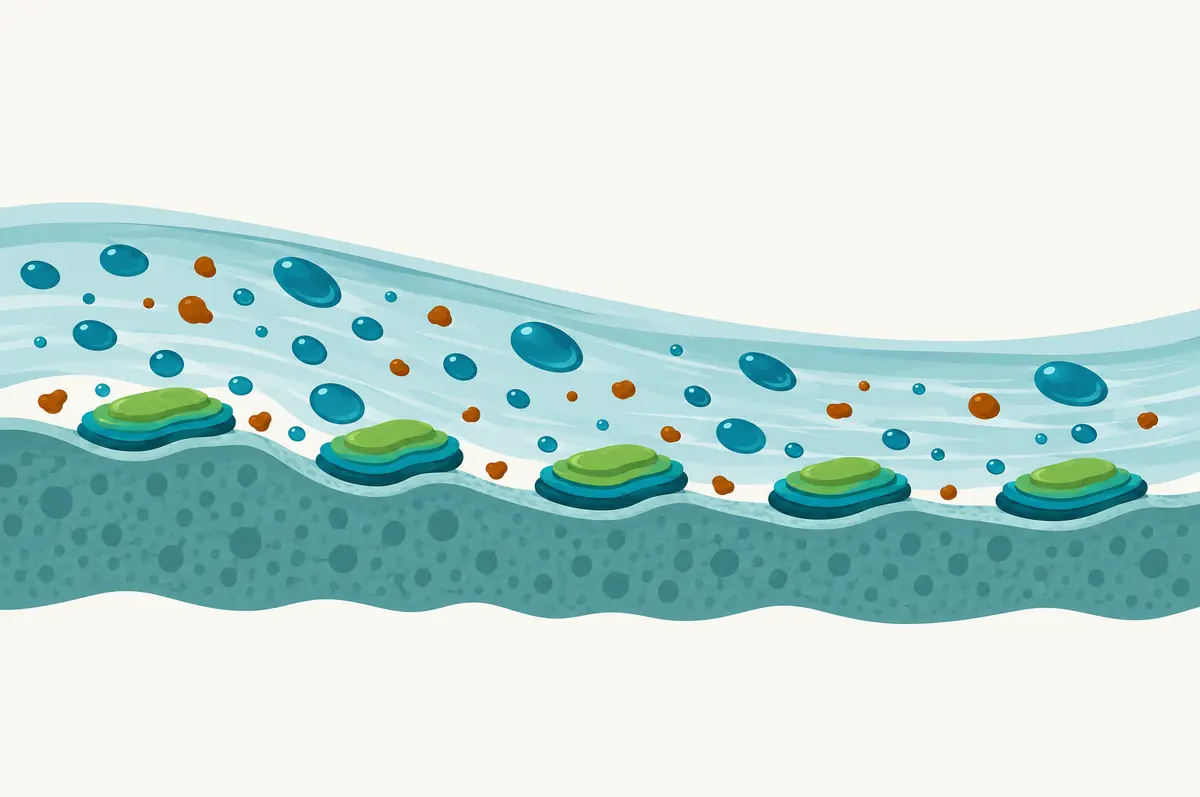
The nasal lining clears material toward the throat within minutes. A liquid spray that runs off or drains has effectively been diluted. Formulation answers are mucoadhesion, viscosity and particle size: a dose that binds to mucin, thickens on contact or sits as fine particles in the right region of the cavity stays available longer. Droplet size also decides where the spray lands and is set with the developer to target the right region of the cavity.
The volume problem
A nasal dose is usually a tenth of a milliliter per nostril. A sublingual film weighs tens of milligrams. Both mean high payload concentration in a small space, which is exactly where aggregation, precipitation and instability appear. Concentrating a protein or a vector is not a neutral step. A carrier that keeps the payload dispersed and shielded at high load is doing real work here.
Where a layered shell helps
For the nasal route, the useful layer is the outer one: a mucoadhesive polymer that holds particles against the epithelium while mucus moves past. For sublingual, the useful property is fast, controlled release at neutral pH with taste masking, since a bitter dose that makes someone swallow early has failed. Our platform can carry a mucoadhesive outer layer, a taste-masking layer and an inner stabilizing matrix in the same particle.
Designed with the developer
Mucosal programs succeed when formulation and immunology are designed together. We work inside the developer's clinical plan, matching particle size, residence time and release to the dose and schedule being tested, and we deliver the formulation data a regulator expects to see alongside the clinical file.
Key facts
- FluMist nasal spray influenza vaccine was approved for self- or caregiver-administration on September 20, 2024, the first influenza vaccine in the United States approved for administration outside a healthcare setting (AstraZeneca, 2024)
- Mucosal vaccine development is limited by short residence time and the need to overcome tolerance at mucosal surfaces (Lavelle and Ward 2022, Nat Rev Immunol 22:236)
- The FDA approved Odactra, a house dust mite allergen extract tablet taken under the tongue, in March 2017 (FDA, 2017)
How our delivery technology applies
Our intranasal work in Life Sciences is built on the same two levers: mucoadhesion and particle size. For a vaccine partner we would treat the nasal cavity as a residence-time problem and report residence time, particle distribution and payload integrity, alongside the developer's immunogenicity program.
Questions
What does encapsulation add to a nasal format?
Residence time and protection. A mucoadhesive outer layer holds particles at the nasal lining while mucus moves past, and inner layers keep the payload stable at high concentration.
Bring us a residence-time target and we will tell you whether our shell can hit it.
Related reading
Last updated: