

Do banana peels add potassium to plants?
Last updated:
A little. Banana peels (from Musa spp.) hold about 487 to 570 mg of potassium per 100 g fresh, and potassium is their main mineral.1 Potassium leaves plant residues easily because it is not bound in organic compounds, so peels and peel water do release some.2 A soil test shows whether plants need potassium at all, and composting is the more dependable way to use peels.5,6,7
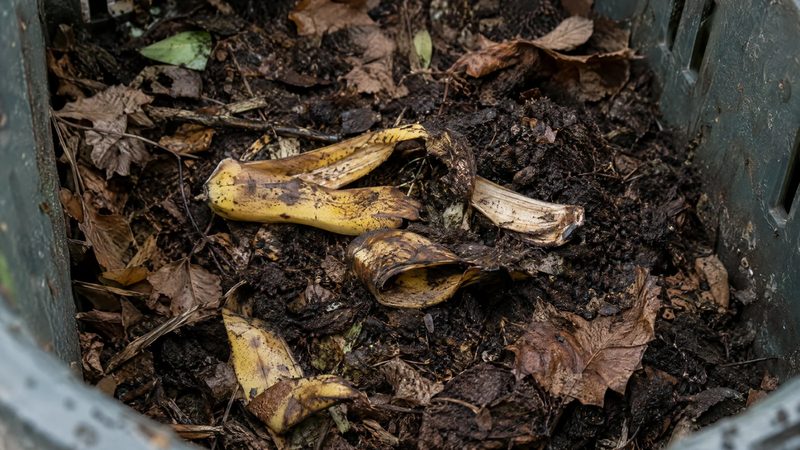
How much potassium is in a banana peel?
Banana peels (the skin of the fruit of Musa spp.) are richer in potassium than in any other macro-element, typically above 1% of their dry weight.1 Fresh peels contain about 487 to 570 mg of potassium per 100 g, and dried peel measures over 8,800 mg per 100 g dry weight because drying removes water and concentrates what is left.1 Peels also contain phosphorus, sulfur, calcium and magnesium in smaller amounts.1
That makes the peel a real but dilute source, and the gap between the fresh and dried figures shows how much of a fresh peel is water.1 Composting concentrates it: in a laboratory study, finished banana peel composts contained more than 100 g of potassium per kilogram and more than 2% total nitrogen.3
| Material | Potassium content | Why it differs |
|---|---|---|
| Fresh peel | About 487 to 570 mg per 100 g fresh weight | Mostly water |
| Dried peel | Over 8,800 mg per 100 g dry weight | Water removed, minerals concentrated |
| Finished peel compost (laboratory) | More than 100 g per kg | Organic matter broken down over 12 weeks |
In North America, nutrients locked in buried peels and other organic materials are released by soil microbes only when the soil is warmer than 50°F and moist, so release slows sharply from late fall through early spring5. In the Southern Hemisphere the same slowdown falls from about May to September.
Does banana water add potassium to plants?
Some potassium does move into the water.2 Potassium in plant residues is released easily because it is not part of any organic compound and does not depend on microbial decomposition, a result of its high solubility.2 Its release from residues depends more on the frequency and intensity of rainfall than on decay, which is the same process a soak imitates.2
The peer-reviewed and extension sources cited here give no measurement of how much potassium a kitchen soak extracts. Because a fresh peel holds only about 0.5% potassium by weight, the water can carry no more than the peel had to give.1 Banana water is a weak, unmeasured potassium solution, not a balanced fertilizer.1,2
Do buried banana peels feed plants?
Potassium from a buried peel can reach the soil without full decomposition, and surface-applied crop residues have raised exchangeable potassium in the top layer of soil in column studies.2 The other nutrients in a peel are slower.5 Nutrients in organic materials are often in forms plants cannot take up until soil microorganisms convert them, which needs soil warmer than 50°F with enough moisture, and cold or dry soil delays the release.5
Burying fresh peels in houseplant pots adds a problem of its own.8 Fungus gnats breed in moist decomposing organic matter, compost and organic fertilizers, and UC IPM advises against using incompletely composted organic matter in potting media unless it has been pasteurized, because it will often be infested.8 A rotting peel in a pot is exactly that kind of material.8
Is composting banana peels better?
Yes, for most gardens.3,6 EPA lists fruit and vegetable scraps among the nitrogen-rich greens for a home compost pile, and finished compost enriches soil and reduces the use of fertilizer.6 In a laboratory composting study, banana peels broke down significantly faster under aerobic conditions than anaerobic ones, and mixing them with poultry litter or cow dung sped mineralization.3
Compost made from peels has fed plants in a pot trial.4 In a small greenhouse study, Swiss chard grown with banana peel compost at three rates outperformed plants grown without compost on every growth measure recorded.4 Compost still counts as a soil amendment rather than a fertilizer: Colorado State University Extension notes that compost and manure add small amounts of nutrients.5
Do your plants need extra potassium?
Not always.5 Colorado State University Extension advises a soil test before applying any fertilizer and notes that potassium rock powders are typically unnecessary in Colorado because many of its soils are naturally high in potassium.5 Clemson Cooperative Extension's standard soil test reports potassium along with phosphorus, calcium, magnesium and several micronutrients.7
Adding nutrients without a test has costs.7 Fertilizing blind may create nutrient imbalances that reduce plant health, and excess fertilizer can cause excessive vegetative growth, delayed maturity and salt burn.7 Confirm a deficiency with a soil test before treating one.5,7
What works instead?
Base potassium decisions on a soil test, compost peels with other kitchen scraps, and use the compost as an amendment.5,6,7 If a test shows a real potassium shortage, Colorado State University Extension lists greensand, feldspar, potassium sulfate and biotite among the potassium sources available to home gardeners; follow the soil test recommendation and the product label.5
| Method | What reaches the plant | Main drawback |
|---|---|---|
| Banana water | Some dissolved potassium | Amount unmeasured and small |
| Burying fresh peels | Potassium early, other nutrients only after microbial breakdown | Slow in cold soil; rotting organic matter favors fungus gnats in pots |
| Composting | Potassium and nitrogen in a finished, stable amendment | Takes weeks to months |
| Fertilizer chosen from a soil test | The nutrient the soil actually lacks | Needs a test first |
Key takeaways
- Potassium is the main mineral in banana peel, at about 487 to 570 mg per 100 g fresh weight.
- Potassium washes out of plant residues easily, so banana water and buried peels release some, in small, unmeasured amounts.
- Other nutrients in a peel need soil microbes and soil above 50°F before plants can use them.
- Composting peels is the dependable route, and fresh peels in pots can feed fungus gnats.
- A soil test tells you whether your plants need potassium at all.
References
- Nutrition, phytochemical profile, bioactivities and applications in food industry of banana peels: a comprehensive review
- The influence of crop residues in vertical soil mobility of potassium
- An evaluation of aerobic and anaerobic composting of banana peels treated with different inoculums for soil nutrient replenishment
- Effects of banana peel compost rates on Swiss chard growth performance and yield in Shirka district, Oromia, Ethiopia
- Organic Fertilizers (CSU Extension Master Gardener GardenNotes #234)
- Composting At Home
- Soil Testing (HGIC 1652)
- Pest Notes: Fungus Gnats (UC ANR Publication 7448)