

How do you disinfect a kennel or shelter?
Last updated:
Remove all feces and debris, scrub with detergent, rinse, then apply a disinfectant that works against non-enveloped viruses such as canine parvovirus, and keep the surface wet for the label's full contact time4,5. Organic matter blocks disinfectants, so cleaning first is essential3. Bleach, accelerated hydrogen peroxide and potassium peroxymonosulfate products are effective; quaternary ammonium products often are not2.
Why is parvovirus so hard to kill in a kennel?
Canine parvovirus type 2 (CPV-2), the cause of parvo in dogs, is extraordinarily hardy: it survives for months outside an animal, even through winter, and resists most household cleaning products1. Infected dogs shed vast numbers of virus particles, which makes an exposed area hard to disinfect1. The disease most often strikes puppies between six and 20 weeks old1.
Parvoviruses are non-enveloped, and non-enveloped viruses are among the organisms most resistant to disinfection, along with bacterial spores4. Most bacteria, fungi and enveloped viruses are killed by most disinfectants; parvovirus is not4. Parvoviruses are, however, sensitive to halogens such as sodium hypochlorite3. Because animals can shed pathogens without showing illness, shelter standards require every enclosure to be fully sanitized before a different animal moves in, even if it looks clean2.
What are the steps to clean and disinfect a kennel?
Cleaning and disinfection are two separate jobs2. Cleaning is the manual removal of urine, feces, food waste, hair and other debris, and detergents can remove up to 90% of environmental pathogens; disinfection then kills most of what remains2. Sanitation cannot be done with water alone, by spraying and quickly wiping off a disinfectant, or by using bleach without cleaning first2.
- 1. Remove the animal; spraying enclosures while animals are inside is unacceptable2.
- 2. Remove all organic matter: manure, bedding, dirt and body fluids hide organisms and inactivate disinfectants5.
- 3. Wash with water and detergent, scrubbing corners and crevices with a brush5.
- 4. Rinse off all detergent, because soaps and detergents can inactivate some disinfectants5.
- 5. Let the surface dry, since excess water dilutes the disinfectant5.
- 6. Apply an EPA-registered disinfectant at the label concentration, including corners and cracks5.
- 7. Keep the surface wet for the full contact time on the label5.
- 8. Rinse off the disinfectant, especially in feed and water areas, then let everything dry completely before the animal returns5.
| Step | Full sanitizing (between animals) | Spot cleaning (same animal stays) |
|---|---|---|
| Animal | Removed or moved to the other compartment2 | Stays in the enclosure2 |
| Items | All items removed2 | Bowls and wet or soiled items removed2 |
| Organic material | All removed2 | All removed2 |
| Detergent | Applied and all surfaces scrubbed, then rinsed2 | Soiled areas cleaned with detergent and a single-use towel2 |
| Disinfectant | Applied for the appropriate contact time2 | Not part of the routine spot clean2 |
| When | Before a different animal, when heavily soiled, or when infectious disease is diagnosed2 | At least daily2 |
Which disinfectants kill parvovirus?
Disinfectants used in animal areas must be effective against non-enveloped viruses such as parvovirus, panleukopenia and calicivirus2. Several studies have found that quaternary ammonium products, common in shelters and clinics, do not eliminate non-enveloped viruses despite label claims2. Accelerated hydrogen peroxide, potassium peroxymonosulfate and bleach products are effective against non-enveloped pathogens at the appropriate concentration and contact time2.
Check that the product label lists the organism you are targeting, and measure the dilution the label gives4. Some disinfectants lose strength quickly once mixed, so fresh solutions work best4.
| Class | Example actives | Activity on non-enveloped viruses | Organic matter |
|---|---|---|---|
| Chlorine compounds | Sodium hypochlorite, chlorine dioxide7 | Effective6 | Rapidly inactivated7 |
| Peroxygen compounds | Hydrogen peroxide, peracetic acid, peroxymonosulfates7 | Varies with product6 | Some work in its presence7 |
| Aldehydes | Formaldehyde, glutaraldehyde7 | Effective6 | Affected7 |
| Quaternary ammonium compounds | Alkyl dimethyl benzyl ammonium chloride7 | No or limited activity6 | Inactivated7 |
| Phenols | Orthophenylphenol7 | No or limited activity6 | May still work in its presence7 |
| Alcohols | Ethanol, isopropanol7 | No or limited activity6 | Inactivated7 |
How do you disinfect for parvo with bleach?
Bleach works on parvovirus only on a clean surface3. In a laboratory study of three CPV-2 strains, a 0.75% sodium hypochlorite solution significantly cut virus levels within 1 minute, a 0.37% solution was as effective after 15 minutes, and a 0.18% solution had no virucidal activity at any time point3. Adding organic matter or feces totally abolished the activity of every concentration tested3.
Cornell's Baker Institute describes diluted household bleach as an acceptable way to disinfect indoor areas that housed an infected dog, including bedding, bowls and all surfaces1. Follow the product label for the dilution and contact time, and measure accurately4. Bleach has no detergent properties, so it never replaces the cleaning step2, and organic material neutralizes bleach solutions in particular4.
Rinse after the contact time5. Quaternary ammonium products and bleach can harm animals that touch or ingest them even at recommended dilutions, so removing the residue is an essential step2. High concentrations of sodium hypochlorite are corrosive and irritating to eyes, skin and mucous membranes3.
Can you disinfect grass, gravel and dirt runs?
No. It is impossible to disinfect gravel, dirt and grass surfaces, so outdoor areas are kept clean and feces are removed between animals or groups2. You cannot and should not bleach a lawn; rain or watering dilutes the virus and sunlight helps, which can bring numbers down to an acceptable level in a few weeks1. Indoors, there is evidence that CPV loses some of its ability to infect after one month1.
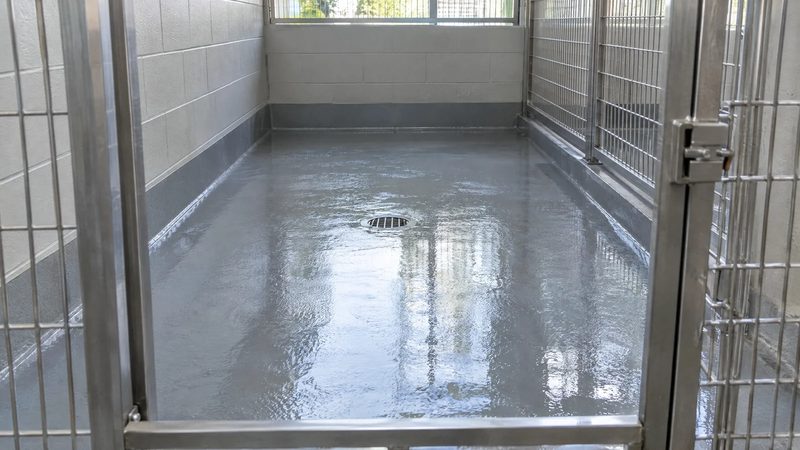
Surface material decides what can be disinfected4. Porous, cracked or pitted surfaces such as wood and concrete are hard to disinfect, and most disinfectants are labeled for hard, smooth surfaces4. Shelter standards call for nonporous surfaces in cages and kennels and recommend sealed, impermeable flooring such as resinous epoxy or urethane, with wall-to-floor joints sealed2.
How do shelters stop parvo spreading between runs?
Isolation and traffic control are part of the shelter sanitation standard2. Shelters must keep separate isolation areas for different contagious diseases, for example keeping dogs with parvovirus apart from dogs with respiratory disease, and isolation rooms must not open directly into other animal housing2. A corridor or vestibule gives staff a place to put on and remove protective equipment, and traffic through isolation is kept to a minimum2.
Fomites matter too. Dedicated boots or disposable shoe covers should be used in isolation, and footbaths must not be relied on, because adequate contact time is impractical and organic debris inactivates many disinfectants in the bath2. Dishwashers may not destroy parvoviruses, so bowls get a disinfectant after the cycle2. Mops can carry pathogens to other areas and are best avoided in animal housing2.
Key takeaways
- Clean first: remove organic matter, scrub with detergent and rinse before any disinfectant goes on.
- Choose a product that works on non-enveloped viruses; bleach, accelerated hydrogen peroxide and potassium peroxymonosulfate do, many quaternary ammonium products do not.
- Keep surfaces wet for the full label contact time, then rinse and dry.
- Organic matter abolished bleach's activity against parvovirus in laboratory testing.
- Grass, gravel and dirt cannot be disinfected; sealed, nonporous floors can.
References
- Canine Parvovirus
- The Guidelines for Standards of Care in Animal Shelters, Second Edition
- In vitro virucidal activity of sodium hypochlorite against canine parvovirus type 2
- Factors Affecting Disinfection (C&D Basics)
- How to Clean and Disinfect (C&D): The C&D Process
- Antimicrobial Spectrum of Disinfectants
- Characteristics of Selected Disinfectants