

How do disinfectants compare?
Last updated:
Disinfectants differ in how organic load, pH, contact time and biofilm affect them. Chlorine dioxide tolerates organic load and works on biofilm. Hypochlorous acid is fast and low hazard but loses activity above pH 7.5. Peracetic acid stays active with organic matter. Quats give residual activity on clean surfaces but are inactivated by organic soil and hard water. None of them replaces cleaning.
Chlorine dioxide, hypochlorous acid, peracetic acid, hydrogen peroxide, quaternary ammonium compounds and citric acid all disinfect, but they are not interchangeable. The right choice depends on organic load, pH, contact time, whether biofilm is present and whether residual activity is wanted. None of them replaces cleaning.
How do the oxidizing disinfectants compare?
Chlorine dioxide is far less pH-dependent than chlorine, tolerates organic load and ammonia better than chlorine, and is effective against biofilm; it usually needs on-site generation. Hypochlorous acid is fast, inexpensive and low in toxicity at use dilution, but loses activity above pH 7.5, is rapidly consumed by organic matter, is unstable in storage and forms chlorinated by-products. Peracetic acid is strong, works at low temperatures and with organic matter, and breaks down to acetic acid, water and oxygen, but is corrosive and pungent. Hydrogen peroxide decomposes to water and oxygen and is comparatively slow alone.
How do quats and citric acid compare?
Quaternary ammonium compounds give good residual activity and low corrosivity, and are widely used on clean surfaces. They have poor biofilm penetration, are inactivated by organic soil and hard water, perform poorly against non-enveloped viruses such as parvovirus, and carry documented resistance and cross-resistance concerns. Citric acid has modest antimicrobial activity, is an effective descaler and is very low hazard, which makes it useful for water line descaling before an oxidant step.
How do you choose a disinfectant, and what can none of them do?
Use chlorine dioxide for biofilm in water systems, hypochlorous acid for clean surfaces where low hazard matters, peracetic acid where organic soil cannot be fully removed, and quats where residual activity on clean surfaces matters. No disinfectant removes soil, works without contact time, or compensates for a persistent source of contamination. Label concentration and contact time govern every use. Where the choice is unclear, test on the actual surface with swabs before and after, and compare results rather than relying on product literature alone.
Key takeaways
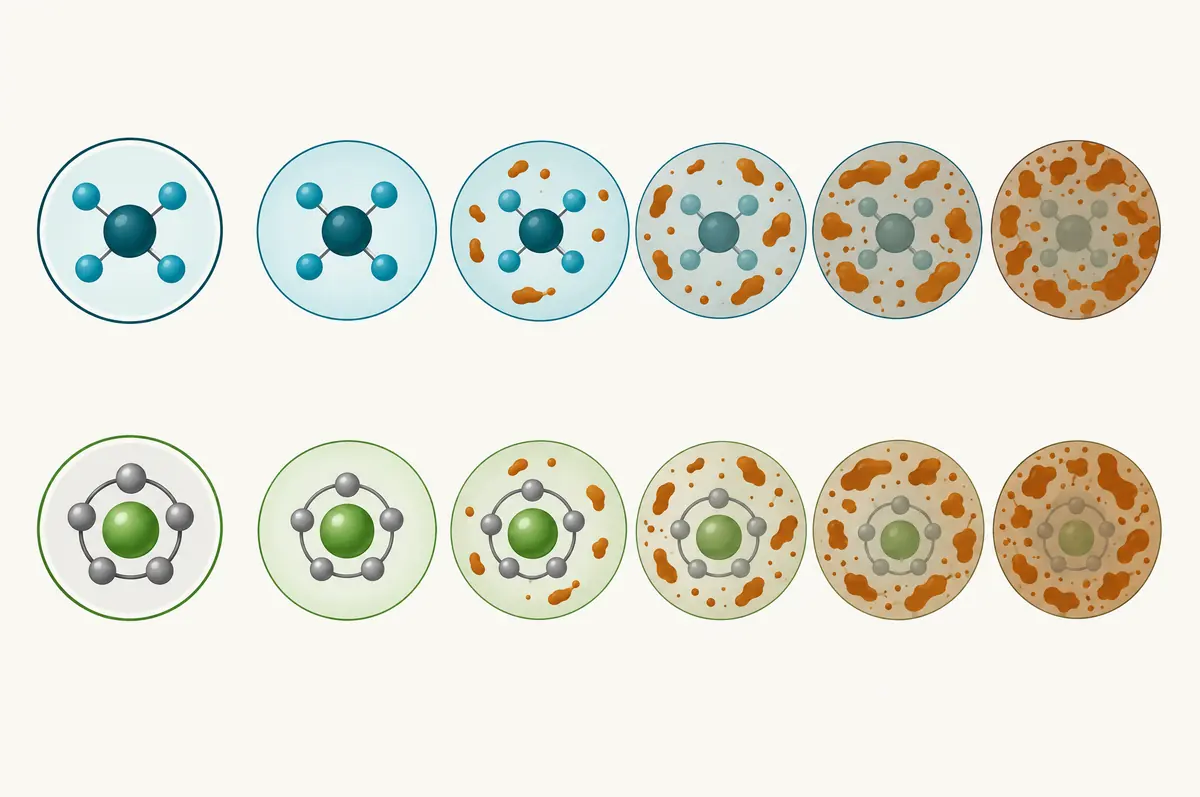
- Chlorine dioxide is far less pH-dependent than chlorine, tolerates organic load and is effective against biofilm.
- Hypochlorous acid loses activity above about pH 7.5 and is rapidly consumed by organic matter.
- Peracetic acid works at low temperatures and with organic matter, and breaks down to acetic acid, water and oxygen.
- Quats give residual activity and low corrosivity on clean surfaces but perform poorly against non-enveloped viruses.
- No disinfectant removes soil or works without contact time; label concentration and contact time govern every use.
Key facts
- Hypochlorous acid dissociates to the less active hypochlorite ion as pH rises above about 7.5 (US EPA 1999, EPA 815-R-99-014).
- Chlorine dioxide inactivates bacteria in drinking water biofilms (Gagnon et al. 2005, Water Res 39:1809) and does not form THMs or HAAs (US EPA 1999, EPA 815-R-99-014).
- Non-enveloped viruses are generally more resistant to disinfectants, including many quaternary ammonium products, than enveloped viruses (CDC, Guideline for Disinfection and Sterilization in Healthcare Facilities 2008).
- Peracetic acid remains active in the presence of organic matter and decomposes to acetic acid, water and oxygen (CDC, Guideline for Disinfection and Sterilization in Healthcare Facilities 2008).
How our delivery technology applies
The main practical drawback of chlorine dioxide in this comparison is handling: it is a gas that is normally generated on site. Vegalab stabilizes it as a nano-encapsulated powder that dissolves to at least 98% ClO2 purity, with solutions stable for up to one month. That moves ClO2 into the same ease-of-use category as tablets and concentrates while keeping its pH range and biofilm performance.
Questions
How do quats compare with hypochlorous acid?
Quaternary ammonium compounds give good residual activity and low corrosivity on clean surfaces, but organic soil and hard water inactivate them and they penetrate biofilm poorly. Hypochlorous acid is fast, inexpensive and low in toxicity at use dilution, but it loses activity above pH 7.5, is rapidly consumed by organic matter and is unstable in storage. Hypochlorous acid suits clean surfaces where low hazard matters; quats suit clean surfaces where residual activity matters.
How does hydrogen peroxide compare with quats?
Hydrogen peroxide decomposes to water and oxygen and is comparatively slow when used alone. Quats leave residual activity on clean surfaces but are inactivated by organic soil and hard water, and they carry documented resistance and cross-resistance concerns.
What factors matter when comparing disinfectants?
The deciding factors are organic load, pH, contact time, whether biofilm is present and whether residual activity is wanted. Label concentration and contact time govern every use. Where the choice is unclear, swab the actual surface before and after treatment and compare results rather than relying on product literature alone.
Unsure which disinfectant fits your site? Ask our team for a recommendation.